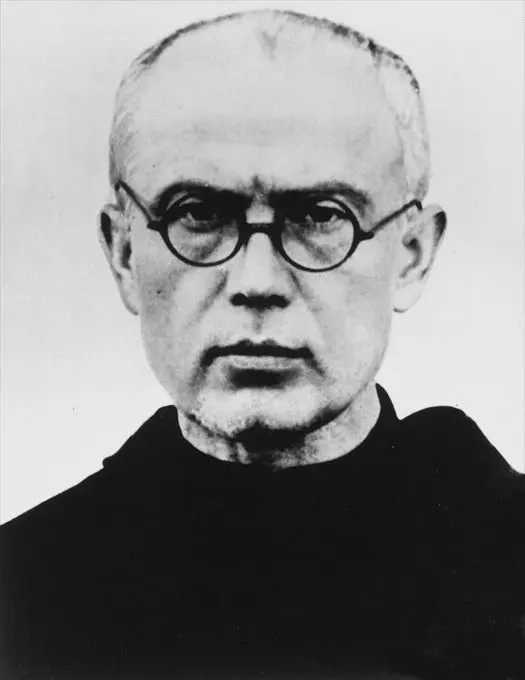
Maximilian Kolbe was a Polish Conventual Franciscan, founder of a vast religious publishing apostolate and of the friary of Niepokalanów near Warsaw. When Germany invaded Poland, he sheltered refugees — including thousands of Jews — at the friary, and was arrested by the Gestapo in 1941 and sent to Auschwitz, prisoner number 16670.
In late July 1941, after a prisoner from Kolbe's block appeared to have escaped, the camp commander ordered ten men from the block to be starved to death in reprisal. When one of the chosen men, Franciszek Gajowniczek, cried out that he had a wife and children, Kolbe stepped forward and asked to take his place. The request was granted. In the starvation bunker of Block 11 he led the condemned men in prayer and hymns; survivors recalled that the cell, normally filled with screams, became a place of quiet psalmody. After two weeks, Kolbe was among the last still alive, and the guards killed him with an injection of carbolic acid on August 14, 1941. He raised his arm to receive it.
Gajowniczek survived the war and lived into his nineties, present at the canonization of the man who had died for him. Pope John Paul II declared Kolbe a 'martyr of charity' in 1982. His death is one of the clearest modern images of the gospel Christ named when he said, 'Greater love hath no man than this, that a man lay down his life for his friends' (John 15:13) — a stranger's life ransomed by a willing substitution, in the darkest place of the twentieth century.