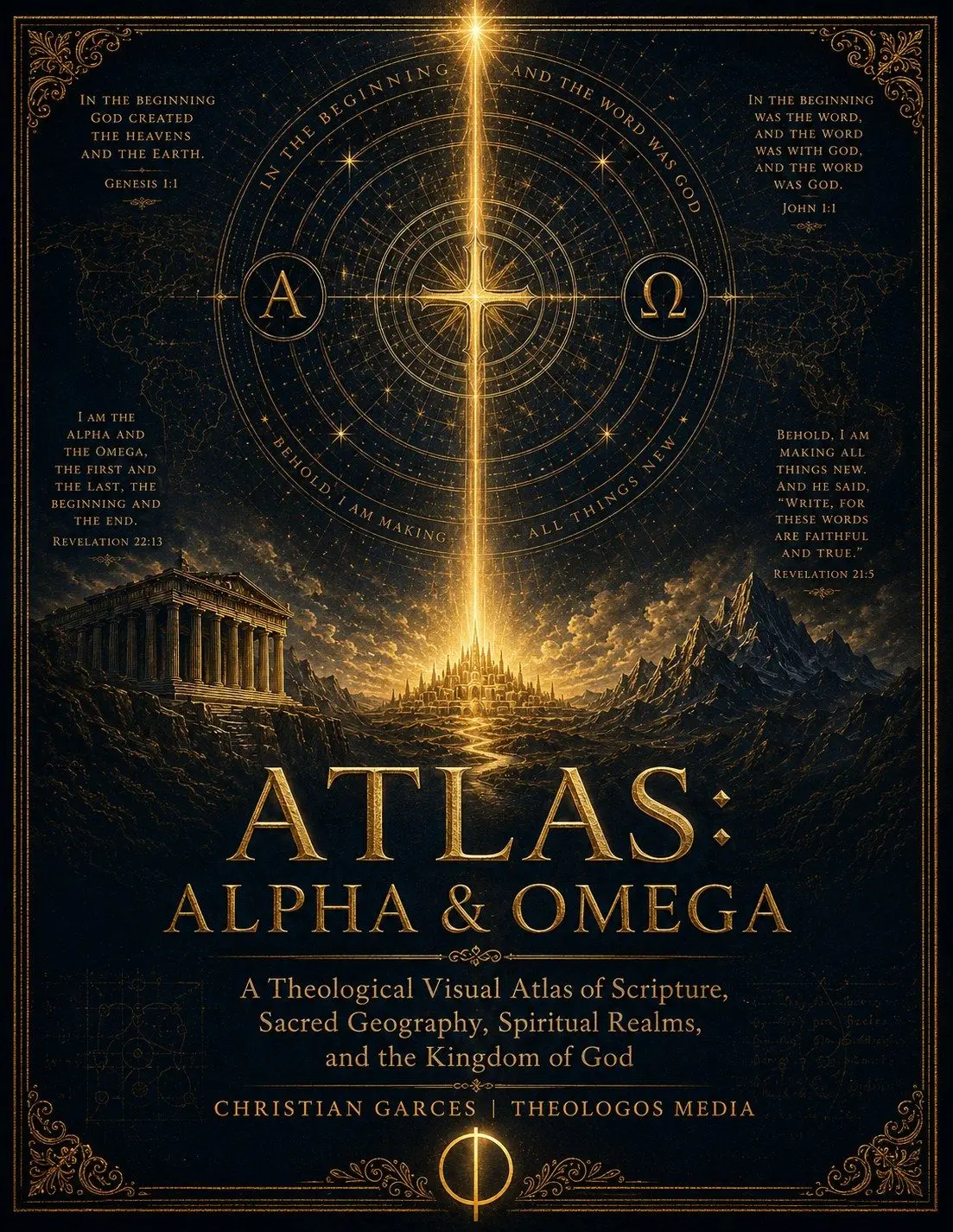
The New Creation chapter holds the Atlas's ending. Revelation 21-22, the New Jerusalem coming down out of heaven from God, the dwelling place of God with man, the no-more-tears, the no-more-sea, the no-more-night. The chapter does not treat the apocalypse as a coded prediction to be decoded; it treats it as the canonical resolution of every line the Atlas has been following.
Revelation as a whole is one of the most-debated books of the New Testament. The Atlas does not adjudicate the major interpretive systems — preterist, historicist, futurist, idealist — because all four have produced serious Christian readings. What it does is read Revelation as the book asks to be read: as a vision, given to John on the island of Patmos in the late first century, describing the things which are and the things which are to come. Chapters 1-3 address the seven churches of Asia, each in its real situation; chapters 4-22 unfold a layered series of visions in which the Lamb who was slain opens the seals on the scroll of history.
The chapter pays attention to the central image of the slain Lamb. John weeps in chapter 5 because no one is found worthy to open the scroll, and an elder tells him weep no more — the Lion of the tribe of Judah, the Root of David, has conquered. John turns and sees not a Lion but a Lamb, standing as though slain (Rev 5:6). The visual paradox is the book's interpretive key. The conquering of Christ does not look like Roman power; it looks like a sacrificed Lamb on a throne. Every later vision in the book is read through this image. Wherever the worship of the Lamb is in view, the reader is on solid ground; wherever the worship of the dragon and the beast is in view, the reader knows what kingdom is being shown.
The seven seals, seven trumpets, and seven bowls are the chapter's most contested material. They are clearly not strictly linear — the seventh of each cycle leads into the next series — and the visions move back and forth across the same historical span from different angles. The Atlas reads them as a layered apocalyptic disclosure of the same realities — the judgments by which the kingdoms of this world give way to the kingdom of our Lord and of His Christ. The specific identifications (which beast, which Babylon, which mark) have been proposed in many different ways by Christian interpreters for two millennia. The Atlas describes the pattern Revelation itself emphasizes — the unmasking and final defeat of the powers that have set themselves against the Lamb — and leaves the more specific identifications to the reader's own study.
Babylon's fall in Revelation 18 is the chapter's longest single image. The harlot city seated on many waters, the merchants of the earth grown rich from her luxury, the slave trade in human bodies and human souls, the music that will be heard no more, the smoke rising from her burning — the chapter is a deliberate echo of the prophetic oracles against ancient Babylon and Tyre, applied now to whatever city in any age organizes itself against the kingdom of God. The Atlas reads the call to come out of her, my people (Rev 18:4) not as a literal emigration from any specific city but as the moral and spiritual disentangling from every Babylon that any generation of Christians will live in.
The marriage supper of the Lamb (Rev 19) is the hinge from judgment to consummation. The bride has made herself ready; she is clothed in fine linen, bright and pure, which is the righteous deeds of the saints. The Hallelujah chorus from the great multitude — the four-fold Hallelujah of Revelation 19 — is the doxology that has accompanied the Christian liturgy in every age. The rider on the white horse (Rev 19:11) is named Faithful and True. His robe is dipped in blood — the blood is His own — and on His robe and on His thigh is the name King of kings and Lord of lords.
The thousand years of Revelation 20 has been read in three principal ways: premillennial (Christ returns before a literal thousand-year reign), postmillennial (the millennium is a golden age before Christ's return), and amillennial (the millennium is the present church age). The Atlas presents the three readings as the historic Christian options and notes that all three have produced serious theology and serious lives. What the chapter does not do is collapse these into a single answer; it lets the reader weigh them in the larger context of the book.
Revelation 21 is the chapter's center and the Atlas's ending. The new heaven and the new earth come down; the holy city, new Jerusalem, descends like a bride adorned for her husband; a loud voice from the throne announces the dwelling place of God is with man. The chapter notes the deliberate echo of Eden. The river of the water of life flows from the throne (Rev 22:1), as the river of Eden flowed out of the garden (Gen 2:10). The tree of life stands on either side of the river (Rev 22:2), as the tree of life stood in the midst of Eden (Gen 2:9). The leaves of the tree are for the healing of the nations — the nations that began at Babel are gathered in. The gates of the city are open. The cherubim with the flaming sword are nowhere in sight.
The chapter pays close attention to what is no longer present. There is no temple in the city, for the Lord God Almighty and the Lamb are its temple (Rev 21:22). There is no need of sun or moon, for the glory of God gives it light, and its lamp is the Lamb. There is no night there. There will no longer be any curse. There is no more sea — the bounded chaos of every earlier biblical scene is unmade. There is no more tears, no more death, no more mourning, no more pain — the first things have passed away.
Chapter 12 closes the Atlas the way Scripture closes itself. The Spirit and the Bride say Come (Rev 22:17). The one who is thirsty is invited to come and take the water of life without price. The Lord Jesus says Surely I am coming soon (Rev 22:20), and the church answers Amen, come, Lord Jesus. The grace of the Lord Jesus be with all the saints. The Atlas as a study system, as a visual companion to Scripture, as a map of the redemptive arc — none of these is the destination. The destination is the city the Lord builds for those who love Him. The whole Atlas is, in the end, commentary on the prayer at the end of the Apocalypse. Come, Lord Jesus.