All Saints' Day
Festum Omnium Sanctorum (Latin) / Kyriake ton Hagion Panton (Greek)
November 1 in the West, the Sunday after Pentecost in the East. The feast of the whole communion of saints — apostles, martyrs, confessors, and the great cloud of unnamed faithful. The harvest of Pentecost across two millennia.
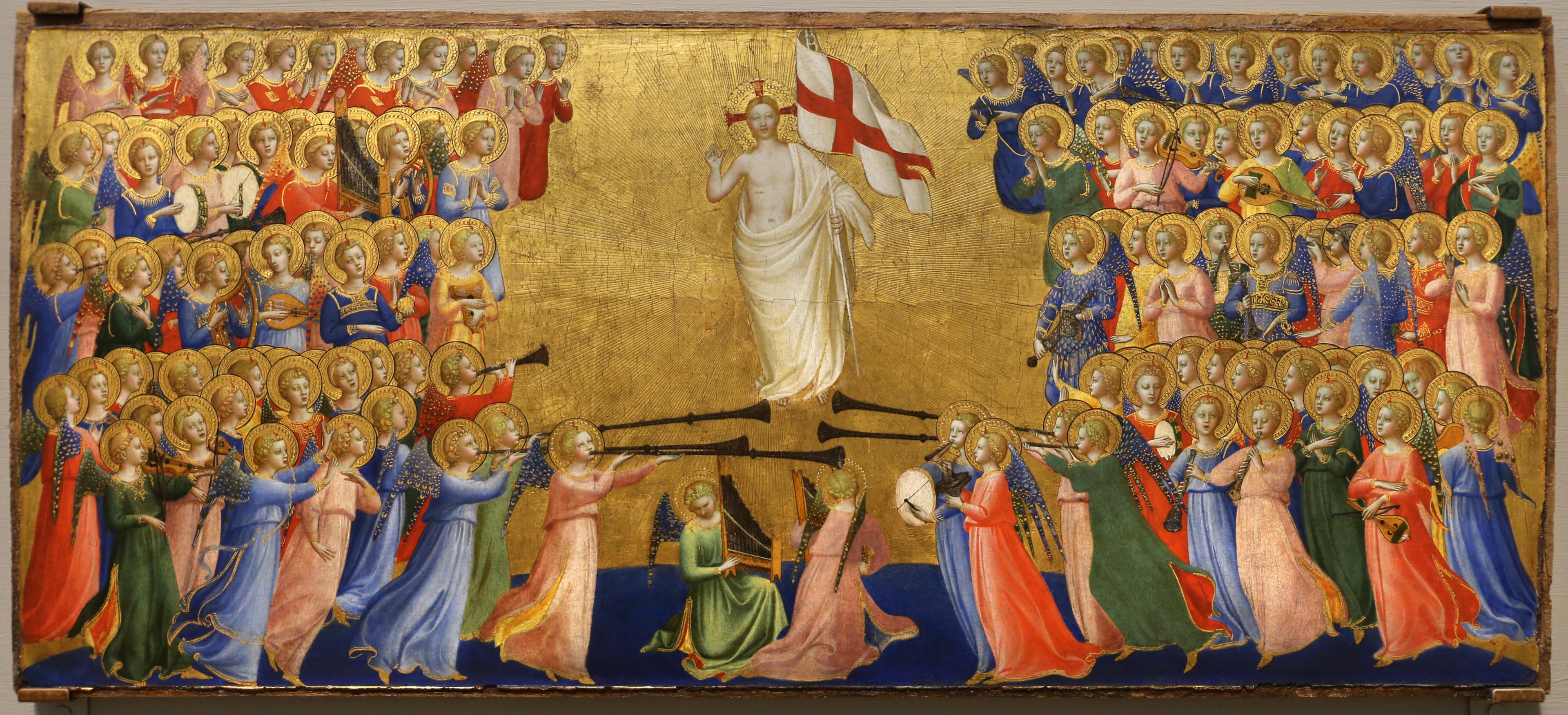
All Saints' Day commemorates the entire "great multitude that no one could number" (Revelation 7:9) of those who have been sanctified in Christ — apostles, martyrs, confessors, virgins, monastics, and the countless unnamed faithful whose lives ended in the friendship of God. The feast began as a commemoration of the martyrs alone, expanded across the fourth and fifth centuries to include all the saints together, and was eventually fixed in the West on November 1 and in the East on the first Sunday after Pentecost.
The earliest evidence is a fourth-century commemoration of all martyrs. John Chrysostom preached a Homily on All Martyrs (PG 50.705–712) at Antioch or Constantinople around the year 400, on the first Sunday after Pentecost. He explains why this date: Pentecost is the feast of the Spirit's descent on the apostles, and the Spirit then went out into the church and produced the army of martyrs — the saints are the harvest of Pentecost. Ephrem the Syrian (c. 373) has a similar feast. The Syriac and Greek calendars from the fifth century forward all carry the commemoration. The Eastern Orthodox church has kept this dating relationship to Pentecost ever since.
The Roman tradition's fixed date of November 1 has a different origin. Pope Boniface IV in 609 (or 610) received the Roman Pantheon — the second-century pagan temple of all the gods — from the Emperor Phocas and consecrated it as the Church of Sancta Maria ad Martyres, depositing in it large quantities of relics from the catacombs. The dedication may have been on May 13. Pope Gregory III (731–741) consecrated an oratory at St. Peter's to "all the saints" on November 1. Pope Gregory IV in 835 formally established the universal Western observance of All Saints' Day on that date. Why November? Possibly to overlap with the Celtic feast of Samhain (the night of the dead in the Celtic year), which was being observed across the British Isles and the Irish missionary churches. The Christianization of Samhain into the Eve of All Hallows is one of the genuine cases of liturgical-folk overlay. The medieval English language merged the two: Hallowmas, Hallowe'en, All Hallows.
All Souls' Day on November 2 was instituted by Odilo of Cluny in 998 as the commemoration of all the faithful departed who are not formally canonized — the great mass of ordinary Christians who have died in the friendship of God and for whom the church prays. The distinction between All Saints (the canonized and the beatified, those known to be in glory) and All Souls (the faithful departed generally, including those still being purified) became standard in the Western tradition. The Eastern tradition does not draw the distinction as sharply; the Soul Saturdays of the Eastern year (the Saturday before Meatfare Sunday, the Saturday before Pentecost, and Saturday of Saint Demetrius) carry the commemorative function that All Souls' Day carries in the West.
Theologically, the feast articulates the communion of saints — the article of the creed that says the church is not just the body of believers currently on earth but a single living body extending across the boundary of death. The saints in glory pray for the church on earth (Revelation 5:8, 8:3–4); the church on earth honors them and asks their intercession; the church in purification (Western theology) is held in remembrance and prayer. Eastern theology speaks of three orders of the church: militant (on earth), suffering (in purification), and triumphant (in glory) — a single communion under one Lord. All Saints' Day is the feast of that communion as a single reality, and the Gospel reading on that day in the Roman lectionary — the Beatitudes — is the description of the kind of life that produces saints. "Blessed are the poor in spirit, for theirs is the kingdom of heaven." The saints are not exceptional cases; they are the ordinary endpoint of an ordinary Christian life lived to its real conclusion.
Scriptural Basis
- Revelation 7:9–17 — "a great multitude that no one could number, from every nation"
- Hebrews 11–12 — the cloud of witnesses
- Matthew 5:1–12 — the Beatitudes (the Gospel of All Saints' Day in the Roman lectionary)
- 1 John 3:1–3 — "we shall be like him, for we shall see him as he is"
- Daniel 7:18 — "the saints of the Most High shall receive the kingdom"
Observance
- Solemn Mass with white vestments; the Litany of the Saints, often sung in procession
- In the West, a holy day of obligation in most Catholic jurisdictions, with All Souls' Day (the commemoration of the faithful departed) on November 2
- In the East: the Sunday after Pentecost is All Saints' Day, with the second Sunday after Pentecost dedicated to the saints of the local nation (All Saints of Russia, All Saints of Greece, etc.)
- Visits to cemeteries and prayers for the dead, particularly on All Souls' Day (Western tradition) and the Saturday before Pentecost ("Soul Saturday" in the Eastern tradition)
- Vigil customs (October 31): the Eve of All Hallows became hallow-e'en in English usage; the modern American Halloween descends from this vigil with much intervening folk and commercial elaboration
Citations & Further Reading
- John Chrysostom, Homily on All Martyrs (PG 50.705–712)
- Bede, Martyrology — November 1 entry
- Liber Pontificalis — entries for Boniface IV (609) and Gregory III (731–741)
- Odilo of Cluny, Statute of All Souls (998)
- Adolf Adam, The Liturgical Year (Pueblo, 1981), 232–238
- Eamon Duffy, The Stripping of the Altars (Yale, 1992), 343–360 (on late-medieval All Saints' devotion)