Boniface — born Wynfrith in Wessex around 675 — left a settled monastic career in England to spend his life as a missionary among the still-pagan peoples of Frisia and Germany. Commissioned by Pope Gregory II and given the name Boniface, he spent four decades preaching, founding monasteries (most famously Fulda), and reorganizing the Frankish church under Roman discipline. He is remembered as the 'Apostle of Germany' because the Christianization of the German heartland owes more to his labors than to any other single figure.
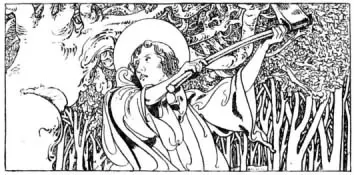
The defining episode of his mission is the felling of Donar's Oak (the 'Oak of Thor') at Geismar around 723. According to his biographer Willibald, Boniface took an axe to the great tree sacred to the thunder-god while a hostile crowd waited for their deity to strike him dead. When nothing happened — and the timber was used to build a chapel dedicated to Saint Peter — the demonstration broke the spell of the old gods for many who watched. It is one of the most vivid scenes of early medieval missionary history.
Boniface died as he had lived — among people not yet converted. On June 5, 754, near Dokkum in Frisia, he and roughly fifty companions were waiting to confirm a group of new Christians when armed raiders fell upon the camp. Tradition holds that Boniface forbade his companions to fight and was cut down holding a Gospel book over his head; the blade-scarred codex preserved at Fulda is venerated as that very book. His witness joined the missionary's labor to the martyr's death — the seed and the blood of the same harvest.