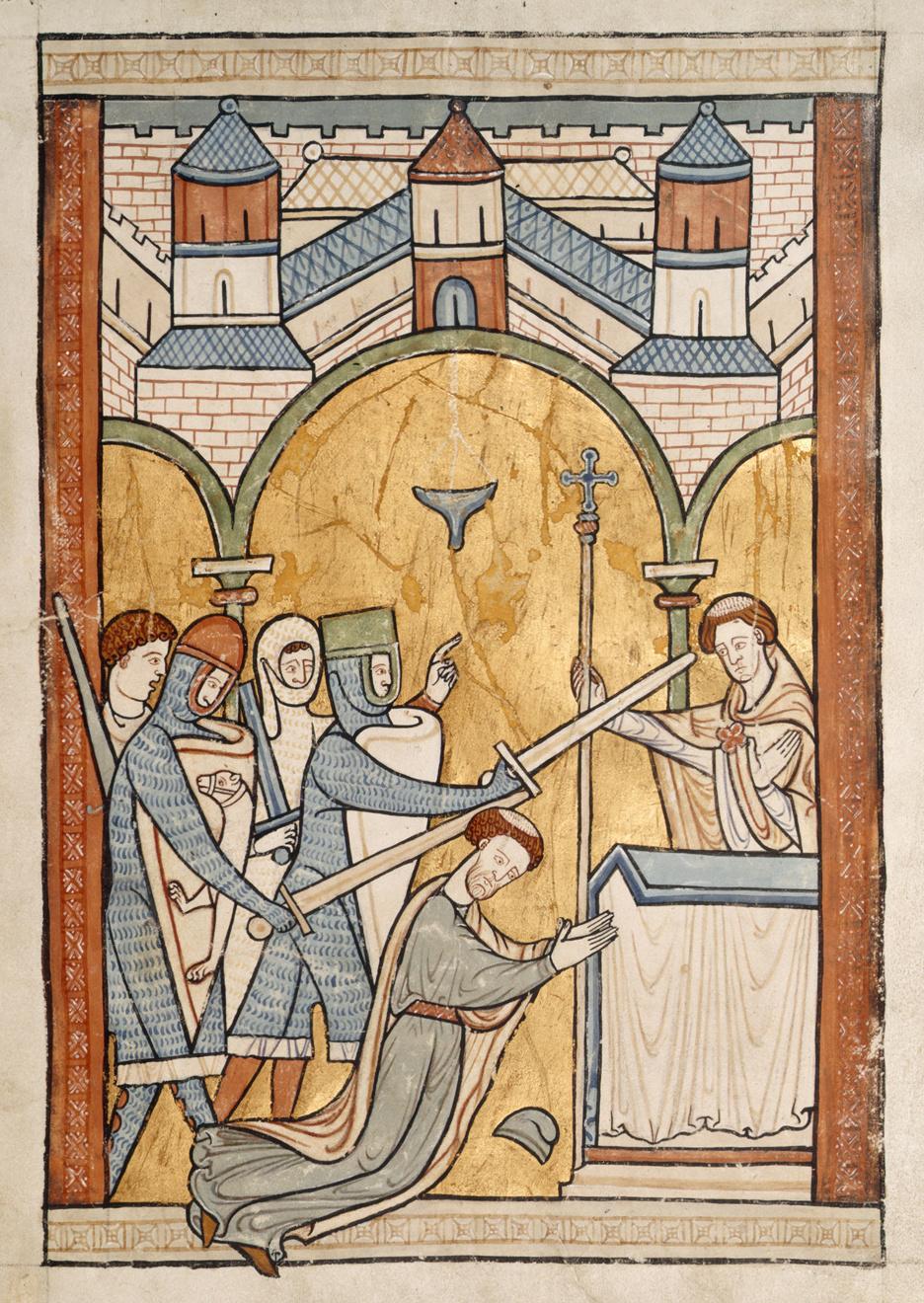
Thomas Becket was a Norman-English administrator who rose through the household of Theobald, Archbishop of Canterbury, to become Lord Chancellor of England under his close personal friend King Henry II. Becket served Henry as Chancellor for seven years (1155–1162) with characteristic efficiency — collecting taxes, enforcing royal authority, and personally leading troops in the field. He was, by every account, the most able administrator of his generation in England.
In 1162, Henry, expecting the same loyal service in spiritual administration, secured Becket's appointment as Archbishop of Canterbury. The choice backfired immediately. Becket resigned the chancellorship, adopted a public ascetic discipline, and began to defend the prerogatives of the church against the crown's encroachments with the same precision he had previously used to extend royal authority. The friendship turned into the most bitter ecclesiastical-political conflict in medieval English history.
The central dispute was over the trial of clergy who committed crimes: Henry insisted that they be tried in royal courts; Becket insisted they belonged to ecclesiastical jurisdiction. The disagreement was constitutional, not merely personal. After the Constitutions of Clarendon in 1164 attempted to formalize royal authority over the church, Becket fled to France and lived in exile for six years. He returned to Canterbury in December 1170 after a partial reconciliation.
On December 29, 1170, four knights of Henry's court — Reginald Fitz Urse, Hugh de Morville, William de Tracy, and Richard le Breton — rode to Canterbury, allegedly responding to Henry's exasperated outburst, 'Who will rid me of this turbulent priest?' Whether Henry intended murder or merely arrest is one of the perennial questions of medieval historiography. What the knights did is not in question. They confronted Becket in the cathedral during Vespers, demanded he reverse his excommunication of bishops who had defied him, and when he refused, they killed him with their swords at the altar. The eyewitness account by Edward Grim, one of Becket's clerks who tried to shield him and lost his arm doing so, survives.
Within three years Becket was canonized — one of the fastest formal canonizations in church history. Henry II performed public penance at the tomb, walking barefoot to Canterbury and submitting to flogging by the monks. The cult of Becket became one of the most powerful in medieval Europe; Chaucer's pilgrims in The Canterbury Tales are walking to his shrine. T. S. Eliot's Murder in the Cathedral (1935) brought the story into modern literature with its searching examination of Becket's motives at the moment of his death: was his willingness to die a holy submission, or a final and most subtle pride?