Michael Sattler
Author of the Schleitheim Confession
A former Benedictine prior who wrote, at a gathering of hunted Anabaptist leaders in February 1527, the seven-article confession that placed the mainstream Anabaptist movement on the side of nonresistance and voluntary church order. Three months later he was tortured and burned at Rottenburg. His wife was drowned days after.
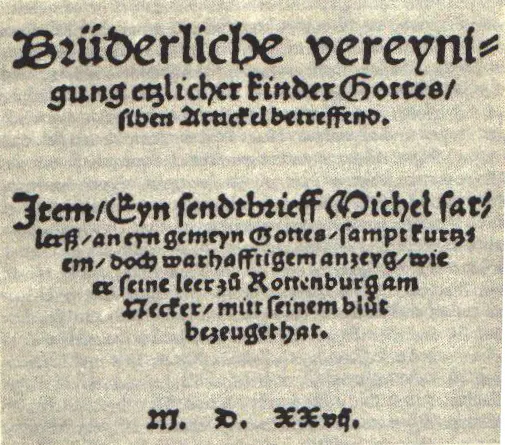
Michael Sattler was prior of the Benedictine monastery of St. Peter's in the Black Forest — a substantial house south of Freiburg — when the Reformation arrived in the Rhine valley. He left sometime around 1523–25; the exact circumstances are debated. The monastery may have been disrupted by mercenary soldiers during the Peasants' War of 1525; he may have been persuaded by the reformers circulating through the region. What is certain is that by 1526 he was in Strasbourg, meeting with both Capito and Bucer — two magisterial Reformers who took the Anabaptists seriously enough to spend days arguing with them — and refusing the magisterial logic that bound the reform to the civil order.
The Schleitheim Confession was written at a gathering of Swiss and south German Anabaptist leaders at the village of Schleitheim, on the German-Swiss border, on February 24, 1527. The context was dire: the Zürich council had just drowned Felix Manz; the Münster disaster was still in the future but the movement was already widely associated with social disorder; scattered communities had no common document to hold them together or to show inquirers what they actually believed. Sattler drafted seven articles; the gathering ratified them.
The seven articles are not a systematic theology. They are answers to live controversies within the movement: (1) Baptism is for those who have repented, believed, and desire to walk in the resurrection of Christ — not for infants. (2) The ban — excommunication — is applied to members who fall into serious sin and refuse pastoral correction, before the breaking of bread, without rancor. (3) The breaking of bread is a memorial of Christ's death, shared by baptized believers only. (4) Separation from the world: Anabaptists are not to participate in Catholic or Protestant state churches, taverns, or civic commitments that bind them to the world's order. (5) Pastors shall be men of good character, supported by the congregation; if martyred, a replacement is appointed immediately. (6) The sword: no Christian may serve as a magistrate, wield the sword of civil justice, or bear arms in war. The Christian's weapons are the ban and the Word. (7) The oath: no Christian may swear, citing Matthew 5:33–37.
The sword article is the most consequential and the most debated. Sattler does not argue that civil government is evil — he explicitly says the sword is ordained by God for the ordering of the world outside the perfection of Christ. He argues that it belongs to the order of the world, not to the order of the church, and that a Christian who has entered the perfection of Christ has moved into a different register of life. This is not political anarchism; it is a ecclesiological argument about what kind of community the church is. The Mennonites, the Hutterites, the Brethren, and ultimately the English Quakers would all inhabit this space.
Zwingli read the Confession and called it 'seductive but untrue.' Calvin, years later, was harsher. Luther fell somewhere in between. The imperial diet had already made Anabaptism a capital offense in 1529; Sattler's execution preceded even that, operating under older heresy and sedition statutes.
Sattler and his wife Margaretha were arrested at Horb am Neckar in February 1527, weeks after Schleitheim. The trial at Rottenburg is one of the most documented martyrdom accounts of the Reformation — an Anabaptist eyewitness account survives. The imperial commission read nine charges; Sattler acknowledged the Anabaptist positions and argued from Scripture for each. Asked what he would do if the Turks invaded, he gave the answer that sealed him: he would not take up arms even then — not because he wished them victory, but because the Christian's posture before enemies is prayer and witness, not the sword. The judges found this treasonous, as it technically was under imperial law.
On May 20, 1527, Sattler was executed publicly in the market square at Rottenburg: his tongue was cut out, flesh was torn in five places with red-hot tongs, one hand was burned off, and he was then burned alive at the stake. Eyewitnesses recorded that as the fire was being prepared he prayed aloud for his judges. His wife Margaretha was drowned in the Neckar several days later after refusing a final offer to recant.
The Schleitheim Confession did not die with its author. It circulated immediately in manuscript copies, was printed within months, and was translated into English by William Tyndale's printer as early as 1527. It reached Menno Simons, the Hutterites, the Dutch Mennonites, and eventually the English Separatists and Quakers. The specific form of Christian social ethics it inaugurated — believers gathered voluntarily, refusing coercion, bearing witness by life rather than law, treating the Sermon on the Mount as a literal rule of life — has survived five centuries of persecution, accommodation, migration, and division. The Amish build their communities on it. Every Christian who has refused military service on grounds of faith is standing somewhere in the field Michael Sattler planted at Schleitheim.
Key Works
- The Schleitheim Confession (Seven Articles, February 24, 1527)
Further Reading
- John H. Yoder, ed. and trans., The Legacy of Michael Sattler (Herald Press, 1973).
- C. Arnold Snyder, The Life and Thought of Michael Sattler (Herald Press, 1984).
- William Estep, The Anabaptist Story, 3rd ed. (Eerdmans, 1996).
- Heinold Fast, ed., Quellen zur Geschichte der Täufer in der Schweiz, vol. 2 (1973).
Frequently Asked Questions
Who was Michael Sattler?
A former Benedictine prior who wrote, at a gathering of hunted Anabaptist leaders in February 1527, the seven-article confession that placed the mainstream Anabaptist movement on the side of nonresistance and voluntary church order. Three months later he was tortured and burned at Rottenburg. His wife was drowned days after.
When did Michael Sattler live?
Michael Sattler lived c. 1490 – 1527 in Black Forest, Germany → Schleitheim → Rottenburg am Neckar.
What tradition is Michael Sattler part of?
Michael Sattler is associated with the Anabaptist / Radical Reformation tradition.
What did Michael Sattler write?
Key works include The Schleitheim Confession (Seven Articles, February 24, 1527).