Martin Luther
Father of the Reformation
An Augustinian monk who lit the match. The 95 Theses, the Diet of Worms, Bible translation into German, the doctrine of justification by faith alone — Luther's intellectual fingerprints are on the whole Protestant world.
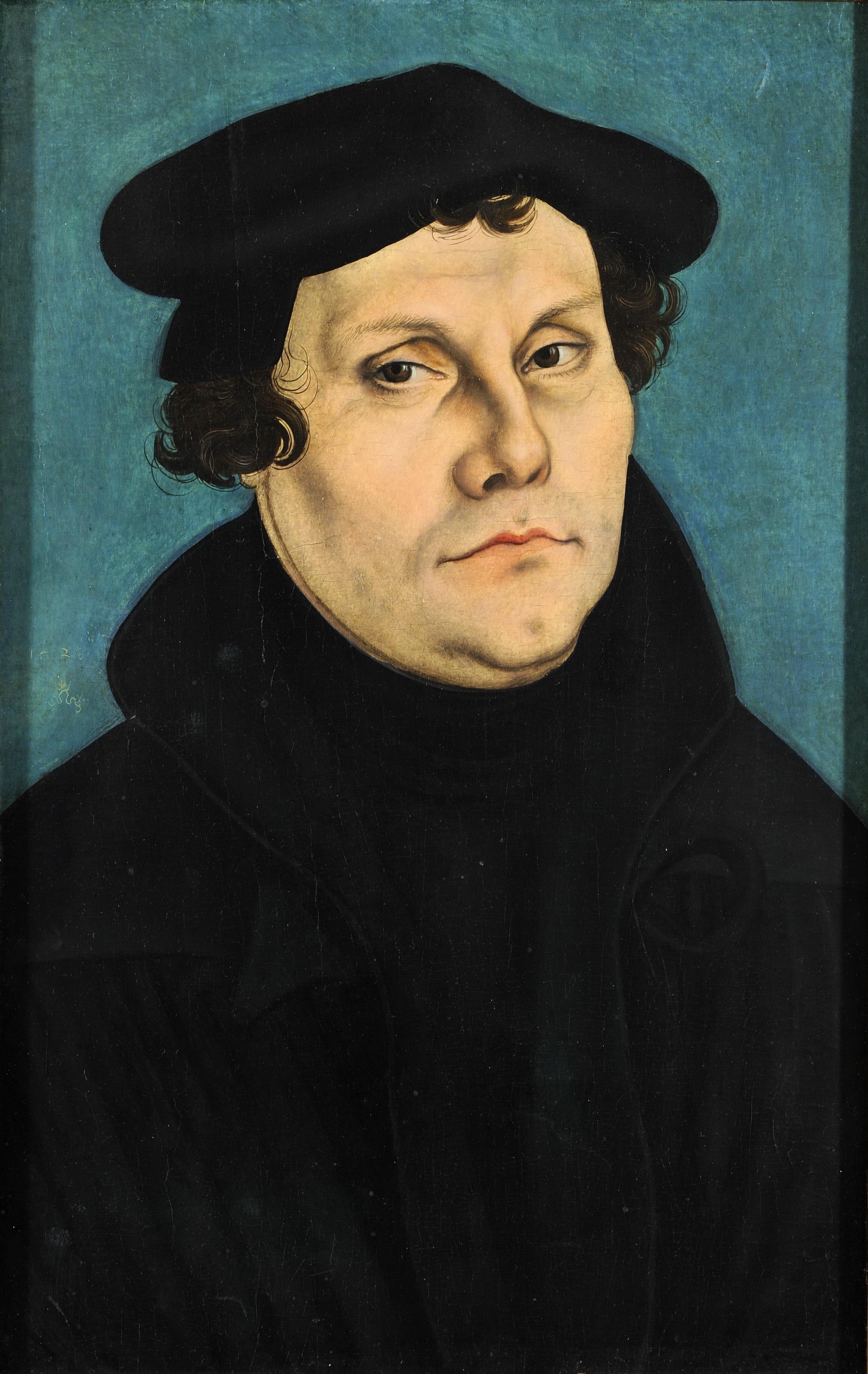
Martin Luther was born to a copper-miner's family in Eisleben in 1483, took monastic vows at the Augustinian friary in Erfurt in 1505 (after a thunderstorm conversion he never tired of recounting), and was ordained a priest in 1507. His earliest theological writing wrestles with the question that produced the Reformation: how can a sinful person stand before a holy God? The answer his teachers gave him — accumulate merit through sacraments, indulgences, and disciplined religious life — drove him to despair. The answer he eventually found in Romans 1:17 — "the just shall live by faith" — produced the Reformation.
The Ninety-Five Theses of October 31, 1517, were not a manifesto. They were a scholar's invitation to academic debate against Johann Tetzel's preaching of plenary indulgences in Saxony. Luther mailed them to Archbishop Albert of Mainz on the same day, and posted them on the Wittenberg castle church door (the standard university bulletin board). The printing press did the rest. Within months they were circulating in Latin and German across Europe, and the question Luther had raised in scholarly form was being asked by laypeople: why does my soul depend on payments to Rome?
Luther's three great treatises of 1520 made the Reformation's theological core public. To the Christian Nobility of the German Nation tore down the wall between clergy and laity (the priesthood of all believers). The Babylonian Captivity of the Church reduced the seven sacraments to two (baptism and the Lord's Supper) and broke the medieval sacramental system. On the Freedom of a Christian articulated the paradox: a Christian is perfectly free, lord of all, subject to none — and perfectly bound, servant of all, subject to all. The pope responded with the bull Exsurge Domine. Luther burned it publicly with the canon law.
At the Diet of Worms in April 1521, before Emperor Charles V and the assembled estates of the empire, Luther was given a final chance to recant. His reply — "Here I stand, I can do no other" (Hier stehe ich, ich kann nicht anders) — may not be the exact verbatim, but the substance is documented. He was declared an outlaw, kidnapped for his own safety by Frederick the Wise's men, and hidden at the Wartburg castle, where he translated the New Testament into German in eleven weeks. His translation shaped modern German the way the King James Bible shaped modern English. He returned to Wittenberg in 1522 and spent the next twenty-four years writing, preaching, and reorganizing the German church.
Key Works
- The Ninety-Five Theses (1517)
- To the Christian Nobility of the German Nation (1520)
- The Babylonian Captivity of the Church (1520)
- On the Freedom of a Christian (1520)
- Bondage of the Will (1525)
- Small and Large Catechisms (1529)
Further Reading
- Heiko A. Oberman, Luther: Man Between God and the Devil (1989)
- Roland Bainton, Here I Stand: A Life of Martin Luther (1950)
- Martin Brecht, Martin Luther (3 vols., 1985–1993)