Huldrych Zwingli
The Swiss Reformer
The Reformer of Zürich. An independent witness, parallel to Luther but theologically distinct — especially on the Lord's Supper, where his memorial view diverged from Luther's bodily presence and produced the Marburg Colloquy of 1529.
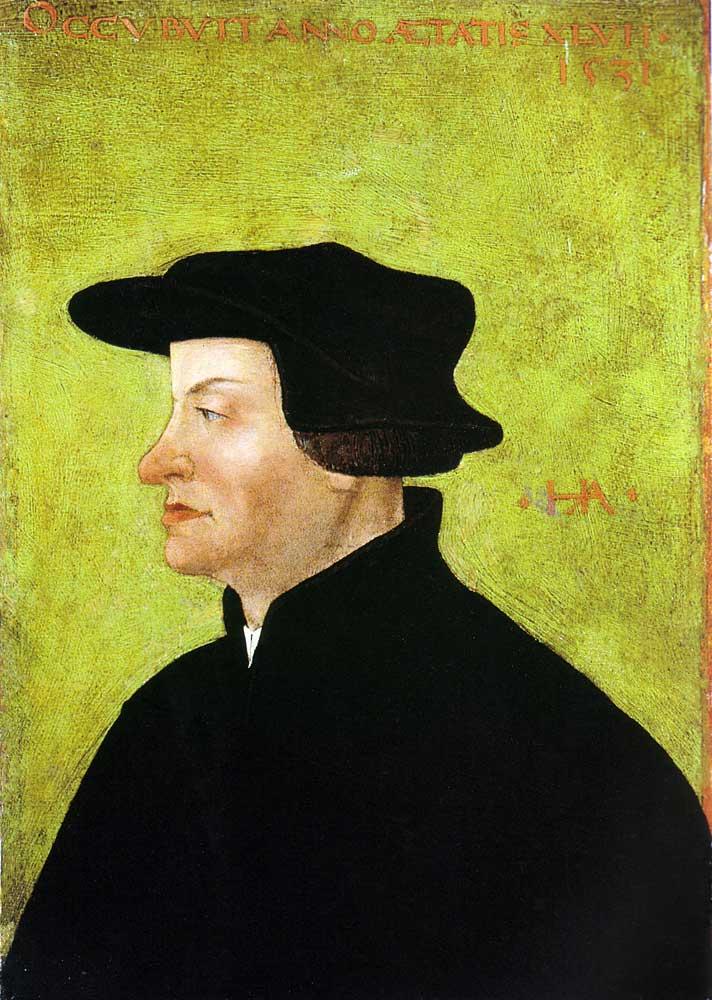
Huldrych Zwingli was educated in the Renaissance humanist tradition at Vienna and Basel, and was a parish priest at Glarus and Einsiedeln before being called as people's priest (Leutpriester) at the Grossmünster in Zürich in 1518. He began his Reformation career on January 1, 1519, by abandoning the medieval lectionary and preaching straight through the Gospel of Matthew — a small change that signaled a fundamental shift toward scriptural-only authority. Zwingli's evangelical convictions matured independently of Luther: he had been reading Erasmus's Greek New Testament since 1516, and he later said that he had been preaching the gospel before he heard Luther's name.
The Sixty-Seven Articles of 1523, defended in the First Zürich Disputation, set out Zwingli's program: only Christ is the head of the church, no human authority can bind the conscience, salvation is by faith alone, the Mass is a memorial not a sacrifice, and external rites — including images and relics — must yield to scripture. The Zürich city council adopted the program by stages; by 1525, the Mass was abolished, images were removed from the churches, and a simple Reformed liturgy was instituted.
Zwingli's most famous theological disagreement was with Luther on the Lord's Supper. At the Marburg Colloquy in October 1529, called by Philip of Hesse in hopes of unifying the Protestant movement, Luther and Zwingli agreed on fourteen of fifteen articles. The fifteenth was the Eucharist. Luther insisted on the bodily presence of Christ in the bread ("this IS my body"). Zwingli read the words symbolically: "this SIGNIFIES my body." They could not agree. Luther refused to accept Zwingli's hand. The Protestant movement entered its first major fracture.
Zwingli's death is one of the most striking in Reformation history. The Catholic and Reformed cantons of Switzerland were at war, and Zürich's troops were defeated at the Battle of Kappel on October 11, 1531. Zwingli, serving as army chaplain in armor, was killed in the fighting. His body was identified, quartered, and burned by the victorious Catholic side. Heinrich Bullinger succeeded him in Zürich and consolidated his theological legacy. The Reformed wing of Protestantism — distinct from both Lutheranism and the radical Anabaptist movement — owes more to Zwingli than is often acknowledged.
Key Works
- Sixty-Seven Articles (1523)
- On True and False Religion (Commentarius de Vera et Falsa Religione, 1525)
- An Account of the Faith (Fidei Ratio, 1530)
- Defense of the Reformed Faith (1530)
Further Reading
- G. R. Potter, Zwingli (1976)
- W. P. Stephens, The Theology of Huldrych Zwingli (1986)
- Bruce Gordon, The Swiss Reformation (2002)