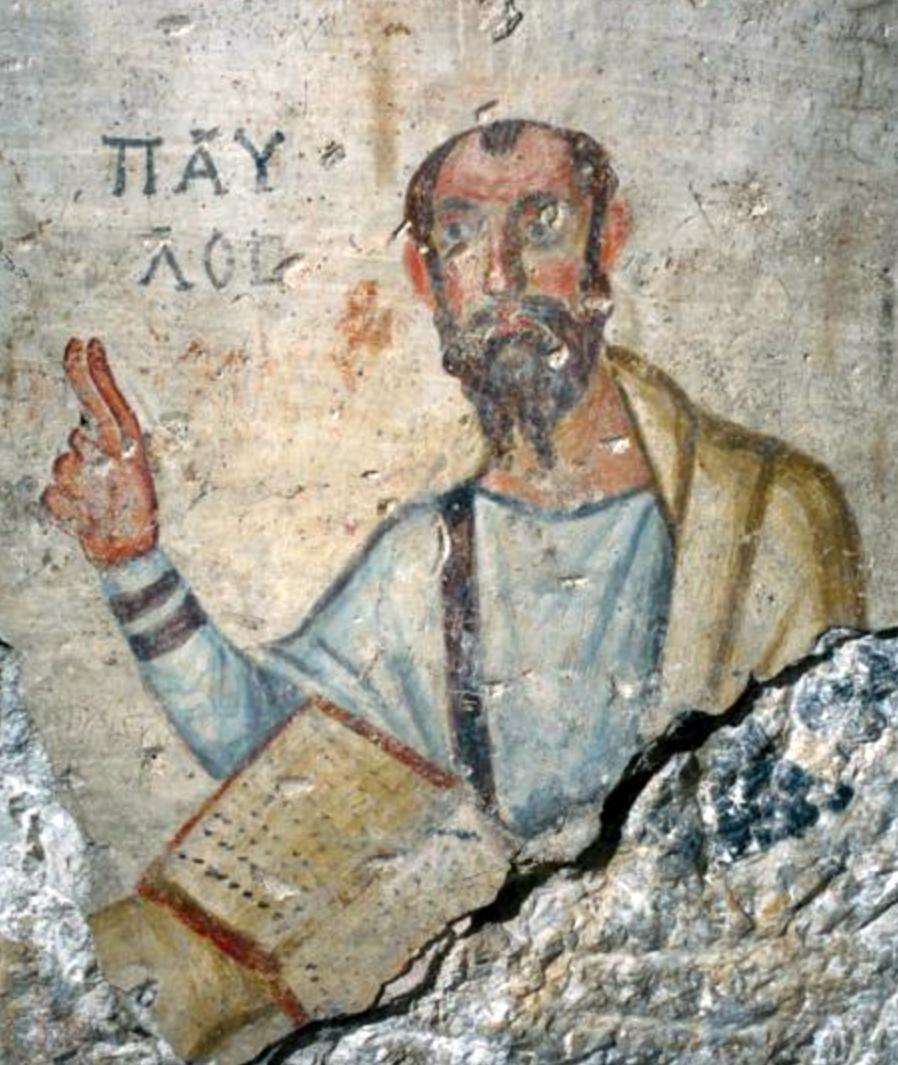
Saul of Tarsus, born around 5 AD in the Roman province of Cilicia (modern southeastern Turkey), was a Hellenistic Jew of the diaspora — a Roman citizen by birth (Acts 22:28), a Pharisee by religious training (Philippians 3:5), and a student in Jerusalem under the great rabbi Gamaliel I (Acts 22:3). He first appears in the New Testament at the stoning of Stephen, holding the cloaks of the witnesses who throw the stones (Acts 7:58; 8:1). The young man at Stephen's death is the same young man who, almost immediately afterward, begins to extend the persecution from Jerusalem outward, dragging followers of the Way from house to house and committing them to prison (Acts 8:3).
His conversion on the road to Damascus, c. 33–35 AD, is one of the most consequential single events in Christian history. The narrative occurs three times in Acts (chapters 9, 22, and 26) and is referenced repeatedly in his own letters (Galatians 1:11–17; 1 Corinthians 9:1; 15:8; 2 Corinthians 12:1–4). The risen Christ appeared to him in light, struck him blind, and called him to be a chosen vessel to bear his name 'before the Gentiles, and kings, and the children of Israel' (Acts 9:15). His blindness was healed by Ananias, a Damascus disciple, three days later. He was baptized, took the apostolic name Paul, and almost immediately began to preach Christ in the synagogues of Damascus.
Three missionary journeys (Acts 13–21) over approximately a decade and a half established Christian communities across the Roman Mediterranean. The first journey (c. 46–48 AD) took him through Cyprus, Pamphylia, and Pisidia. The second (c. 49–52) carried the gospel for the first time into Macedonia and Greece — founding the churches of Philippi, Thessalonica, Berea, Athens, and Corinth. The third (c. 53–57) included a long period at Ephesus where, according to Acts 19, 'all they which dwelt in Asia heard the word of the Lord Jesus.' He was arrested in Jerusalem in 57 AD (Acts 21), held in custody at Caesarea for two years, appealed to Caesar as a Roman citizen, and was sent to Rome under guard (Acts 27–28), where he spent two years under house arrest awaiting trial.
His letters are the earliest Christian writings in the New Testament — earlier than any of the Gospels in their final form. The thirteen letters that bear his name are about a third of the New Testament by volume. Critical scholarship has divided them into three groups by relative confidence of Pauline authorship: the seven 'undisputed' letters (Romans, 1–2 Corinthians, Galatians, Philippians, 1 Thessalonians, Philemon — universally accepted); the three 'disputed' letters (Ephesians, Colossians, 2 Thessalonians — accepted by the patristic tradition, debated in modern scholarship); and the three 'pastoral' letters (1–2 Timothy and Titus — most disputed in modern scholarship but accepted in the patristic and ecclesial reception). Even on the most skeptical modern reconstruction, the undisputed seven represent the largest and most influential body of work by any single first-century author whose writings have survived.
Romans 1–11 is the most extended theological argument in the New Testament: the universal scope of sin under both law and conscience (Romans 1:18–3:20), the justification of the ungodly by faith apart from works of the law (3:21–5:21), the new life in Christ that breaks the power of sin (6:1–8:39), and the unfinished story of Israel's place in God's covenantal purposes (9:1–11:36). The argument is the foundation document of every subsequent Christian articulation of justification, sanctification, and the relation between Israel and the Church.
Paul's death in Rome is attested by 1 Clement (c. 96 AD, the earliest non-canonical Christian writing), Ignatius of Antioch, and Tertullian. The consensus tradition places his execution under Nero, around 64–67 AD, at a site outside the city walls along the Ostian Way. The Tre Fontane Abbey south of Rome marks the traditional location. As a Roman citizen, Paul could not be crucified; he was beheaded by sword — the iconographic attribute that identifies him in Christian art. His tomb is identified beneath the high altar of the Basilica of Saint Paul Outside the Walls (San Paolo fuori le Mura), and 2002–2009 Vatican archaeology found a first-century burial within the basilica's foundations and a 4th–5th century sarcophagus bearing the inscription PAULO APOSTOLO MART — Paul, Apostle, Martyr.