Pentecost
Pentecoste (Greek — "the fiftieth [day]")
Fifty days after Pascha — the descent of the Spirit, the birth of the church, the fulfillment of Shavuot. Fire on Sinai becomes fire on the apostles; the Torah given to Israel becomes the Spirit poured out on all flesh.
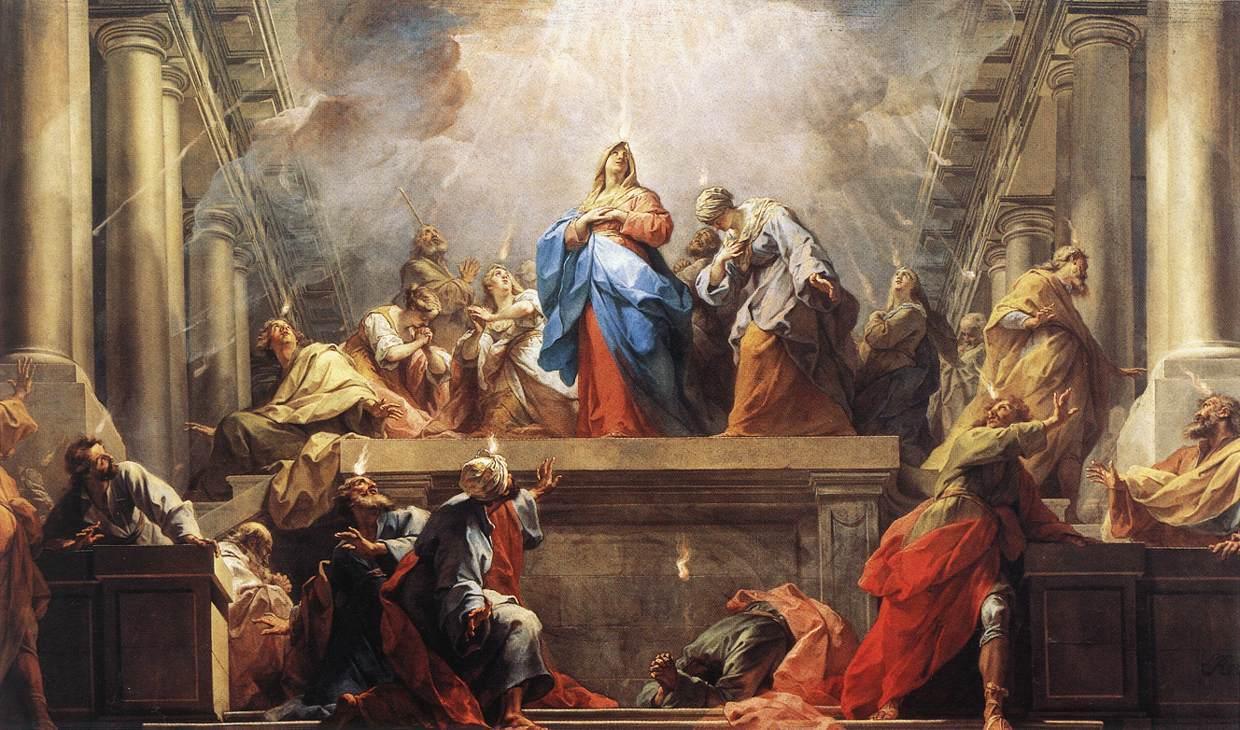
Pentecost is the great feast of the Holy Spirit and, in liturgical structure, the close of the paschal season. The Greek name pentekoste means "fiftieth" and is the direct translation of the Hebrew Shavuot ("weeks") — the Jewish feast that the rabbis later called the Festival of the Giving of Our Torah (Zeman Mattan Torateinu). The Jewish feast counted fifty days from Passover; the Christian feast counts fifty days from Pascha. Acts 2:1 frames the event explicitly: "when the day of Pentecost had come" — that is, when the existing Jewish feast had arrived. The apostles were not inventing a new feast in Acts 2; they were gathered for the old one when the Spirit fell.
The theological geometry of the day is exact. Shavuot in Jewish tradition commemorates the giving of the Torah at Sinai fifty days after the Exodus. The Babylonian Talmud (Shabbat 86b–88a) develops the chronology in detail. On that day, fire descended on the mountain (Exodus 19:18), the voice of the Lord went out in seventy languages (so the midrash, see Exodus Rabbah 5:9), and the Torah was given to Israel. On the Christian Pentecost, fire descends — now on the heads of the apostles (Acts 2:3). The disciples speak in tongues, and "devout men from every nation under heaven" hear in their own languages (Acts 2:5–11). Peter cites Joel 2 to interpret it: "in the last days... I will pour out my Spirit on all flesh." The Sinai pattern is repeated with universal scope. Christian preaching from Irenaeus and Tertullian forward made the parallel explicit.
The feast was firmly established as the second great paschal day by the end of the second century. Tertullian writes around 200 that no day is more appropriate for baptism after Pascha than Pentecost (De Baptismo 19). Origen, Eusebius, the Apostolic Constitutions, and the great Eastern liturgies all describe Pentecost as the conclusion and crown of the fifty days of Easter joy. The entire fifty-day span (the Pentecost season in the Eastern tradition, in some sense the original "Pentecost") was a single great Sunday — no fasting permitted, no kneeling permitted. The fiftieth day itself was the festal climax of that season.
Liturgically, the feast in the Roman tradition is marked by the red vestments of fire and the Spirit, by the hymn Veni Creator Spiritus (a ninth-century composition, traditionally ascribed to Rabanus Maurus), and by the sequence Veni Sancte Spiritus (twelfth or thirteenth century, ascribed variously to Stephen Langton or Pope Innocent III). The Pentecost vigil parallels the Easter Vigil in structure. The Eastern liturgy is dominated by the kneeling prayers of Sunday evening — long sets of prayers said while the whole congregation kneels for the first time since Pascha. The transition is liturgically vivid: the church has been standing in resurrection joy for fifty days, and now it kneels in the presence of the Spirit it has received.
Theologically, Pentecost is the feast of the church. If Christmas celebrates the Word becoming flesh and Easter celebrates the conquest of death, Pentecost celebrates the birth of the community in which both of those mysteries are made present through time. The Spirit who descended at Pentecost is the Spirit who animates the church, who illumines the Scriptures, who consecrates the sacraments, and who indwells every baptized believer. Eastern theology speaks of the church as one of the two hands of God (Irenaeus's phrase) — the Son and the Spirit — together accomplishing the divine purpose. Pentecost is the day on which the second hand is laid on the body of the church. The fifty days are completed. Ordinary Time begins.
Scriptural Basis
- Leviticus 23:15–22 — the Feast of Weeks (Shavuot), fifty days after Passover
- Deuteronomy 16:9–12 — the same feast
- Acts 2:1–41 — the descent of the Holy Spirit, the rushing wind, the tongues of fire, the gift of languages, Peter's sermon
- Joel 2:28–32 — "I will pour out my Spirit on all flesh" (the Joel prophecy Peter quotes at length)
- John 14–16 — Christ's farewell discourses on the coming of the Paraclete
- 1 Corinthians 12 and Romans 12 — the gifts of the Spirit and the body of Christ
- Numbers 11:25–29 — Moses's wish that all the Lord's people were prophets
Observance
- The principal Sunday liturgy with red vestments (the color of fire and of martyrdom)
- The Veni Creator Spiritus and Veni Sancte Spiritus — the two great Pentecost hymns of the Western church
- In the East: the kneeling prayers of Pentecost Sunday evening, the first time the church has knelt since Pascha (kneeling was suppressed through the fifty days of Eastertide)
- Vigil of Pentecost (Saturday evening) with extended Old Testament readings, parallel in structure to the Easter Vigil
- Many traditional confirmations of catechumens; in the Orthodox church, the feast is associated with the dignity of the priesthood
- Decoration of churches with greenery and flowers (a survival from the Jewish Shavuot custom)
Citations & Further Reading
- Acts 2 — the Lukan narrative of the descent
- Babylonian Talmud, Tractate Shabbat 86b–88a (the Jewish reckoning of Shavuot as the giving of the Torah)
- Tertullian, De Baptismo 19 (Pentecost as the second great baptismal day)
- Origen, Contra Celsum 8.22 — the church's keeping of Pascha and Pentecost
- Apostolic Constitutions 5.20
- John Chrysostom, Homilies on Pentecost (PG 50.453–470)
- Talley, The Origins of the Liturgical Year (Pueblo, 1986), 55–78