Christmas
Nativitas Domini
The celebration of the Incarnation. December 25 in the West and most of the East, January 7 in the Julian-calendar Orthodox churches. Earliest attestation in the Roman Chronograph of 354, with theological calculations a century earlier.
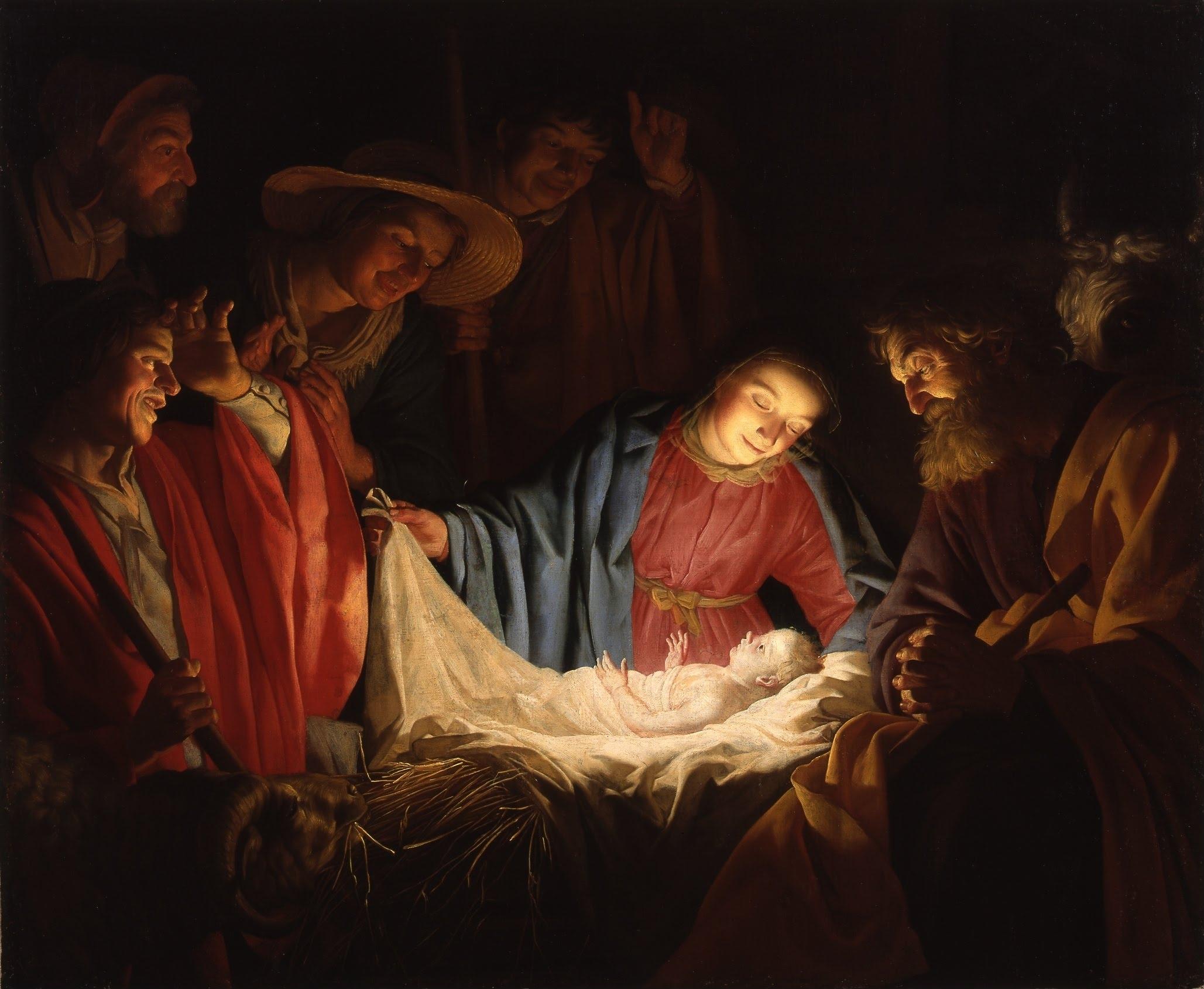
Christmas is the celebration of the Incarnation — the eternal Son of God taking human flesh from the Virgin Mary at a specific moment in Roman history. The earliest Christian writers we have do not yet celebrate it as an annual feast; the New Testament itself shows no liturgical interest in Christ's birthday. By the early third century, however, theologians were trying to calculate the date. Sextus Julius Africanus (Chronographiai, c. 221) placed the conception of Christ on March 25, and the birth nine months later on December 25. Hippolytus of Rome (Commentary on Daniel 4.23, c. 204) gives the same date. The earliest unambiguous celebration of December 25 as the Nativity is in the Roman Chronograph of 354, where the entry for that day reads natus Christus in Betleem Iudeae.
The popular claim that the church simply Christianized the Roman feast of Sol Invictus (instituted by Aurelian on December 25, 274) does not survive close examination. The Chronograph of 354 records both feasts on the same date but does not derive one from the other; the third-century calculations of Africanus and Hippolytus predate Aurelian's feast. The likelier explanation, defended by Thomas Talley (The Origins of the Liturgical Year, 1986), is the so-called calculation hypothesis: early Christians believed Christ died on March 25 (Tertullian, Adversus Iudaeos 8), inferred from the rabbinic principle of the "integral age" that he was also conceived on March 25, and counted nine months forward to December 25. The Sol Invictus parallel may have helped the feast spread, but it is not its origin.
The Eastern church initially celebrated the Nativity on January 6 as part of a combined feast of birth and baptism called Epiphany (manifestation). The Cappadocian Fathers introduced the December 25 feast at Constantinople and Antioch in the 370s and 380s: Gregory of Nazianzus preached his Oration 38 (Eis ta Theophania) on December 25, 380, calling it "the day of the holy birth." Most of the Eastern churches adopted the December date over the following decades; the Armenian Apostolic Church alone retained January 6 for the Nativity, which it observes to this day. The Orthodox churches that use the Julian calendar (Russia, Serbia, Georgia, Jerusalem, parts of Ukraine, Mount Athos) celebrate December 25 on what is January 7 in the civil Gregorian calendar.
The liturgical structure of the feast in both East and West is built around three layers. There is the historical event itself (the birth at Bethlehem). There is the theological mystery (the eternal Word becoming flesh, John 1:14). And there is the sacramental encounter — the Eucharist of Christmas Day, where the church receives the same incarnate Lord whose birth it commemorates. The Roman liturgy preserves this in the three Masses of the day: at midnight, the manger; at dawn, the shepherds; at the day Mass, the high theological proclamation of John 1.
Christmas's twelve days (December 25 through January 5) form a single liturgical unit, the Christmastide of the Western calendar and the dodekameron of the East. The feast does not end on Christmas Day; it begins there. The First Sunday after Christmas, the feast of the Holy Family (in the modern Roman calendar), the feasts of Stephen (December 26), John the Evangelist (December 27), and the Holy Innocents (December 28), New Year's Day (the Octave of Christmas, in the Roman tradition the feast of the Circumcision and of Mary, Mother of God), and Epiphany (January 6) all belong to it. The commercial collapse of Christmas onto a single afternoon is a modern shrinkage that the liturgical year was specifically designed to resist.
Scriptural Basis
- Isaiah 7:14 — Immanuel prophecy
- Isaiah 9:6 — "For unto us a child is born"
- Micah 5:2 — Bethlehem prophecy
- Matthew 1:18–25 — the Annunciation to Joseph
- Luke 2:1–20 — the Nativity narrative
- John 1:1–14 — "the Word became flesh" (read as the Gospel at Christmas Day Mass)
- Hebrews 1:1–4 — the Son as the radiance of the Father's glory
Observance
- Three traditional Masses on Christmas Day: Midnight (Ad Galli Cantum), Dawn (In Aurora), and Day (In Die)
- The twelve days of Christmas, December 25 through January 5
- In the East: the Royal Hours, the Vigil of the Nativity, and the long Matins of the feast
- The Christmas Vigil of December 24 (Christmas Eve)
- Carols, the Christmas crèche (originated with Francis of Assisi at Greccio, 1223), evergreens, and lights — many of these absorbed from local pre-Christian winter customs and re-interpreted Christologically
Citations & Further Reading
- Sextus Julius Africanus, Chronographiai (fragments preserved in Eusebius and Syncellus)
- Hippolytus of Rome, Commentary on Daniel 4.23
- Chronograph of 354 (Codex-Calendar of 354), entry for December 25
- Gregory of Nazianzus, Oration 38 (On the Theophany)
- Thomas J. Talley, The Origins of the Liturgical Year (Pueblo, 1986), 79–155
- Susan K. Roll, Toward the Origins of Christmas (Kok Pharos, 1995)