Epiphany
Theophania (Greek) / Epiphania (Latin)
January 6 — the older twin of Christmas. The Magi in the West, the Baptism of Christ in the Jordan in the East. The Theophany when the Trinity is revealed and the world's waters are sanctified.
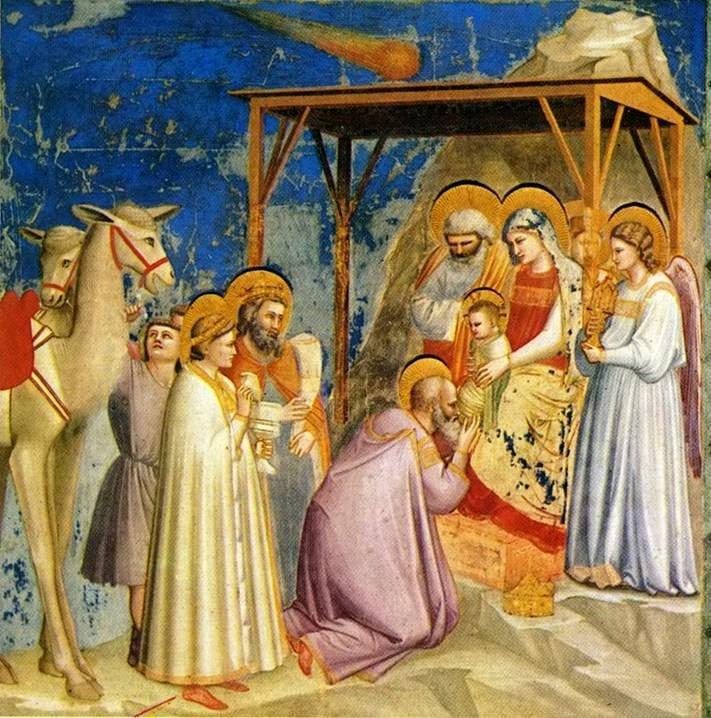
Epiphany is the older sister of Christmas. The Eastern churches were celebrating January 6 as the feast of Christ's manifestation a century before Rome fixed December 25, and the Greek word epiphaneia — manifestation, appearance — covers a wider theological territory than the Western nativity narrative alone. In the original Eastern feast, three manifestations of Christ's divinity were celebrated together: his birth (the Magi recognizing him as king), his baptism (the Father's voice declaring him Son), and his first miracle at Cana ("manifesting his glory," John 2:11). The medieval Eastern liturgy still speaks of "the threefold manifestation."
The earliest evidence for the feast is in Clement of Alexandria around 200, who reports that the Basilidean Gnostics in Egypt celebrate Jesus's baptism on what corresponds to January 6 or 10 (Stromata 1.21.146). Clement does not say catholic Christians keep the same feast, but his framing implies that the date was already significant before the Gnostic appropriation. By the fourth century, the feast is everywhere in the Greek-speaking East: Gregory of Nazianzus's Oration 39 (Eis ta hagia phota — On the Holy Lights) was preached at Constantinople on January 6, 381, and Egeria the Spanish pilgrim records the elaborate Jerusalem liturgy for the feast in her diary (Itinerarium 25–26, c. 384).
When the Eastern churches adopted December 25 for the Nativity in the late fourth century, the feast of January 6 narrowed in the East to a single primary emphasis: the Baptism of Christ in the Jordan. The Theophany of January 6 is the day when the Trinity is revealed in the Jordan — the Father's voice from heaven, the Son standing in the water, the Spirit descending as a dove. The Great Blessing of Waters that the Orthodox church performs on this feast is a sacramental enactment of the same theology: as Christ's baptism sanctified all water, so the water now blessed carries the grace of his immersion. The Russian, Greek, Serbian, and Ethiopian traditions all carry vivid forms of this practice — processions to rivers and seas, plunges into icy water, the carrying home of blessed water for the year ahead.
When the Western churches adopted December 25 for the Nativity, the feast of January 6 narrowed in the West to a different primary emphasis: the visit of the Magi to the infant Christ in Matthew 2. The theological logic is the same — the manifestation of Christ's divinity — but the iconographic focus is the kingship of Christ and his recognition by the Gentile world. The Magi (traditionally numbered three because of the three gifts, named by the eighth century as Caspar, Melchior, and Balthasar) become the firstfruits of the Gentiles, the fulfillment of Isaiah 60 and Psalm 72.
Epiphany also marks the structural turn of the Western liturgical year from the Christmas cycle to Ordinary Time, with a brief Epiphany season carrying the themes of Christ's manifestation into the early weeks of January. The feast of the Baptism of the Lord, in the modern Roman calendar, falls on the Sunday after Epiphany — a late Western recovery of the older Eastern emphasis. From there the church moves toward Lent. The two great feasts of the early year — December 25 and January 6 — stand together as the twin pillars of the Christmas-Epiphany cycle, with the twelve days between them as a single celebration of "God with us" revealed.
Scriptural Basis
- Isaiah 60:1–6 — "Arise, shine, for your light has come... nations shall come to your light"
- Matthew 2:1–12 — the visit of the Magi (the Western emphasis)
- Matthew 3:13–17, Mark 1:9–11, Luke 3:21–22 — the Baptism of Christ in the Jordan (the Eastern emphasis)
- John 2:1–11 — the wedding at Cana (the third manifestation, included in early Epiphany liturgies)
- Psalm 72:10–11 — "the kings of Tarshish and of the isles" foretelling the Magi
Observance
- In the East (Theophany): the Great Blessing of Waters, in churches and at rivers, lakes, or the sea — the world's waters sanctified through Christ's baptism in the Jordan
- In the West: the procession of the Magi, the chalking of doors with C+M+B (Caspar, Melchior, Balthasar / or Christus Mansionem Benedicat — "may Christ bless this house"), and the blessing of homes
- The Twelve Days of Christmas conclude on the eve of Epiphany; the season of Epiphany then continues until Lent
- King cake / Galette des Rois / Rosca de Reyes in many Western European traditions
- Solemn announcement of the date of Easter, read at Mass on Epiphany — a survival from before the universal computus was settled
Citations & Further Reading
- Clement of Alexandria, Stromata 1.21.146
- Gregory of Nazianzus, Oration 39 (On the Holy Lights)
- Egeria, Itinerarium 25–26
- John Chrysostom, Homily on the Baptism of Christ (PG 49.363)
- Thomas J. Talley, The Origins of the Liturgical Year (Pueblo, 1986), 135–155
- Roll, Toward the Origins of Christmas (Kok Pharos, 1995), 121–164