Holy Week
Hebdomas Sancta (Latin) / Megale Hebdomas (Greek — the Great Week)
The Great Week. From Palm Sunday's procession to Holy Saturday's silence and the Easter Vigil's new fire — the year's dramatic and liturgical center. The whole shape preserved in Egeria's fourth-century Jerusalem diary.
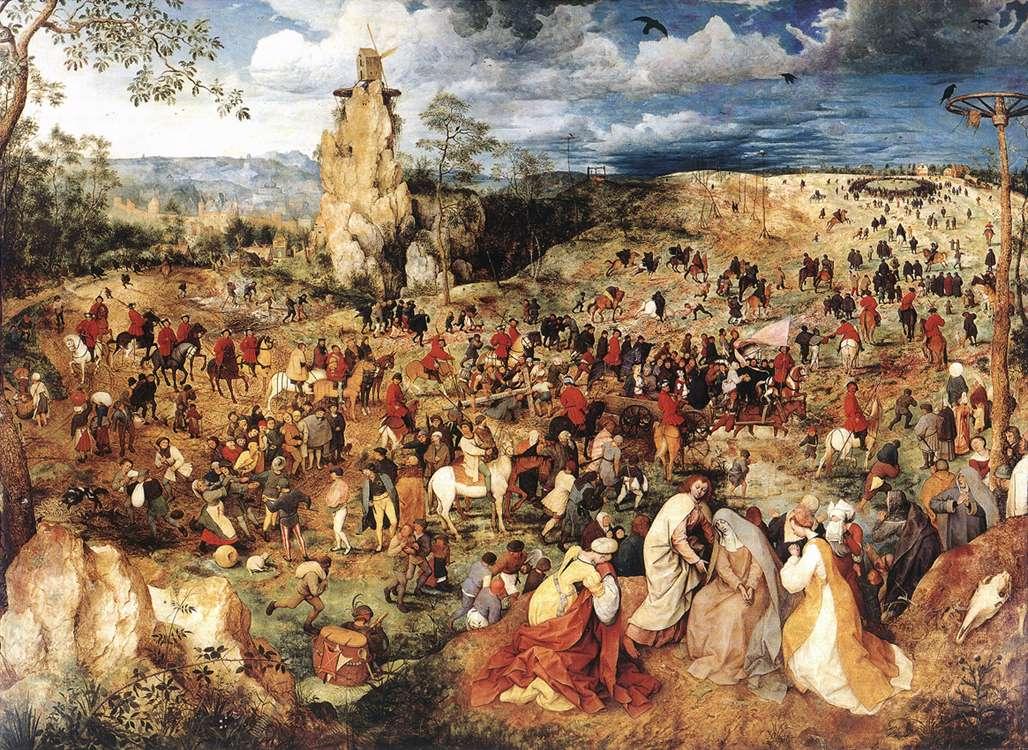
Holy Week is the dramatic climax of the entire Christian year. It is not a series of separate commemorations of separate events but a single extended liturgical action — the church reliving and entering into the last week of Christ's earthly life and the central mystery of his death and resurrection. The Eastern tradition calls it simply the Great Week (Megale Hebdomas); the Latin tradition calls it the Sacred Triduum for its last three days (Holy Thursday, Good Friday, Holy Saturday); both traditions treat it as the year's structural and spiritual center.
The fourth-century Jerusalem liturgy is the source of nearly everything we now do in Holy Week. The Spanish nun Egeria, pilgrim to the Holy Land in the early 380s, kept a diary of the Jerusalem liturgical year — and her account of Holy Week (Itinerarium 30–43) is so detailed that we can reconstruct the entire week with confidence. On Palm Sunday, the Jerusalem church gathered at the Mount of Olives in the afternoon, sang hymns and read Matthew 21, then processed back to the city carrying olive and palm branches with the bishop. On Holy Thursday, they celebrated the Eucharist at the Martyrium (Constantine's basilica on Calvary) and then kept vigil through the night at Gethsemane. On Good Friday, they venerated the wood of the True Cross from morning through afternoon — pilgrims kissed the relic under the watchful eye of two deacons because (Egeria notes) someone had once bitten off a fragment. On Holy Saturday night, the great vigil at the Anastasis with its scriptural readings and the dawn Eucharist of Easter. The Roman, Constantinopolitan, Antiochene, and Alexandrian liturgies all absorbed Jerusalem's pattern through the next century.
The Triduum (Holy Thursday evening through Easter Vigil) is liturgically a single continuous action interrupted only by rest. The Mass of the Lord's Supper on Thursday evening has no formal conclusion; the priest and people leave in silence after the procession of the Blessed Sacrament to the altar of repose. The Good Friday liturgy has no opening rites — it begins where Thursday left off. The Easter Vigil has no preliminary because Holy Saturday's silence has been the preliminary. The three liturgies are three movements of one liturgical drama: institution, sacrifice, resurrection.
Each day carries its own dominant theme. Palm Sunday: the entry of the king who comes humble on a donkey, and the immediate turn of the crowd from "Hosanna" to "Crucify him." Holy Monday and Tuesday in the East: the parable of the ten virgins and the Bridegroom services that call the church to vigilance. Holy Wednesday: the betrayal by Judas (in the Roman tradition, the day of Tenebrae — the gradual extinguishing of candles as the Office of Readings is sung). Holy Thursday: the institution of the Eucharist at the Last Supper, the washing of feet, the new commandment (mandatum novum, from which Maundy Thursday gets its name). Good Friday: the Crucifixion, the seven last words, the veneration of the Cross. Holy Saturday: the descent into Hades, the harrowing of hell, the silence before resurrection.
And then the Easter Vigil. The new fire is struck outside the dark church; the Paschal Candle is lit and carried in; the Exsultet — perhaps the most lyrical text in the entire Roman liturgy — proclaims "This is the night, this is the night, this is the night" when Christ broke the chains of death. The long readings move from Genesis 1 (the first creation) through the Red Sea (the first Passover) through Ezekiel's dry bones to the Resurrection. Catechumens are baptized; the church renews its baptismal vows; the lights blaze up; the bells, silent since Maundy Thursday, ring out; and the Eucharist of Easter begins. Holy Week ends not in death but in the resurrection it has been moving toward all along.
Scriptural Basis
- Zechariah 9:9 — "Behold, your king is coming, humble and mounted on a donkey" (read on Palm Sunday)
- Isaiah 50:4–9, 52:13–53:12 — the Servant Songs (read across the week)
- Matthew 21, 26–27 — the entry into Jerusalem and the Passion
- Mark 11, 14–15 — the same
- Luke 19, 22–23 — the same
- John 12–19 — the Johannine Passion (read in its entirety on Good Friday)
- Hebrews 10:1–18 — the once-for-all sacrifice
Observance
- Palm Sunday: blessing of palms, procession, reading of the Passion narrative
- Holy Monday through Wednesday: extended preparation; in the East, the Bridegroom services (Nymphios)
- Maundy Thursday: Chrism Mass (blessing of oils), Mass of the Lord's Supper, washing of feet (mandatum, from John 13), stripping of the altar, all-night vigil at the altar of repose
- Good Friday: Liturgy of the Word, veneration of the Cross, communion from the reserved sacrament — in the Western rite, no Mass is celebrated
- Holy Saturday: silence; in the East, the Vesperal Liturgy of St. Basil with fifteen Old Testament readings
- Easter Vigil (Saturday night): the new fire, the Exsultet, the readings (Genesis through the Resurrection), baptisms of catechumens, the first Eucharist of Easter
Citations & Further Reading
- Egeria, Itinerarium 30–43 (the Jerusalem Holy Week, c. 384)
- Cyril of Jerusalem, Mystagogical Catecheses (the post-baptismal lectures of Easter Week)
- John Chrysostom, Catechetical Homilies (Holy Week sermons at Antioch and Constantinople)
- Adolf Adam, The Liturgical Year (Pueblo, 1981), 64–80
- Patrick Regan, Advent to Pentecost: Comparing the Seasons in the Ordinary and Extraordinary Forms of the Roman Rite (Liturgical Press, 2012)
- Thomas J. Talley, The Origins of the Liturgical Year (Pueblo, 1986), 27–78