Anabaptist Tradition
The Radical Reformation
The Radical Reformation. Where Luther reformed the church, Zwingli the city, and Calvin the polity, the Anabaptists left the state church entirely — believer's baptism, pacifism, refusal of oaths, and a sustained witness of mutual aid and simplicity that has endured five centuries.
The Anabaptist movement began on January 21, 1525, when a small group of disaffected disciples of Huldrych Zwingli gathered in the house of Felix Mantz in Zürich. Conrad Grebel, a young patrician scholar, baptized George Blaurock, a former priest. Blaurock then baptized the others. They had concluded — from the same Scripture Zwingli had been preaching to them — that infant baptism was unscriptural and that the Reformation must begin again from the foundation of a believing, voluntary church. The Zürich city council saw the rebaptism (anabaptismos in Greek) as sedition against the civic-religious order and within months had outlawed it. Felix Mantz was the first Anabaptist martyr, drowned in the Limmat River in January 1527 — the city's mocking inversion of his baptism.
The Schleitheim Confession of February 1527 — seven articles drafted by the former Benedictine prior Michael Sattler — gave the early Swiss Anabaptists their doctrinal and ethical center. Baptism upon confession of faith. The ban (church discipline by exclusion from the Lord's Supper). The Lord's Supper as a memorial among the regenerate. Separation from the world. Pastors chosen by the congregation. The refusal of the sword ("the sword is ordained by God outside the perfection of Christ; within the perfection of Christ the ban alone is used"). The refusal of oaths. Sattler was burned at the stake three months after drafting the Confession. His wife was drowned a week later. The pattern of early Anabaptist life — fugitive, hunted, martyred — was set within two years of the movement's birth.
Two early catastrophes nearly destroyed the movement and permanently shaped its later self-understanding. The Peasants' War of 1524–1525, with which the early Anabaptists were sometimes associated by their enemies (despite their pacifism), produced massacres across Germany. More damaging was the Münster Rebellion of 1534–1535, when a radical apocalyptic Anabaptist faction led by Jan Matthys and Jan van Leiden seized the city of Münster, instituted polygamy and community of goods, declared the New Jerusalem, and was destroyed by a combined Catholic-Lutheran siege. Münster was a horrifying aberration — but it became the propaganda image of all Anabaptists for the rest of the 16th century. The mainstream Anabaptist response, articulated above all by Menno Simons in the Netherlands from the late 1530s, was to insist on absolute biblical pacifism and patient suffering — and to rebuild a community life that bore no resemblance to the Münster apocalypse.
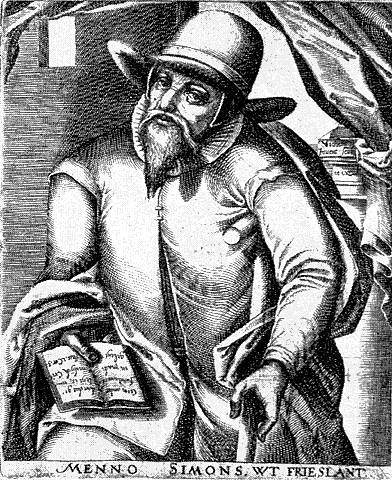
Menno Simons (1496–1561), a former Frisian Catholic priest, gave the Dutch and North German Anabaptist movement the pastoral leadership and theological articulation it needed in the wake of Münster. The Mennonite name (Mennisten, Mennonites) attaches to him because of the success of his rebuilding work. The Dordrecht Confession of 1632 codified the mature Dutch Mennonite position. Jakob Ammann's stricter party — over the question of how rigorously to apply the ban and avoid social contact with the excommunicated — broke from the Mennonites in the Swiss Alps in the 1690s and became the Amish. Jakob Hutter's Moravian community of goods became the Hutterite tradition. The Brethren (German Baptist Brethren, Church of the Brethren) emerged in Schwarzenau in 1708 as a separate but related movement. The Bruderhof communities arose in the 20th century from German Hutterite influence.
The Anabaptist witness has been preserved through five centuries of migration. Fleeing persecution, Mennonite communities moved from Switzerland to the Palatinate, from the Netherlands to Prussia, from Prussia to the Russian steppes (under Catherine the Great's invitation in 1763), from Russia to the Canadian prairies and Paraguay and Mexico in waves through the 19th and 20th centuries, and from German lands directly to colonial Pennsylvania and Ontario. Today the global Anabaptist family numbers approximately 2.1 million, with the largest concentrations in the United States, Canada, Ethiopia (the Meserete Kristos Church, a Mennonite body with over 250,000 members), the Democratic Republic of Congo, Paraguay, and India. The Anabaptist insistence that the church is composed of regenerate believers in voluntary association, separated from state power, has — by way of the English Baptist tradition and the American religious liberty settlement — shaped a far larger portion of global Christianity than the Anabaptist numbers themselves would suggest.
Distinctives
- Believer's baptism (often by pouring or sprinkling in the early Anabaptist tradition, immersion later)
- Voluntary, regenerate church membership — no infant baptism, no state church
- Separation of church and state — refusal of magistrates' authority over conscience
- Pacifism / nonresistance — refusal of the sword in defense of self, church, or nation
- Refusal of oaths (following Matthew 5:34)
- Mutual aid, simplicity of life, community discipline (the ban)
- Two-kingdoms ethics: the church lives by the Sermon on the Mount, the world by the sword
Key Figures
- Conrad Grebel, Felix Mantz, George Blaurock (Zürich, 1525)
- Michael Sattler (Schleitheim Confession, 1527, martyred)
- Menno Simons (1496–1561) — gives his name to the Mennonites
- Jakob Ammann (c. 1644–1730) — leader of the Amish division
- Jakob Hutter (martyred 1536) — founder of the Hutterite communal tradition
Defining Documents
- Schleitheim Confession (1527) — drafted by Michael Sattler
- Dordrecht Confession (1632) — Dutch Mennonite confessional standard
- Menno Simons, The Foundation of Christian Doctrine (1539, revised 1558)
- The Martyrs Mirror (Thieleman J. van Braght, 1660) — the great Anabaptist martyrology