Baptists
Believer's Baptism by Immersion
The believer's-baptism tradition. Adult immersion, congregational autonomy, religious liberty, and a robust emphasis on the personal accountability of every believer directly to God.
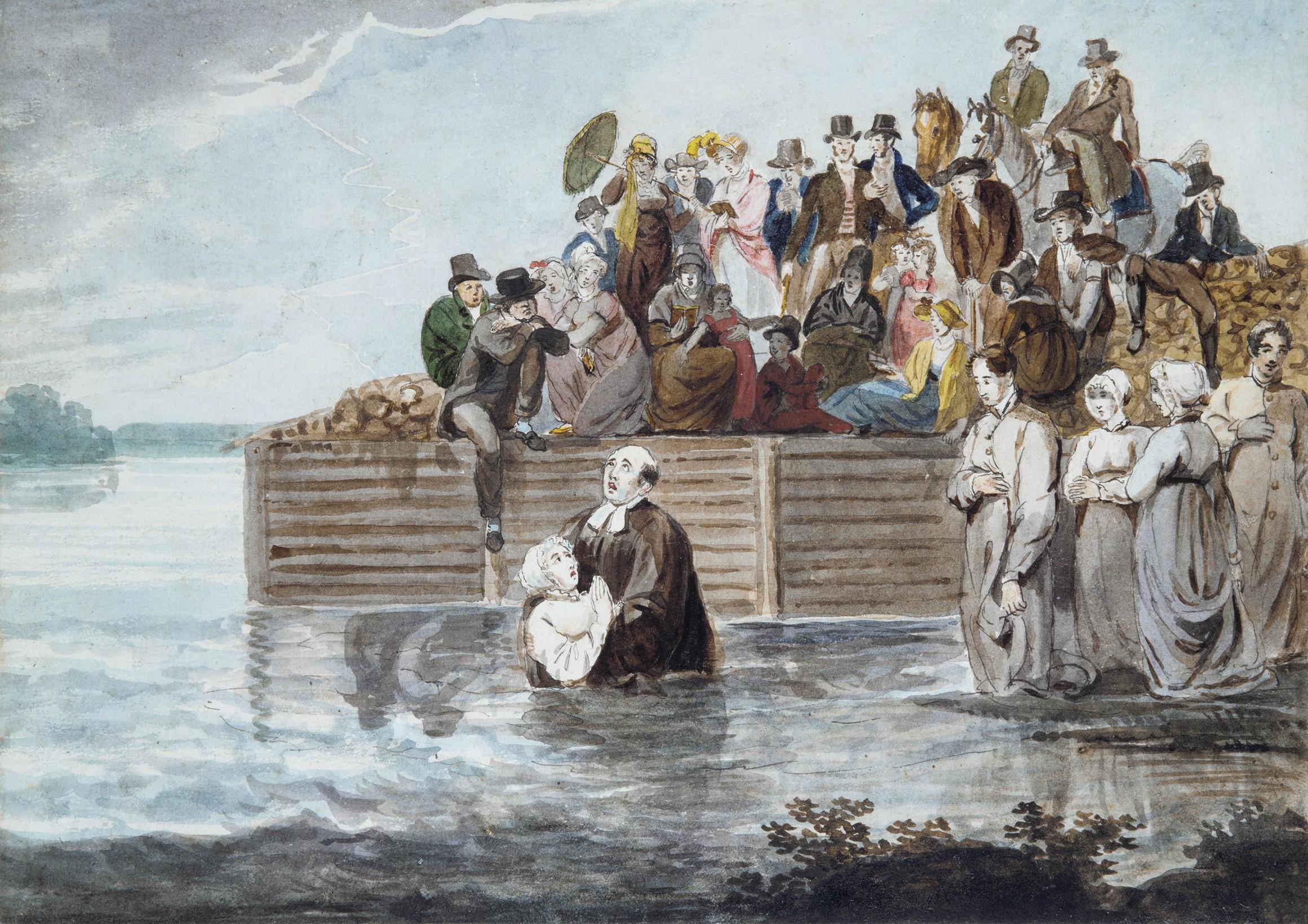
The Baptist movement emerged in the early 17th century out of English Separatism — Protestants who had concluded that the Church of England's reformation was incomplete and that genuine church order required separation. John Smyth, a Cambridge-educated former Anglican, baptized himself and his small congregation in Amsterdam in 1609 after concluding that infant baptism was unscriptural. Thomas Helwys returned to England in 1611, founded the first Baptist church on English soil at Spitalfields, and was imprisoned for his pamphlet A Short Declaration of the Mystery of Iniquity (1612) — the first significant English-language defense of religious liberty.
Believer's baptism by immersion is the practice that gives the movement its name and its identity. Baptists hold that baptism is the public confession of personal saving faith, intelligible only to one who can actually confess — and that the New Testament pattern, both in the Greek word baptizō ("to immerse") and in the symbolism of burial and resurrection (Romans 6:3–4), requires full immersion rather than affusion. The infant baptism of the historic churches is therefore, on Baptist principle, not baptism at all.
Baptist ecclesiology is congregational and voluntarist. Each local congregation, composed of regenerate baptized believers, is autonomous — there is no Baptist hierarchy, no Baptist magisterium, no Baptist pope. Baptist associations and conventions (like the Southern Baptist Convention, the largest single Baptist body in the United States) exist by voluntary cooperation, not by ecclesial authority over the local church. Closely related is the principle of soul competency — every believer's direct accountability to God in matters of faith — and the Baptist insistence on religious liberty, both for Baptists themselves and (in the best Baptist tradition, beginning with Roger Williams) for the religious other.
The Baptist tradition has been theologically diverse. The General Baptists (Smyth's stream) held to Arminian doctrines of grace; the Particular Baptists (which produced the London Baptist Confession of 1689) held to Calvinist particular redemption. Today the worldwide Baptist family includes Reformed Baptists, Arminian Baptists, Free Will Baptists, Southern Baptists (the largest Protestant body in the United States), African-American Baptist bodies (the National Baptist Convention USA), the Baptist World Alliance, and many independent Baptist churches. Worldwide Baptist membership is approximately 110 million.
Distinctives
- Believer's baptism by immersion (not infant baptism)
- Congregational church government — each local church autonomous
- Religious liberty / separation of church and state
- Soul competency — every believer's direct accountability to God
- Scripture as sole authority for faith and practice (no creedal subscription required of laity)
- The Lord's Supper as memorial
Key Figures
- John Smyth & Thomas Helwys (English General Baptists)
- Roger Williams (founder of Providence)
- John Bunyan (Pilgrim's Progress)
- Charles Spurgeon (the "Prince of Preachers")
- Adoniram Judson (Burmese missions)
- Billy Graham
Defining Documents
- The London Baptist Confession (1644, revised 1689)
- The New Hampshire Confession (1833)
- The Baptist Faith and Message (1925, 1963, 2000) — Southern Baptist Convention