Charismatic Renewal
Pentecost Within the Historic Churches
Pentecostal experience without leaving home. From 1960 onward — beginning with an Episcopal priest's announcement in Van Nuys — the baptism of the Spirit, tongues, prophecy, and healing crossed into the Episcopal, Catholic, Lutheran, and Reformed churches.
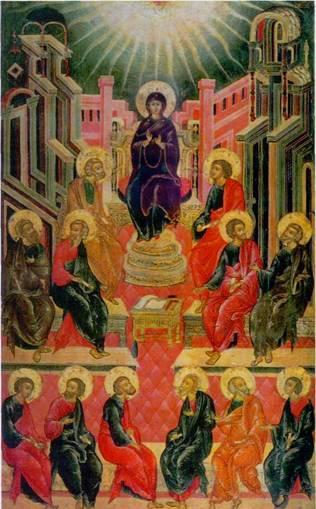
The Charismatic Renewal is the 20th century's second wave of Pentecostal experience — a movement that took the substance of what had happened at Azusa Street in 1906 and brought it into the historic denominations of the West. Where classical Pentecostalism had emerged outside the mainline churches and produced new denominations (Assemblies of God, Foursquare, Church of God in Christ), the Charismatic Renewal would carry Pentecostal experience inside Episcopal, Roman Catholic, Lutheran, Reformed, and Methodist churches without requiring members to leave them.
The conventional starting point is April 3, 1960, when Dennis Bennett — rector of St. Mark's Episcopal Church in Van Nuys, California — announced to his congregation that he had received the baptism of the Holy Spirit and had spoken in tongues. The announcement provoked a parish crisis: Bennett resigned that morning to spare St. Mark's the conflict, and within weeks Time and Newsweek had covered the story. The Bishop of Los Angeles forbade tongues in his diocese; the Bishop of Olympia (Washington) invited Bennett to take St. Luke's, Ballard — a struggling parish in Seattle that became, under Bennett's ministry, one of the principal centers of Anglican charismatic life. By 1962 the movement had spread to Lutheran (Larry Christenson at San Pedro, California), Presbyterian, and independent congregations across the United States.
The Catholic Charismatic Renewal began at Duquesne University in Pittsburgh in February 1967, when a small group of Catholic graduate students on a retreat — having read David Wilkerson's The Cross and the Switchblade and John Sherrill's They Speak with Other Tongues — sought and received the baptism in the Holy Spirit. The Duquesne Weekend, as it came to be called, was followed almost immediately by a similar outpouring at the University of Notre Dame, and by 1971 the movement had its first international conference. Cardinal Léon-Joseph Suenens of Mechelen-Brussels — one of the moderators of the Second Vatican Council — became the renewal's principal Catholic protector, leading the production of the Malines Documents (six theological statements from 1974 to 1986) that gave the Catholic Charismatic Renewal a theologically responsible articulation. Pope Paul VI received the renewal officially at St. Peter's in 1975. John Paul II and Benedict XVI continued the recognition; Pope Francis has been the renewal's most enthusiastic papal supporter.
Theologically, the Charismatic Renewal differs from classical Pentecostalism on a single key point: it does not require speaking in tongues as the initial evidence of Spirit baptism. The Renewal holds that the gifts of the Spirit (charismata) — tongues, prophecy, healing, words of knowledge, discernment — remain available to the Church today and are exercised in love for the building up of the body (1 Corinthians 12–14). But the experience of Spirit baptism is allowed to take varied forms across personalities and traditions: dramatic in some, quiet in others, sacramental in Catholic and Anglican settings (where it is often integrated with the Catholic theology of confirmation), revivalistic in evangelical contexts. The historic confessions of each host tradition are retained: Catholic charismatics remain Catholic, Lutheran charismatics remain Lutheran, Anglican charismatics remain Anglican.
By 1980 the Charismatic Renewal had touched every major Western denomination. By the late 1980s the so-called Third Wave (associated with John Wimber and the Vineyard movement) had carried Pentecostal experience into evangelical churches that had previously resisted both classical Pentecostalism and the Renewal — Calvary Chapel, the Vineyard, and many of the seeker-sensitive megachurches of the 1980s and 1990s. Pew Research's 2006 "Spirit and Power" study estimated the global Renewal (classical Pentecostal + Charismatic + Neocharismatic) at approximately 600 million; the World Christian Encyclopedia in revised editions places the Charismatic Renewal proper at roughly 150 to 250 million, distributed across the historic denominations. Together with classical Pentecostalism, charismatic Christianity is the second-largest stream of world Christianity after Roman Catholicism, and it is the fastest-growing form of Christian faith in Africa, Latin America, and the Global South.
Distinctives
- Baptism in the Holy Spirit and the exercise of spiritual gifts inside the historic denominations
- Tongues, prophecy, and healing held as available but no longer required as initial evidence
- Renewal of sacramental worship through charismatic prayer (especially in Catholic and Anglican settings)
- Strong emphasis on personal conversion and experiential encounter with the Holy Spirit
- Ecumenical posture — gifts and Spirit-experience as a bridge across confessional lines
- Continuity with the host tradition's confessions, sacraments, and church order
Key Figures
- Dennis Bennett (Episcopal trigger, 1960)
- Cardinal Léon-Joseph Suenens (Catholic Charismatic Renewal)
- Larry Christenson (Lutheran Charismatic)
- Michael Harper (Anglican Renewal, Fountain Trust)
- Kevin Ranaghan (Duquesne Weekend, 1967 — Catholic Pentecost)
Defining Documents
- Dennis Bennett, Nine O'Clock in the Morning (1970)
- Léon-Joseph Cardinal Suenens, A New Pentecost? (1974)
- The Malines Documents (1974–1986) — six theological statements on Catholic Charismatic Renewal
- The Kansas City Charismatic Conference, A Statement of Faith (1977)