Lutheranism
Justification by Faith Alone
The first wave of the Reformation, anchored in Luther's doctrine of justification by faith alone. Confessional Lutheranism centers on the Book of Concord, the bodily presence in the Lord's Supper, and the Law-Gospel hermeneutic.
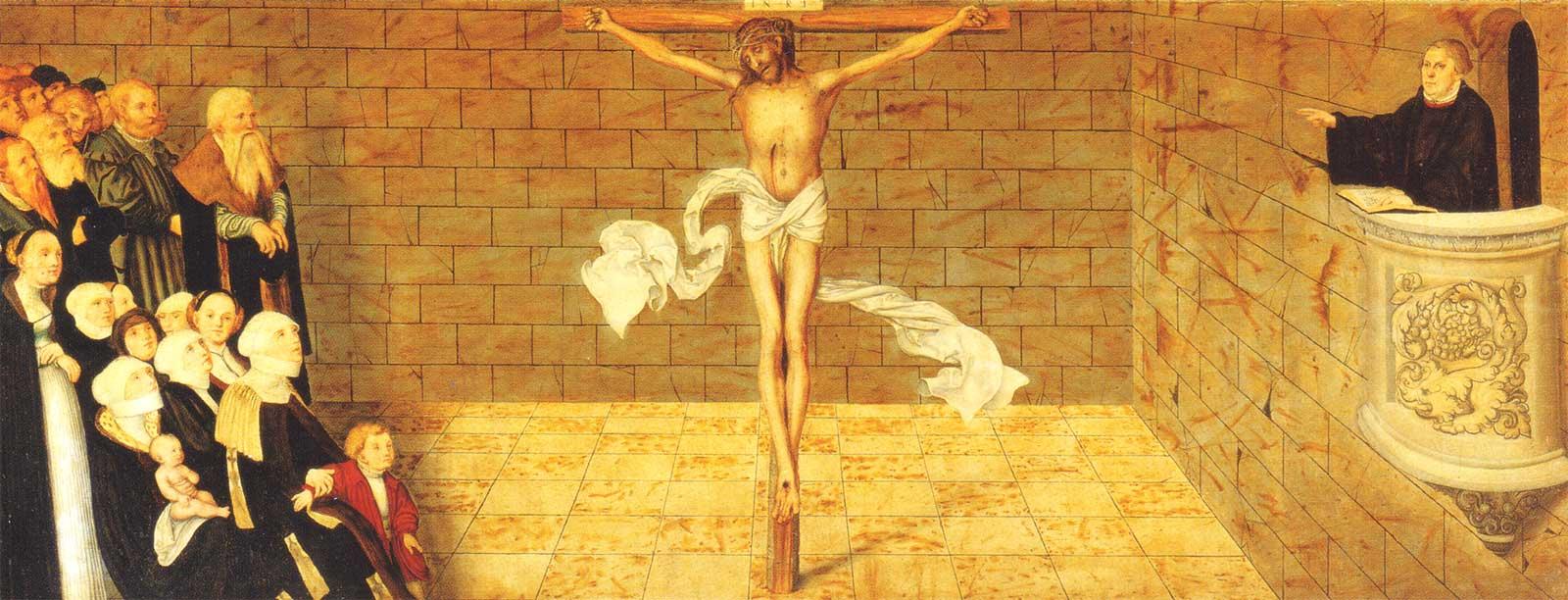
Lutheranism began as the unintended consequence of an Augustinian monk's protest against the sale of indulgences in Saxony in 1517. By 1530, when the Augsburg Confession was presented to Emperor Charles V at the Diet of Augsburg, it had become a distinct ecclesial movement with its own confessional standard. The Augsburg Confession — drafted primarily by Philip Melanchthon under Luther's supervision — remains the foundational document of Lutheran identity worldwide and is the lodestar against which Lutheran orthodoxy is still measured.
The doctrine of justification by faith alone (sola fide) is the theological center. As Luther taught it — and the Augsburg Confession Article IV formalized it — the sinner is declared righteous before God on the basis of Christ's righteousness imputed through faith, not on the basis of any work or merit. This is the "article on which the church stands or falls" (articulus stantis et cadentis ecclesiae). Around it cluster the other distinctive Lutheran emphases: the priesthood of all believers, the simul iustus et peccator (simultaneously righteous and sinner) account of the Christian life, and the Law-Gospel hermeneutic that reads Scripture as a tension between God's holy demand and God's free gift.
On the Lord's Supper, Lutheranism differs sharply from both the Reformed and the Catholic traditions. Against Zwingli's symbolism, Luther insisted on a real bodily presence: "this IS my body." Against the Catholic doctrine of transubstantiation, Luther held that the bread and wine remain bread and wine — but Christ is bodily present "in, with, and under" them (the formula has come to be called sacramental union or, less precisely, consubstantiation). The Lutheran insistence on this point at the Marburg Colloquy in 1529 marks the first major fracture within the Protestant movement.
Confessional Lutheranism — the form preserved most rigorously in the Lutheran Church–Missouri Synod, the Wisconsin Evangelical Lutheran Synod, and various continental confessional churches — adheres to the Book of Concord (1580), which collects the three ecumenical creeds, the Augsburg Confession, Luther's catechisms, and the Formula of Concord. Mainline Lutheranism — particularly the Evangelical Lutheran Church in America and the Lutheran World Federation churches — has been shaped more loosely by the same documents read through 20th-century theology. Worldwide Lutheran membership is approximately 70–80 million, concentrated in northern Europe, North America, and rapidly growing in sub-Saharan Africa.
Distinctives
- Justification by faith alone (sola fide)
- Scripture alone (sola scriptura) as final authority
- Two-kingdoms doctrine (church and state distinguished)
- Real bodily presence of Christ in the Lord's Supper
- Two sacraments: Baptism and the Lord's Supper
- Law-and-Gospel as the hermeneutical key to Scripture
Key Figures
- Martin Luther
- Philip Melanchthon
- Martin Chemnitz
- Johann Gerhard
- Johann Sebastian Bach (theologically literate Lutheran)
Defining Documents
- The Augsburg Confession (1530)
- Luther's Small and Large Catechisms (1529)
- The Book of Concord (1580)
- The Formula of Concord (1577)