Methodism
The Holiness Awakening
The 18th-century Anglican revival that became its own world tradition. Wesley's class meetings, Christian perfection, Arminian grace, and the small-group discipline that made revival sustainable.
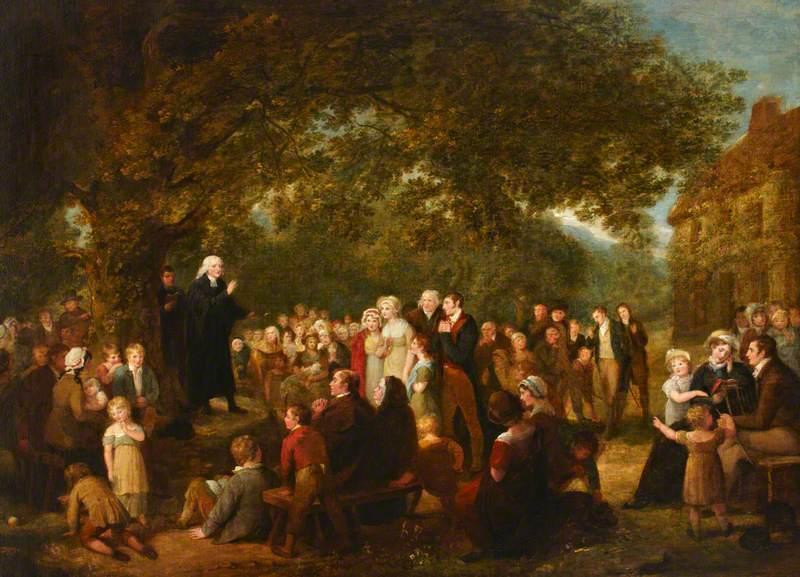
Methodism began as a renewal movement within the Church of England in the 1730s — the Oxford "Holy Club" of John and Charles Wesley and their circle. By 1739, after John Wesley's Aldersgate experience in 1738 and the inauguration of field preaching, it had become a national religious phenomenon. By 1784, with Wesley's ordination of ministers for North America, it was on its way to becoming a distinct world communion. Wesley himself never authorized formal Methodist separation from the Church of England in his lifetime, but the institutional shape of post-Wesleyan Methodism made separation inevitable.
Theologically, Methodism is Arminian — it affirms that God's saving grace is genuinely offered to all and may be genuinely resisted. This separates Wesley from the Reformed tradition (and was the cause of Wesley's split with the Calvinist Methodist George Whitefield in 1740). On grace, Wesley taught a sequence: prevenient grace (the grace that comes before, awakening the sinner), justifying grace (the moment of new birth), and sanctifying grace (the lifelong growth in holiness). His most distinctive teaching — Christian perfection or entire sanctification — held that the sanctifying work could, by faith, reach a moment of completion in this life: a real transformation of the heart's affections so that love of God and neighbor becomes the controlling motive.
The Methodist class meeting was the structural genius of the movement. Wesley organized converts into societies, divided each society into classes of about twelve, and required every Methodist to attend a weekly class meeting under a lay leader. The classes asked five searching questions every week ("What known sins have you committed since our last meeting?" "What temptations have you met with?"). Conversion was personal; sanctification was social. The class meeting made revival sustainable in a way that earlier awakenings had not been.
Methodism's social engagement was the natural consequence of its theology. Wesley personally led campaigns against the slave trade (his last surviving letter, written six days before his death, was to William Wilberforce urging him forward in the abolition fight). Methodist preachers were leaders in early industrial-era literacy, prison reform, and education. The Holiness movement of the 19th century — Phoebe Palmer in particular — gave Wesley's perfectionism a new pastoral form, and through the Holiness movement, Pentecostalism emerged in the 20th century. Worldwide Methodism (United Methodist Church, Wesleyan, Free Methodist, African Methodist Episcopal, and related bodies) numbers approximately 80 million.
Distinctives
- Christian perfection / entire sanctification
- Arminian doctrine of grace (against Calvinist predestination)
- Class meetings — small-group accountability
- Itinerant preaching and lay leadership
- Active social engagement (abolitionism, education, prison reform)
- The Quadrilateral: Scripture, Tradition, Reason, Experience
Key Figures
- John Wesley
- Charles Wesley (hymnwriter)
- George Whitefield (Calvinist Methodist)
- Francis Asbury (American Methodist organizer)
- Phoebe Palmer (Holiness Movement leader)
Defining Documents
- John Wesley's Standard Sermons (53 sermons)
- Wesley's Explanatory Notes Upon the New Testament (1755)
- A Plain Account of Christian Perfection (1766)
- The Articles of Religion (Wesley's 1784 abridgement of the Anglican Thirty-Nine)