Reformed Christianity
The Sovereignty of God
The systematic wing of the Reformation. Calvin's sovereignty of God in salvation, presbyterian church order, the regulative principle of worship, and a comprehensive vision of Christ over every sphere of life.
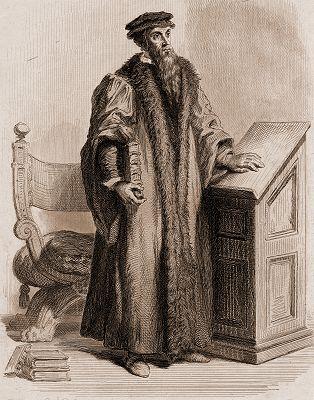
Reformed Christianity emerged in the Swiss cantons in the 1520s — first under Huldrych Zwingli in Zürich, then under John Calvin in Geneva — and spread rapidly across France (the Huguenots), the Netherlands, Scotland, England (in part), Hungary, and the British colonies of North America. "Reformed" is the broad tradition; "Presbyterian" describes those Reformed churches organized on the Scottish model; "Continental Reformed" describes the Dutch and German bodies. The same theological lineage runs through them all.
The defining theological emphasis is the sovereignty of God — and specifically, God's sovereignty in salvation. The doctrine of election (or predestination), already present in Augustine and Aquinas, was given systematic and confessional form by Calvin and by the later Reformed scholastics. The Synod of Dort (1618–1619), responding to the Arminian Remonstrants, produced the Canons of Dort and the five points later summarized in English as TULIP (Total depravity, Unconditional election, Limited atonement, Irresistible grace, Perseverance of the saints). The five points are not the whole of Reformed theology — they are a defensive sharpening at one historical moment — but they remain a useful index of Reformed soteriology.
On worship, the Reformed tradition holds the regulative principle: only what Scripture commands or warrants may be done in public worship. This is the principle that produced the simplicity of Reformed liturgy, the cessation of the medieval ceremonial year (later modified in some Reformed churches), and the historic Reformed preference for exclusive psalm-singing (now widely relaxed). On the Lord's Supper, the Reformed tradition rejects both Catholic transubstantiation and Lutheran bodily presence — Calvin taught a spiritual presence of Christ to the believer's faith, more substantial than Zwingli's pure memorial but less material than Luther's.
Reformed church government is Presbyterian: church power is vested in elders (presbyters) elected by the congregation, organized into a session (local), presbytery (regional), and general assembly (national). The Westminster Confession of Faith and Catechisms (1646–1647), produced by the Westminster Assembly during the English Civil War, remain the central confessional standard of English-speaking Presbyterianism. Worldwide Reformed membership is approximately 80 million across roughly 80 distinct denominations.
Distinctives
- The sovereignty of God in salvation (election / predestination)
- Scripture alone, with a robust covenantal hermeneutic
- Memorial / spiritual-presence view of the Lord's Supper
- Presbyterian church government (elders, sessions, presbyteries, general assemblies)
- Regulative principle of worship
- Comprehensive Christ-and-culture vision
Key Figures
- Huldrych Zwingli
- John Calvin
- John Knox
- Theodore Beza
- Francis Turretin
- Jonathan Edwards
Defining Documents
- The Heidelberg Catechism (1563)
- The Belgic Confession (1561)
- The Canons of Dort (1619)
- The Westminster Confession of Faith, Larger and Shorter Catechisms (1646–1647)
- The Second Helvetic Confession (1566)