Antony the Great
Father of Monasticism
The father of monasticism. Heard the Gospel read in church, sold everything, walked into the Egyptian desert at age 20, and lived there in solitude for nearly 80 years. Athanasius's Life of Antony shaped every monastic tradition that followed.
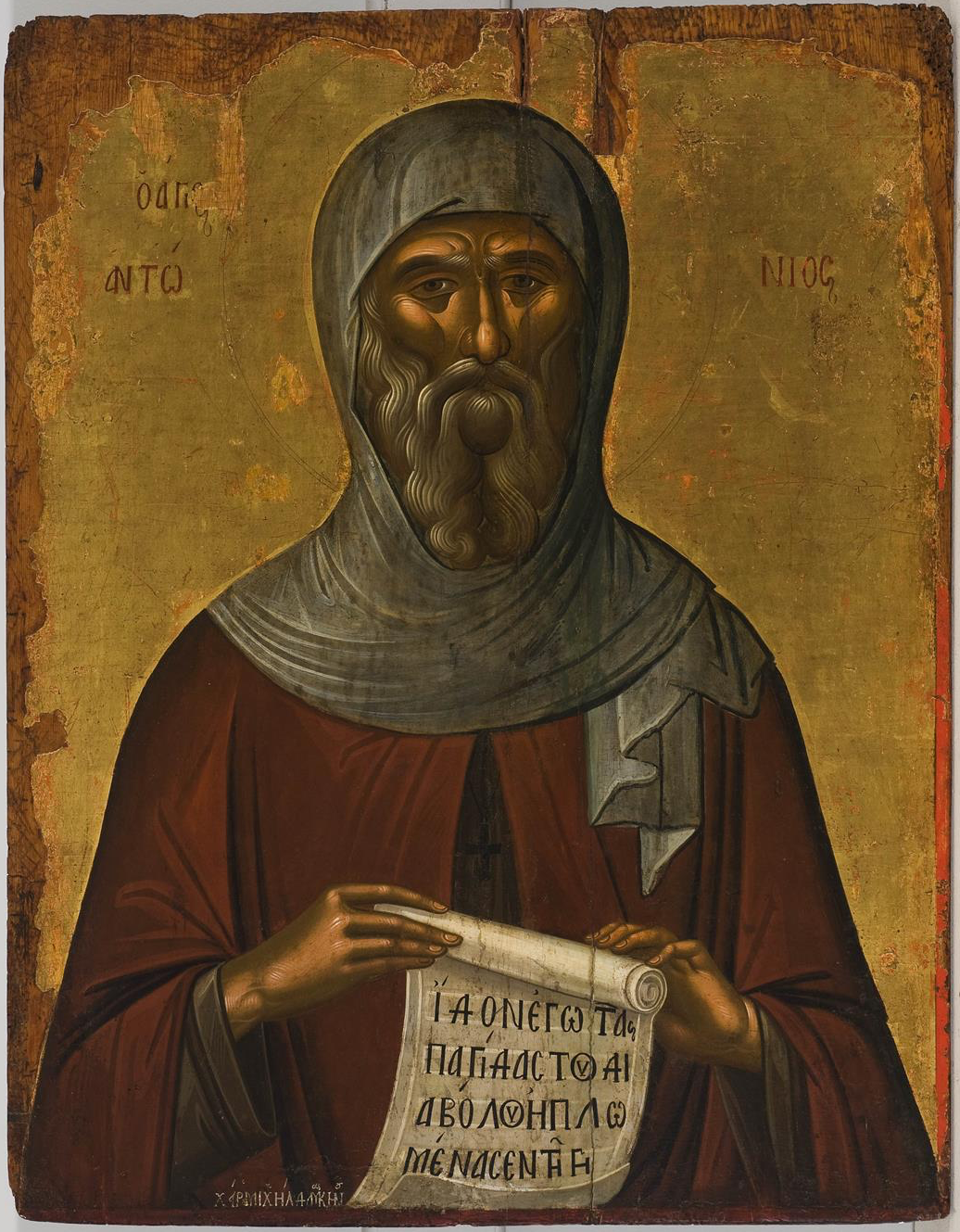
“I no longer fear God — I love him. For love casts out fear.”
— Antony the Great
Antony was born around 251 to a moderately wealthy Coptic Christian family in Coma, Upper Egypt. According to Athanasius's Life of Antony — written shortly after Antony's death and the foundational document of all later Christian monasticism — Antony was twenty when he walked into church and heard the Gospel read: "If thou wouldst be perfect, go, sell what thou hast, and give to the poor, and come, follow me" (Matthew 19:21). He took it as addressed to himself, sold his inheritance, settled his sister in a community of consecrated virgins, and went into the desert.
The Vita Antonii's literary structure tells the story in three phases of withdrawal. Antony first lived as an ascetic on the edge of his village under the direction of an elderly hermit. He then withdrew to the abandoned tombs outside the village. Finally, around 285, he crossed the Nile and lived in an abandoned Roman fort at Pispir for twenty years, never being seen by visitors who brought him bread. When he finally emerged in his fifties, the Life records that his body was "in the same condition as before, neither fatted from lack of exercise, nor emaciated from fasting," and his soul was unstained by the years alone. The miracle was the equilibrium.
The temptation accounts in the Life of Antony shaped centuries of Christian iconography — Hieronymus Bosch and Mathias Grünewald and a long line of Renaissance and Baroque painters returned again and again to the demonic apparitions Athanasius describes. The Coptic Christian tradition reads these as real demonic encounters; modern psychologically inclined readers as a deep account of the desert's effect on the human imagination. The Life leaves both readings open. Antony's response to the visions in the Vita is not exorcism but recognition: he refuses to be afraid, refuses to dignify the manifestations with debate, and turns back to prayer.
Antony emerged from his hermitage at intervals to encourage other Christians during the Diocletianic persecution, to support Athanasius against the Arians during the 4th-century theological crisis, and to engage in conversations with philosophers and emperors who sought him out. The Life records his death at age 105 in 356, attended by two faithful disciples. His tunic and the only two cloaks he had ever owned he sent as a final gift to Athanasius. The model — the solitary, ascetic, prayerful, theologically engaged, dead-to-the-world Christian — became, through Athanasius's Life, the prototype of every monastic life that followed: Eastern, Western, Coptic, Latin, Russian, Celtic, the whole lineage descends from one Egyptian man in a desert cave.
Sources & Further Reading
- Athanasius of Alexandria, Vita Antonii (c. 360 AD)
- Apophthegmata Patrum (Sayings of the Desert Fathers), Antony series
- Letters of St. Antony (seven letters, surviving in Coptic, Greek, Latin)