Evagrius Ponticus
The Theologian of the Desert
The theologian of the desert. A trained intellectual who left the bishop's court in Constantinople for the cells of Nitria and Kellia. Mapped the inner life as a battle with eight thoughts — the lineage that would become the seven deadly sins.
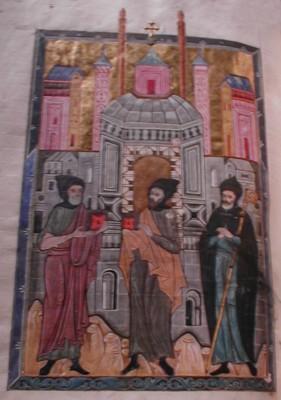
“A monk is one who is separated from all and united with all.”
— Evagrius Ponticus
Evagrius was born around 345 in Pontus (northern Asia Minor). He was educated by the great Cappadocian theologians — Basil the Great ordained him a reader, and Gregory of Nazianzus made him a deacon at the Council of Constantinople in 381. He served Gregory in the imperial city, was a rising star of the Constantinopolitan church, and might have been a bishop within a decade. Around 382, however, he fell into an entanglement with a married woman, fled the city in horror at his own attraction, and ended up in Jerusalem at the convent of Melania the Elder. She prescribed monasticism. He took the habit and went to Egypt.
Evagrius spent the last seventeen years of his life in the desert of Nitria and then the cells (Kellia) — the monastic complex deeper in the desert where Macarius the Great's tradition was still the living memory. He was the most educated man in the desert and immediately began to do what only an educated theologian could do: he wrote down what the desert was teaching. His Praktikos, a slim handbook for monks, is one of the most influential texts in the history of Christian spirituality.
Evagrius's greatest contribution was the doctrine of the eight thoughts (logismoi). He observed in the desert monks — and in himself — that the human soul is besieged by eight characteristic temptations: gluttony, lust, avarice, sadness, anger, sloth (or acedia — the spiritual weariness peculiar to the contemplative life), vainglory, and pride. Each thought he analyzed: how it presents itself, how it deceives, what scriptural texts can be used as antirrhesis (counter-words) to expel it. Through John Cassian, who studied with Evagrius's disciples and brought his teaching to the Latin West, the eight thoughts were transmitted to Gregory the Great, who consolidated them into the seven deadly sins. Every later Western treatment of the cardinal vices descends from Evagrius's analysis in a 4th-century Egyptian cell.
Evagrius's later theology incorporated certain Origenist speculations about the preexistence of souls and the eventual restoration of all rational beings. After his death, these views were condemned posthumously at the Second Council of Constantinople in 553 — and Evagrius's name was anathematized along with Origen's. His writings on the contemplative life nevertheless survived, sometimes under other names (some of his Greek works were preserved in Syriac and Armenian translation by communities outside the imperial church). The Eastern Orthodox tradition through the Philokalia and the Western tradition through Cassian both inherit his teaching on the eight thoughts, even when the man himself is not named.
Sources & Further Reading
- Evagrius, Praktikos (on the eight thoughts and the contemplative life)
- Evagrius, Chapters on Prayer (153 sentences on prayer)
- Evagrius, Antirrhetikos (on resisting the eight thoughts with scriptural texts)
- Palladius, Historia Lausiaca, ch. 38