Isaac the Syrian
Isaac of Nineveh
A 7th-century Church of the East monk-bishop who resigned his see after five months to live alone in the Persian mountains. His mystical homilies in Syriac were read by Coptic, Greek, Russian, and Ethiopian monks — and Dostoyevsky kept a copy beside his bed.
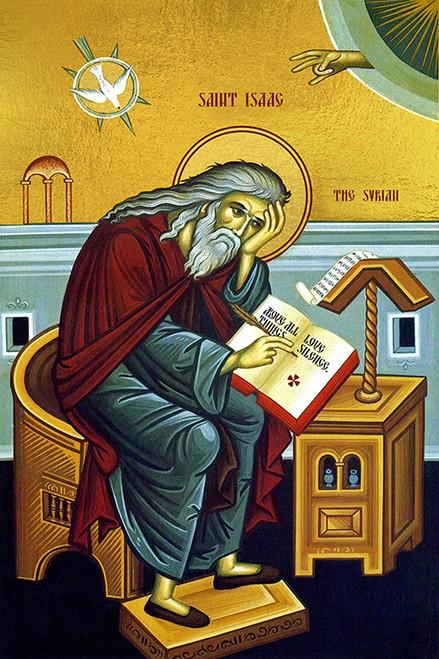
“Be at peace with your own soul, then heaven and earth will be at peace with you.”
— Isaac the Syrian
Isaac was born in the Beth Qatraye region of the Persian Gulf (modern eastern Arabia and Qatar) in the early 7th century and entered monastic life in the Church of the East — the so-called Nestorian church, in communion with neither Constantinople nor Rome. He was educated in Syriac and Greek patristic theology and rose to prominence as a monastic writer. Around 676, the Catholicos George I of the Church of the East ordained him bishop of Nineveh (near modern Mosul in Iraq). Isaac held the see for five months before requesting release on the grounds that the duties of episcopal administration were incompatible with the contemplative life he had been pursuing. The Catholicos accepted his resignation. Isaac withdrew to Mount Matout in Khuzestan, where he spent the rest of his life as a solitary, ultimately going blind in his old age and dictating his writings to disciples.
Isaac wrote in Syriac and in a style of immense pastoral patience and theological depth. His Ascetical Homilies — the First Part of which has been known to the wider Christian world since the 9th-century Greek translation made by the Sabaite monks Patrikios and Abramios — treat the entire spectrum of the inner life: the stages of repentance, the experience of compunction, the warfare of the passions, the discernment of thoughts, the gift of tears, the silence of the heart, and finally the experience of "wonder" (Syriac tehra) in which the mind is taken up beyond words into the love of God. Where Evagrius had given the desert a logical taxonomy of the eight thoughts, Isaac gave it a phenomenology of the mystical life that would shape Eastern Christian spirituality from the Sinai of John Climacus to the Hesychasm of Gregory Palamas to the Russian staretz tradition.
Isaac's most distinctive theological contribution is his teaching on the love of God. He insists, against any view of God's wrath that would compromise the absolute character of divine love, that there is no element of vengeance in God's relation to creation. The pains of hell, in Isaac's reading, are the sufferings of the divine love striking against creatures who have made themselves incapable of receiving it — "those who suffer from the scourge of love." Some of Isaac's apparent sympathies with universalist hopes for the eventual reconciliation of all things (apokatastasis) have made him controversial in some Orthodox circles, while making him a particular favorite in others. The Second Part of his homilies — discovered in a Bodleian Library manuscript by Sebastian Brock in 1983 and edited from the original Syriac — confirmed the universalist tendency more sharply than the Greek tradition had preserved.
Isaac's writings crossed every confessional border in the Christian East. The Greek translation was read in Byzantine and Athonite monasteries. The Slavic translation, made from the Greek at Mount Athos in the 14th century, became the staple of Russian monastic spirituality — Dostoyevsky kept Isaac the Syrian on his desk while writing The Brothers Karamazov, and Father Zosima's monastic teachings are sprinkled with Isaac's vocabulary. An Arabic translation circulated in the Coptic and Melkite churches. An Ethiopic translation, made from the Arabic, gave Isaac to the Ethiopian monastic tradition. A Latin translation produced in 15th-century Italy gave him to the Catholic West. A man who resigned a bishopric after five months and lived in a Persian mountain cave became, by his writings alone, perhaps the most ecumenically read mystical theologian of the first Christian millennium.
Sources & Further Reading
- Isaac the Syrian, Ascetical Homilies (First Part, surviving in Syriac; Greek translation 9th c. by monks of Mar Saba)
- Isaac the Syrian, Second Part (discovered by Sebastian Brock in a Bodleian manuscript in 1983)
- Ishodnah of Basra, Book of Chastity (9th c.) — earliest biographical notice
- The Philokalia (Greek tradition) — selections from the Ascetical Homilies