John Cassian
Bridge from the Desert to the West
The bridge from the Egyptian desert to the Latin West. Spent fifteen years among the abbas of Nitria and Scetis, then wrote the Institutes and Conferences — the books Benedict commanded his monks to read.
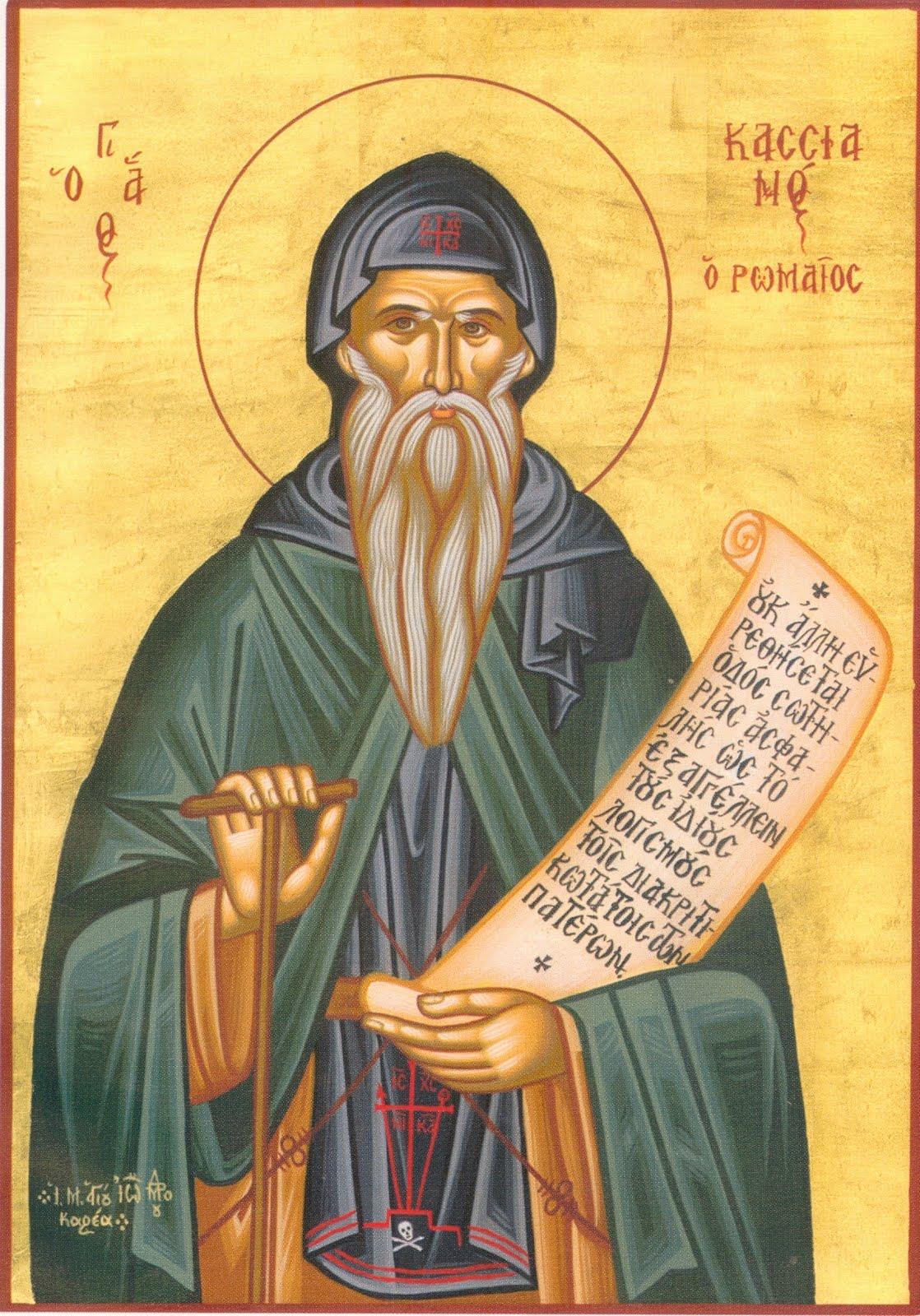
“Whatever the mind has been thinking about before the time of prayer is bound to come back to it during prayer.”
— John Cassian
John Cassian was born around 360 in a Latin-speaking region (probably Scythia Minor, modern Romania). As a young man he and his friend Germanus traveled to Bethlehem to enter monastic life there. After a few years they were given permission to visit Egypt — the great fountainhead of monastic experience — and spent the next fifteen years among the abbas of Nitria and Scetis, recording their conversations and absorbing their practice.
The Egyptian sojourn was interrupted around 399 by the First Origenist Controversy, when Theophilus of Alexandria expelled the Origenist monks (including Evagrius's disciples) from the desert. Cassian, who had absorbed much of Evagrius's teaching, left Egypt and made his way through Constantinople (where he was ordained by John Chrysostom) to Rome and finally to Marseille around 415, where he founded two monasteries — one for men and one for women — and lived out the rest of his life.
The two great Latin works Cassian produced at Marseille — the Institutes (twelve books on monastic practice and the eight thoughts) and the Conferences (twenty-four dialogues with Egyptian abbas on the inner life) — are the canonical transmission of Egyptian monastic teaching to the Latin West. Through them, the desert's wisdom on prayer, the eight thoughts, the discernment of spirits, the role of solitude, and the structure of community life became available to Western readers who would never see Egypt themselves. The Rule of Benedict, the foundational text of Western monasticism, ends with the explicit instruction to read "the Conferences and the Institutes of our holy Fathers" (RB 73:5) — naming Cassian directly.
Cassian's theology of grace involved him in one of the great controversies of the 5th century. He resisted what he understood as the more extreme implications of Augustine's later doctrine of grace, particularly the doctrine of irresistible grace and absolute predestination. His Conference 13, on the relationship between grace and free will, was attacked by Prosper of Aquitaine as "Semi-Pelagian" (the label is later) and the position was condemned at the Second Council of Orange in 529. The Latin Church thereafter held Cassian's monastic writings in the highest regard while quietly setting aside Conference 13 — preserving the wisdom of the desert without the theology of grace that came with it.
Sources & Further Reading
- Cassian, Institutes of the Coenobia (Latin, c. 420)
- Cassian, Conferences (24 dialogues with Egyptian abbas, Latin, c. 420–429)
- Gennadius, De Viris Illustribus 62
- Rule of Benedict 73:5 — "the Conferences and the Institutes of our Fathers"