Macarius the Great
The Lamp of the Desert
Founder of the monastic settlements at Scetis — the desert valley that produced more of the Apophthegmata than any other place. A pastor of monks who balanced solitude with weekly common life and shaped Eastern spirituality for centuries.
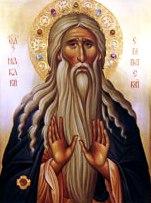
“If you keep your soul guarded against external thoughts, you will see the Lord within you.”
— Macarius the Great
Macarius the Great (also called Macarius of Egypt or Macarius the Lamp) was born around 300 in a small Egyptian village. He spent his early adult years as a camel-driver and was ordained a village reader before withdrawing to the desert. Around 330 he settled at Scetis (the modern Wadi el-Natrun, between Cairo and Alexandria), where over the following decades a vast community of solitary cells grew up around him. By the late 4th century, Scetis had become the great center of Egyptian semi-eremitic monasticism — the model that would shape Eastern Christian monasticism more profoundly than Pachomian cenobitism.
The semi-eremitic pattern Macarius established was a deliberate middle way between Antony's solitude and Pachomius's full community. Each brother lived alone in his cell, six days of the week given to prayer, manual labor, and silence. On Saturday evenings the brothers gathered for the all-night vigil and the eucharistic liturgy on Sunday morning. The pattern preserved the depth of solitude while preventing the isolation from becoming spiritually destructive — a brother could be "hidden" most of the time and yet be known and loved by his community when he emerged.
Macarius's Apophthegmata are among the most extensive in the collection. They are concrete, often paradoxical, frequently funny. A brother asks Macarius what is required to be saved. Macarius answers: "Flee from men." The brother asks what fleeing from men means. Macarius answers: "Sit in your cell and weep for your sins." Another saying: a brother weighed down by anger comes to Macarius and asks how he should respond to a particular offense. Macarius hands him a stick and tells him to go beat the dead in the graveyard and report back. The brother does so, and the dead, naturally, do not respond. "Such must you become," Macarius tells him, "toward both insults and praise."
The corpus of Pseudo-Macarian Homilies — fifty extended sermons that circulated under Macarius's name from the 5th century onward — was almost certainly composed not by Macarius the Great but by a 5th-century Syrian author with Messalian tendencies. The homilies were nevertheless enormously influential on later Christian mystical theology — read by John Wesley in 18th-century England, by Russian Orthodox spirituality (through the Philokalia), and by Pietist German Protestantism. The historical Macarius and the literary tradition that grew up around his name together exercised a vast influence on the shape of Christian inwardness in the centuries that followed.
Sources & Further Reading
- Palladius, Historia Lausiaca (c. 419) — extended treatment of Macarius
- Apophthegmata Patrum, Macarius series (one of the longest in the collection)
- Pseudo-Macarian Homilies (Spiritual Homilies, attributed to Macarius, 4th–5th c.)