Mary of Egypt
The Penitent of the Wilderness
A converted prostitute who spent 47 years alone in the trans-Jordan desert. The Life of Mary of Egypt, attributed to Sophronius, became one of the most beloved hagiographies of the Eastern Church.
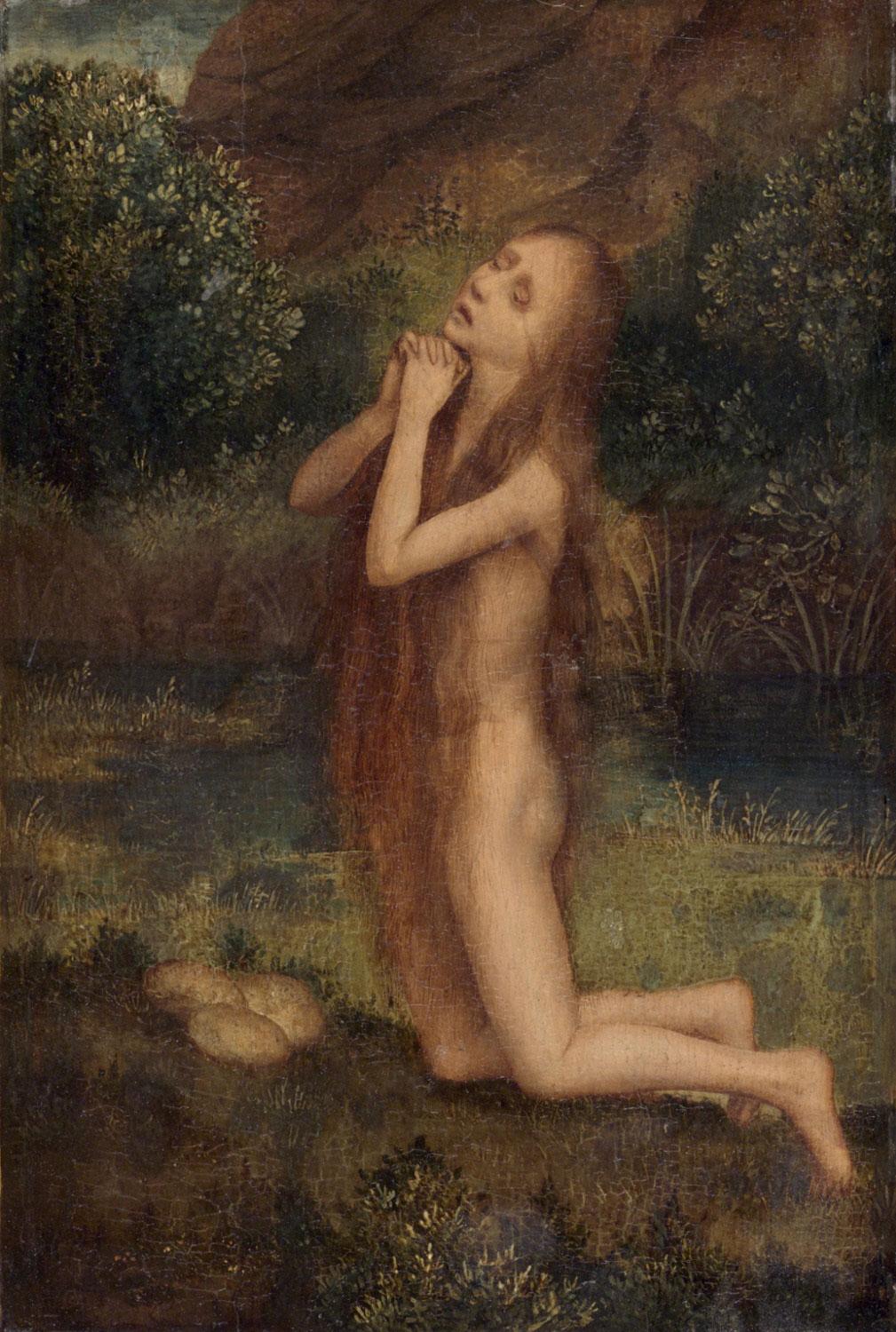
“I shed bitter tears, and stretched out my hands to her who is in truth the Mother of God.”
— Mary of Egypt
Mary's story comes to us almost entirely through one source — the Life of St. Mary of Egypt, attributed to Sophronius, Patriarch of Jerusalem in the early 7th century. Whether the Life records a real woman or a literary composite, its theological power is independent of the question. As Sophronius tells it, Mary was an Alexandrian — born around 344, fled to the city at twelve, and lived for the next seventeen years as what she herself, in her later confession, calls "a public temptation." She did not, she insisted, accept money for her sexual relationships — she sought partners for pleasure alone. The distinction matters: she was not driven to her life by poverty but had chosen it freely.
The conversion came on a pilgrim ship bound for Jerusalem. Mary, hearing of the journey, decided to go along — partly out of curiosity, partly to find sexual partners among the pilgrims. In Jerusalem on the feast of the Exaltation of the Holy Cross, she went with the crowd to enter the Church of the Holy Sepulchre. At the threshold she was thrown back by an invisible force. The crowd flowed past her. She tried again. She was thrown back again. Standing alone, she suddenly understood that her body itself was barred from the holy place by what she had done with it. She wept, looked at an icon of the Theotokos in the church porch, and prayed for permission to enter and for the strength to renounce her life. The Life records her crossing the threshold the next morning, venerating the True Cross, and walking out of the city eastward across the Jordan into the desert.
Mary lived alone in the trans-Jordan wilderness for forty-seven years. She told her story, only at the very end of her life, to a single witness — the monk Zosimas, who encountered her by accident during his Lenten solitude. By that time her clothes had rotted off and her body had been burned dark by the sun. She knew the Scriptures by heart although she had been illiterate at her conversion; the Life accounts for this by recording that she had received the gift of understanding in her years of prayer. She begged Zosimas to bring her communion the following Holy Thursday and meet her again at the same place the year after that, returning two more times to test her perseverance and her humility.
Zosimas came on Holy Thursday with the reserved sacrament. Mary received communion and asked him to come back the following year. When he returned a year later, he found her body lying near a stream, perfectly preserved, with an inscription scratched into the sand beside her requesting his prayers and naming her date of death. A lion came out of the desert and helped Zosimas dig her grave. The story has been read in every Orthodox church on the fifth Sunday of Great Lent for over a thousand years. Whatever historical kernel lies under the Life, what the Church has preserved in Mary of Egypt is a theology of conversion so absolute that it became iconic — the literal embodiment of repentance unto the desert.
Sources & Further Reading
- Sophronius of Jerusalem, Life of St. Mary of Egypt (c. 600 AD)
- Apophthegmata Patrum (some traditions, though her main hagiography is Sophronius)