Moses the Black
Moses the Ethiopian
An Ethiopian slave who became a murderous bandit chief, then a desert monk at Scetis, then one of its most beloved abbas. Martyred at seventy-five in a Berber raid he forbade his brothers to defend against — "all who take up the sword shall die by the sword."
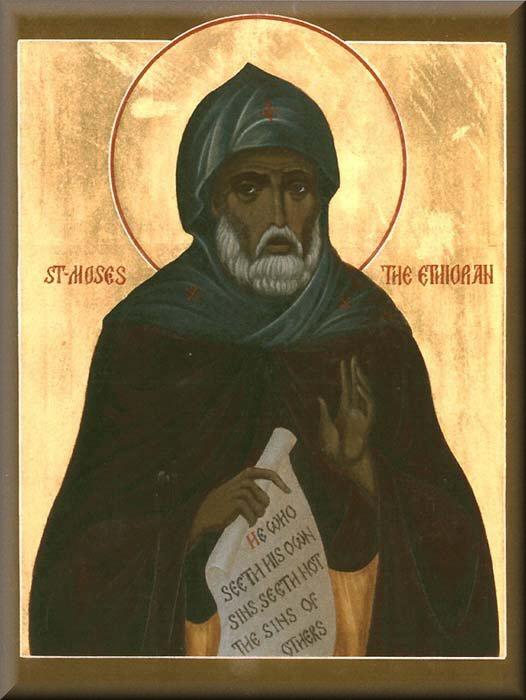
“If a brother sins and you do not feel ashamed because of him, neither will God forgive you.”
— Moses the Black
Moses was born around 330, almost certainly in the territory of the Nile kingdom of Nubia (the Coptic tradition identifies him as Ethiopian, the common Late Antique term for sub-Saharan Africans). He was sold into slavery in the household of an Egyptian official, dismissed for theft and probably for involvement in murder, and became the leader of a gang of seventy-five bandits in the Nile Delta. Sozomen records that he was a man of enormous physical size and strength who terrorized travelers on the road from Egypt to Libya. The sources do not agree on what produced his conversion — Sozomen attributes it to a near-encounter with the law that pushed him into hiding among the monks at Scetis; Palladius to a direct experience of repentance. Both agree on the outcome. Around his early thirties, the bandit chief Moses settled in the cells of Wadi el-Natrun and submitted to a life of obedience under the abbas of Scetis.
The Apophthegmata preserve more sayings of Abba Moses than of almost any other desert father, and they form a distinctive body of monastic literature within the collection — partly because Moses's enormous physical presence and notorious past gave every story he told the weight of personal authority, and partly because his sayings exhibit a tenderness toward fellow sinners that is unmistakable. The most famous saying is the story of the elder council. A brother had fallen into sin, and the brothers of Scetis convened to judge him. Abba Moses was asked to attend. He came to the meeting carrying a basket full of sand on his back, with the sand pouring out behind him through holes in the basket. The brothers asked what he was doing. "My sins are running out behind me," he answered, "and I do not see them, and I have come today to judge the sins of another." The brother was forgiven.
Moses's enormous size also became material for the sayings. Once at a celebration in church, the priest tried to humiliate him publicly by ordering him to leave the sanctuary because of his black skin. Moses left without protest, weeping, and said only: "They have done well, you of the ash-colored skin, you of the dark color — for you are not a man." The priest later acknowledged his fault, and the Coptic tradition has read the story since as one of the great early Christian rebukes of racial prejudice — without minimizing the genuine wound of the moment for Moses himself.
Around 405, when Moses was approximately seventy-five years old, a band of Berber raiders attacked the monastery of Scetis. Moses had received warning of the attack and was urged by his brothers to flee or to organize a defense. He refused both. "All who take up the sword shall die by the sword," he told them — quoting Christ's words to Peter in Gethsemane. He gathered his closest disciples in his cell and waited. The raiders entered the cell and killed him along with six of his brothers. One disciple who hid survived to tell the story. Moses was buried at Scetis. The Monastery of Saint Moses the Black at Wadi el-Natrun still stands today and preserves his relics. He is venerated as a martyr by the Coptic Orthodox Church on 24 Pa'oni, by the Eastern Orthodox tradition on August 28, and by African-American Christians of every confession as one of the great early African saints — a former criminal made into a desert father, and a desert father made into a martyr of nonviolence.
Sources & Further Reading
- Apophthegmata Patrum, Moses series (one of the most quoted sets in the collection)
- Palladius, Historia Lausiaca, ch. 19
- Sozomen, Ecclesiastical History VI.29
- Coptic Synaxarium, 24 Pa'oni