Pachomius the Great
Father of Cenobitic Monasticism
Father of cenobitic monasticism. Where Antony lived alone, Pachomius gathered men into community under a written rule. The first Christian monastery — the template for Benedict, the Rule of the Master, and every later religious community.
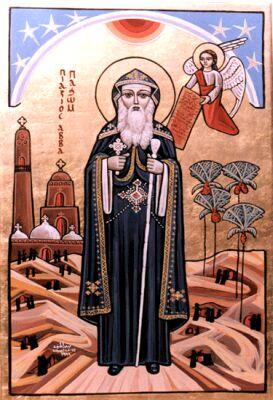
“Conform yourself to the Gospel, not to the customs of men.”
— Pachomius the Great
Pachomius was conscripted into the Roman army as a young man around 312, and during his deployment was kept in a prison cell that local Christians supplied with food. He had never heard of Christ. The kindness of the Christians astonished him, and he converted on his release. He spent the next seven years as a hermit-disciple under an elder named Palamon, learning the eremitic life that Antony had pioneered.
Around 320, while praying at the abandoned village of Tabennisi on the Nile, Pachomius received what the Life of Pachomius describes as a divine summons to gather men into a common life. He responded by building cells, accepting brothers who came to him, and writing a rule that ordered every hour of the day. By the time of his death in 348 he had founded nine men's monasteries and two women's, with a total population estimated at three to seven thousand.
The Pachomian Rule — the earliest surviving Christian monastic rule — established the structural features that all later communities would inherit. Common meals at fixed times. Common prayer at fixed hours. Manual labor allocated to each brother (weaving palm-leaf mats, making baskets, copying manuscripts). Universal obedience to the superior. A novitiate before admission. Distinctive monastic dress. The whole community organized into "houses" of about 30–40 men, each with its own master, and the houses gathered together as the "monastery," all gathered under the abba. The brothers ate in silence, slept in cells, and traveled in pairs when sent out on errands. Every detail that would later be associated with the monastic life was already, in skeleton form, in Pachomius's rule.
Jerome translated the Praecepta into Latin in 404 — at the request of a delegation of Latin-speaking pilgrims who wanted Pachomian discipline in their own monastic foundations. Through Jerome's translation, the Pachomian Rule shaped John Cassian's Institutes, the Rule of the Master, and ultimately the Rule of Benedict (early 6th c.). When Benedict tells his monks to read "the Rule of our holy father Basil" and to imitate "the Lives of the Fathers," he is naming the Pachomian heritage directly. The man who built a community in the Nile flood plain in the early 4th century is the structural ancestor of every Catholic, Orthodox, and Anglican religious order in the world today.
Sources & Further Reading
- Pachomian Koinonia I–III (Life of Pachomius, Bohairic, Sahidic, and Greek versions)
- The Rule of Pachomius (Praecepta, surviving in Latin in Jerome's translation, 404)
- Apophthegmata Patrum, Pachomius series