Aimee Semple McPherson
Sister Aimee, Foursquare Founder
Canadian farm girl who became the first major woman evangelist of the radio age. Founded the Foursquare Gospel Church in 1923, built the 5,300-seat Angelus Temple in Los Angeles, and made Pentecostal Christianity a feature of American mass culture.
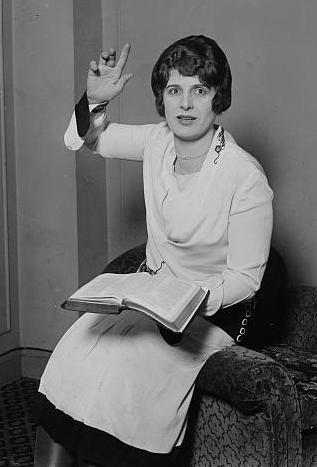
Aimee Elizabeth Kennedy was born on October 9, 1890, on a farm near Salford, Ontario, to a Salvation Army mother and a Methodist father. She was converted at age seventeen under the preaching of the Irish Pentecostal evangelist Robert Semple, married him at eighteen, and sailed with him to China as a missionary in 1910. Robert died of malaria in Hong Kong three months after their arrival; Aimee returned to the United States with their infant daughter Roberta, married a businessman named Harold McPherson, gave birth to a son Rolf, and by 1915 had decided that the only thing that would save her from spiritual collapse was a return to the preaching ministry her first husband had given her. She left McPherson — they were eventually divorced — and began an itinerant evangelistic ministry up and down the Atlantic coast.
By 1918 she had reached Los Angeles in a 1912 Packard touring car she called her "Gospel Car," with her mother Minnie Kennedy as business manager and her two young children in the back seat. She held her first major Los Angeles meeting at Victoria Hall, then at increasingly large venues across the country: a five-week revival in San Diego in 1921, the Denver Auditorium in 1922, the Spreckels Organ Pavilion in San Diego again with crowds of 30,000. Her preaching was theatrical, accessible, and decisively Pentecostal — divine healing, the baptism in the Holy Spirit, and a personal, urgent altar call. By 1922 she was one of the most famous evangelists in America and the first major woman in that role since Phoebe Palmer.
The Foursquare Gospel Church was born in McPherson's 1922 Oakland sermon on Ezekiel's vision of the four living creatures (Ezekiel 1). The four faces — the lion, the man, the ox, the eagle — McPherson read as the four offices of Christ: Savior, Baptizer in the Holy Spirit, Healer, and Coming King. The name stuck. The denomination was formally organized as the International Church of the Foursquare Gospel in 1927, with headquarters at the newly completed Angelus Temple in the Echo Park neighborhood of Los Angeles. The Angelus Temple — a 5,300-seat sanctuary on a 22,500-square-foot rotunda, built for $1.5 million and dedicated on January 1, 1923 — was for decades the largest single congregation in North America. McPherson staged illustrated sermons there in full theatrical costume, broadcast services on her radio station KFSG (the third licensed radio station in Los Angeles and the first owned by a church), trained ministers at L.I.F.E. Bible College, and operated a 24-hour soup kitchen that fed more than 1.5 million people through the Great Depression.
McPherson's life was bracketed by tabloid controversy. In May 1926 she vanished from a Santa Monica beach and was assumed drowned; she reappeared in Douglas, Arizona five weeks later with a story of kidnapping that the Los Angeles district attorney Asa Keyes did not believe. A grand jury hearing in the summer and autumn of 1926 was eventually dropped, but the affair never fully left her public reputation. A third marriage in 1931 to David Hutton ended in divorce in 1934. Through it all the Foursquare Church continued to grow — by McPherson's death in 1944 it had over 400 congregations and 200 mission stations worldwide.
McPherson died on September 27, 1944, in an Oakland hotel room from an apparently accidental overdose of barbiturates. The Foursquare Church was led after her death by her son Rolf McPherson for the next 44 years and has continued to grow into a global Pentecostal body of approximately 9 million adherents in over 150 countries. Her legacy is contested in the way the legacies of pioneering women in male-dominated traditions usually are — she was theologically conservative but ecclesiastically radical, a tabloid celebrity who genuinely fed the poor, a woman who built one of the largest religious institutions in 20th-century America while being told repeatedly that she should not be doing so. She remains the first major woman to found and lead an American Christian denomination, and the principal reason that Pentecostal Christianity entered the mass-cultural mainstream of the 1920s and 1930s.
Key Works
- This Is That: Personal Experiences, Sermons and Writings of Aimee Semple McPherson (1919, revised 1923)
- In the Service of the King (1927) — autobiography
- The Foursquare Hymnal (1957, posthumous; based on her hymn selections)
- The Bridal Call (magazine, 1917–1944) and Foursquare Crusader (1925–1944)
- Operatic-style sacred dramas staged at the Angelus Temple (over 150 illustrated sermons)
Further Reading
- Daniel Mark Epstein, Sister Aimee: The Life of Aimee Semple McPherson (1993)
- Matthew Avery Sutton, Aimee Semple McPherson and the Resurrection of Christian America (2007)
- Edith Blumhofer, Aimee Semple McPherson: Everybody's Sister (1993)