Chuck Smith
Pastor of the Jesus Movement
Ventura pastor who opened the doors of a small Costa Mesa church to the hippies of the Jesus Movement in the late 1960s. From Calvary Chapel Costa Mesa came verse-by-verse expository teaching, contemporary worship music (Maranatha! Music), and a network of approximately 1,800 affiliated churches worldwide by 2013.
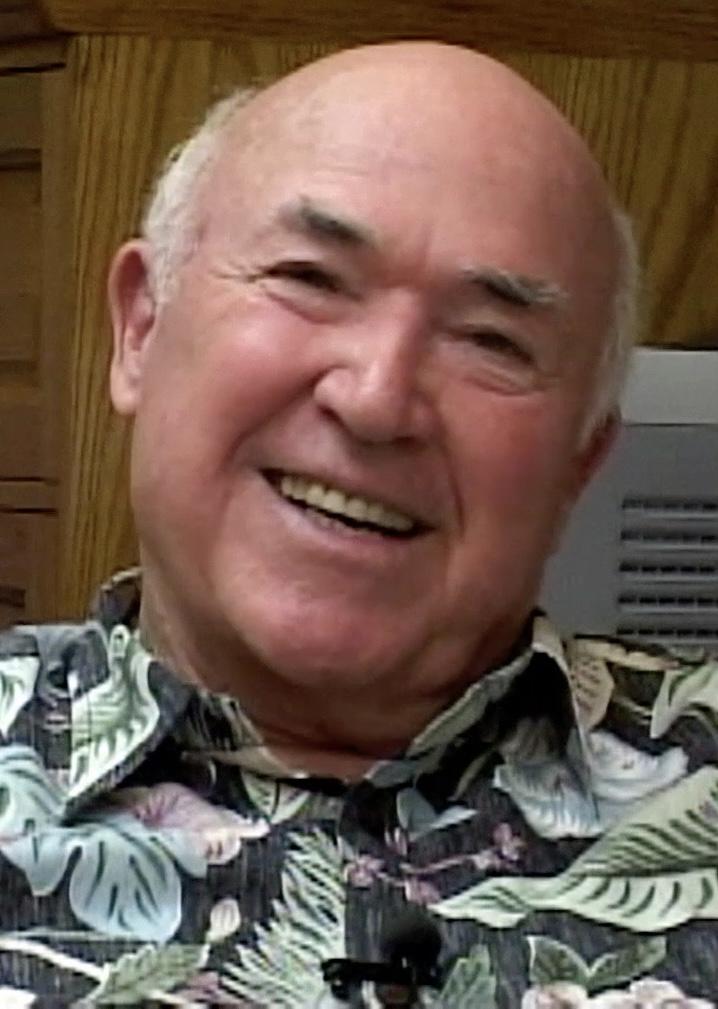
Charles Ward Smith was born in Ventura, California, on June 25, 1927, the son of devout members of the International Church of the Foursquare Gospel — the Pentecostal denomination Aimee Semple McPherson had founded four years earlier. He was educated at L.I.F.E. Bible College (now Life Pacific University) in Los Angeles, McPherson's training school, and was ordained as a Foursquare minister in 1948. He spent the next seventeen years pastoring small Foursquare congregations in California and Arizona, growing increasingly restless with what he experienced as an over-organized, denominationally-bureaucratic ministry. In 1965, at the age of thirty-eight, he resigned from the Foursquare denomination and accepted a call to a struggling independent congregation of approximately twenty-five people called Calvary Chapel in Costa Mesa, California.
The first three years at Calvary Chapel were quiet growth driven by Smith's distinctive teaching method — verse-by-verse expository preaching through entire books of the Bible, in an accessible conversational register, often with a guitar-led song service in place of the traditional Foursquare worship structure. The decisive turn came in 1968 when Smith's daughter Janette brought home a young, long-haired, recently-converted hippie named John Higgins. Smith's first instinct was suspicion; his second, after a conversation with Higgins, was hospitality. He and his wife Kay opened the church and eventually their home to the Southern California hippie and surf culture that had been swept by the early stirrings of the Jesus Movement. By 1971 Calvary Chapel Costa Mesa was baptizing thousands of converts in the Pacific Ocean off Corona del Mar beach. By 1972, when Time magazine ran its famous "Jesus Revolution" cover story (June 21, 1971), Calvary Chapel had become the most visible institutional center of the Jesus Movement in the United States.
The Calvary Chapel distinctives that emerged from those years became the template for thousands of subsequent churches. Verse-by-verse expository teaching through whole books of Scripture was the structural backbone — Smith taught through the entire Bible repeatedly over his ministry, and his Through the Bible radio teaching series (broadcast continuously since the 1970s on his Calvary-affiliated K-Wave radio network and via Calvary Chapel's broadcasting arm) became one of the most widely-distributed bodies of expository preaching in American Christianity. Worship was contemporary — Maranatha! Music, founded at Calvary Chapel Costa Mesa in 1971, gave the Jesus Movement its musical voice and effectively created the contemporary Christian music industry; bands and artists associated with the early Maranatha! catalogue (the Maranatha! Singers, Love Song, Children of the Day, Karen Lafferty) shaped what is now the standard Sunday-morning worship idiom across non-denominational Protestantism. Church government was simple: a senior pastor with a board of elders, autonomous of any denominational hierarchy.
Calvary Chapel's theological identity was deliberately minimalist. Smith taught from a broadly evangelical position: the inerrancy of Scripture, the deity and bodily resurrection of Christ, salvation by grace through faith, the priesthood of all believers, and a pretribulational premillennial eschatology that Smith taught with particular vigor (his 1978 prediction that the rapture would occur around 1981 — based on Hal Lindsey's reading of Matthew 24:32–34 and the founding of modern Israel in 1948 — was one of the few specific eschatological statements Smith later publicly acknowledged as a mistake). On the spiritual gifts Smith was a measured charismatic — he believed in and practiced the gifts, but published Charisma vs. Charismania in 1983 to draw a deliberate line between Calvary Chapel and what he saw as the excesses of certain charismatic and Word-of-Faith ministries.
By 2013 the Calvary Chapel Association numbered approximately 1,800 affiliated churches worldwide, with major concentrations in California, the western United States, and growing networks in Latin America, the United Kingdom, Eastern Europe, and the Pacific Rim. Smith led the mother church at Costa Mesa for forty-eight years — from 1965 until his death from lung cancer on October 3, 2013, at the age of eighty-six. His funeral filled the 2,300-seat Costa Mesa sanctuary and overflow venues for several services. The institutional shape of contemporary American non-denominationalism — the megachurch with a senior pastor, verse-by-verse expository preaching, contemporary worship, anti-denominational ecclesiology, and Spirit-receptive but not Pentecostal-identified culture — owes more to Chuck Smith than to any other single 20th-century figure. Through the Vineyard movement (which broke from Calvary Chapel under John Wimber in the early 1980s), through the seeker-sensitive megachurches that learned from Calvary Chapel's example, and through the thousands of independent congregations that emerged in its wake, Smith's Costa Mesa ministry reshaped American Protestantism more thoroughly than any denominational leader of his generation.
Key Works
- Through the Bible (radio teaching series) — thousands of hours of expository sermons aired through Calvary Chapel Magazine and the K-Wave radio network
- Calvary Chapel Distinctives (1996) — the closest thing to a Calvary Chapel confession
- Charisma vs. Charismania (1983) — his measured engagement with the charismatic movement
- The Final Curtain (1989) — eschatology
- Living Water (1996) — exposition of John 7
Further Reading
- Chuck Smith Jr. & Tal Brooke, Harvest (1987) — early account of the Jesus Movement and Calvary Chapel
- Larry Eskridge, God's Forever Family: The Jesus People Movement in America (2013)
- Donald E. Miller, Reinventing American Protestantism: Christianity in the New Millennium (1997) — Calvary Chapel as a new-paradigm church