Ellen G. White
Prophetess of the Adventist Movement
The visionary and primary theological architect of the Seventh-day Adventist Church. Across seventy years she received ~2,000 visions, wrote 40+ books and roughly 5,000 articles, and shaped the church's distinctive doctrines on the Sabbath, the heavenly sanctuary, health reform, and education.
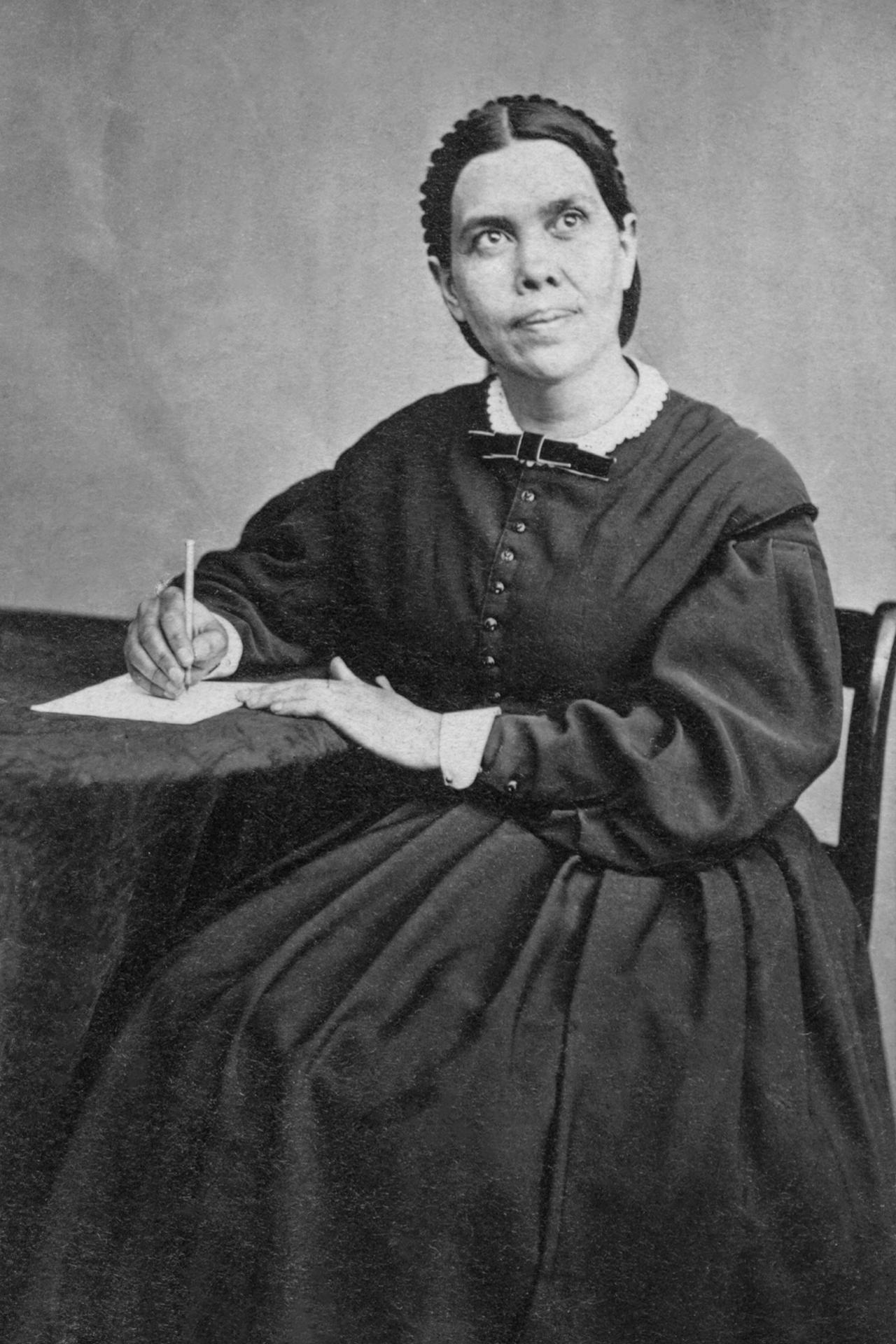
Ellen Gould Harmon was born on November 26, 1827, in Gorham, Maine, the youngest of eight children of a hat-maker named Robert Harmon and his wife Eunice. At age nine she was struck in the face by a stone thrown by a classmate; the injury permanently disfigured her, ended her formal schooling, and left her in fragile health for the rest of her life. She and her family came under the influence of Millerite preaching in the early 1840s, accepted the doctrine of the imminent return of Christ, and shared in the Great Disappointment of October 22, 1844. In December 1844, when she was seventeen, Ellen Harmon received her first vision while praying with four other Adventist women in South Portland, Maine — a vision of the Adventist people walking on a path lit from behind toward the New Jerusalem, with those who looked away falling into the darkness below. She would receive what Adventists count as approximately 2,000 such visions over the next seventy years.
She married James White, a young Adventist preacher and editor, in August 1846. The two were married for thirty-five years until James's death in 1881. Together they were the principal organizers of the Sabbatarian Adventist movement: James edited the Advent Review and Sabbath Herald (founded 1850), traveled and raised funds across the eastern United States, and chaired the General Conference when it was organized in 1863; Ellen received and recorded the visions, wrote constantly, and provided the prophetic authority that distinguished Seventh-day Adventism from the dozen other Millerite splinter movements. Joseph Bates, a former sea captain and Seventh Day Baptist who had come to Sabbatarian conviction independently, persuaded the Whites of the Saturday Sabbath in 1846, and Ellen received confirming visions shortly afterward. The three pillars of distinctive Adventism — the Saturday Sabbath, the heavenly-sanctuary doctrine, and the prophetic gift of Ellen White — were locked into place by 1850.
Ellen White's vision of June 6, 1863, on health reform — received at the home of Aaron Hilliard in Otsego, Michigan — initiated the strand of her work that would have the broadest cultural influence. She wrote against pork, tobacco, alcohol, tea, coffee, and the heavy meat-based diet typical of mid-19th-century America, and in favor of vegetarianism, water cures, fresh air, exercise, and natural healing. The Western Health Reform Institute opened in Battle Creek in 1866; renamed the Battle Creek Sanitarium under John Harvey Kellogg's leadership in 1876, it became the most famous health-reform institution in the United States in the late 19th century, and its kitchen — designed to produce palatable meatless food — gave the world corn flakes, granola, peanut butter as a commercial product, and the modern breakfast-cereal industry. The Loma Linda University Medical Center in California (founded 1905 at White's direction) became one of the world's leading Adventist hospitals; the Adventist healthcare network worldwide now operates hundreds of hospitals and clinics, and Adventist health practices have been studied by epidemiologists as the basis for one of the longest-lived demographic groups in the United States.
The Great Controversy (1888, expansively revised 1911) is White's theological magnum opus — a roughly 700-page sweep through 1,400 years of church history from Christ to the eschaton, organized around the cosmic struggle between Christ and Satan. The book gives Adventists their distinctive historicist reading of Revelation and the prophetic role of the papacy; it remains the single most widely distributed religious book in Adventist history (estimated at over 100 million copies in over 150 languages). The Desire of Ages (1898) and Steps to Christ (1892) are her devotional works on the life and saving work of Christ — texts that contemporary Adventists read alongside Scripture as devotional aids and that have shaped Adventist Christology in a Christ-centered direction more often associated with evangelicalism than with the apocalyptic strand of Millerite thought.
White's reputation outside Adventism has always been contested. She was accused in her lifetime — and the accusations have continued since — of unacknowledged use of source material in her historical and devotional writing (a 1980 study by Walter Rea, The White Lie, made the most thorough case; the church's response has been to acknowledge substantial use of secondary sources while denying the implication of dishonesty). Adventists today hold that her writings have a real but "lesser light" prophetic authority subordinate to Scripture, that they speak with applied counsel rather than original doctrine, and that they are properly read alongside Scripture rather than as a substitute for it. She lived for the last twelve years of her life at Elmshaven, her home near St. Helena, California, and died there on July 16, 1915, at the age of eighty-seven. The Adventist Church she had helped found numbered approximately 136,000 members at her death; it numbers approximately 22 million today.
Key Works
- The Great Controversy (1888, revised 1911) — the magnum opus of Adventist prophetic-historical theology
- Steps to Christ (1892)
- The Desire of Ages (1898) — her devotional life of Christ
- Christ's Object Lessons (1900)
- Testimonies for the Church (9 volumes, 1855–1909)
- The Ministry of Healing (1905) — the consolidated Adventist health-reform manual
Further Reading
- Arthur L. White (her grandson), Ellen G. White: A Biography (6 vols., 1981–1986)
- George R. Knight, Walking with Ellen White (1999)
- Ronald Numbers, Prophetess of Health: A Study of Ellen G. White (1976, revised 2008)
- Jonathan Butler & Ronald Numbers (eds.), The Disappointed: Millerism and Millenarianism in the Nineteenth Century (1987)