Heinrich Bullinger
Antistes of Zürich
Zwingli's successor and the longest-serving leader of the Reformed cause anywhere. For forty-four years he presided over Zürich, wrote the Second Helvetic Confession, and made the Reformed church a coherent international body through tens of thousands of letters.
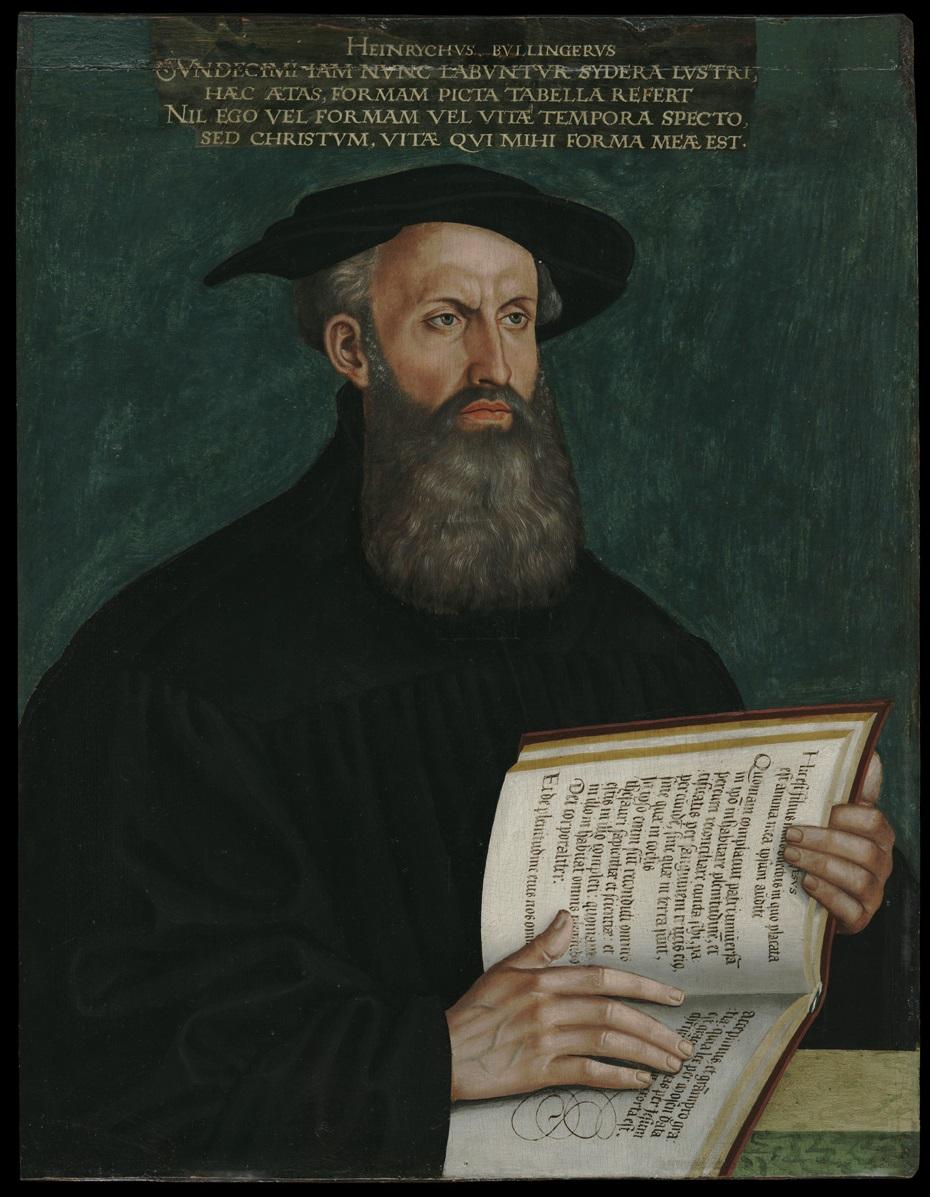
Heinrich Bullinger was the son of a parish priest in Bremgarten in the Swiss canton of Aargau. He was educated in the humanist tradition at Cologne, where he encountered the writings of Erasmus, Melanchthon, and Luther and quietly embraced the Reformed cause by 1522. He became a teacher at the Cistercian monastery school at Kappel, married a former nun in 1529, and ministered in Bremgarten until the disastrous Second Kappel War of 1531 cost the Reformed cantons their independence and Zwingli his life. Driven from Bremgarten, Bullinger arrived in Zürich on December 9, 1531. Twenty-one days later, the city council elected him Zwingli's successor as Antistes (chief pastor) of the Zürich church.
Bullinger was twenty-seven when he took the post. He would hold it for forty-four years, until his death in 1575 — the longest-serving leader of any Reformed church anywhere. Where Zwingli had been a polemicist in the heat of the Reformation's first decade, Bullinger was a builder: he consolidated the gains, normalized the institutions, and reframed the Reformed movement as a settled European tradition rather than a Swiss insurrection. The Zürich church order he stabilized — preaching, catechesis, the prophesyings of the clergy (regular collegial Bible study), and the simple weekly liturgy — would shape Reformed practice from Heidelberg to Edinburgh to colonial New England.
His theological masterpiece is the Decades — fifty sermons in five volumes (1549–1551) covering the whole of Reformed dogmatics in expository form. The Decades were translated into English under Elizabeth I and made required reading for Church of England clergy who lacked university degrees; through this provision, Bullinger shaped the theology of an entire generation of Elizabethan churchmen. His commentaries on the New Testament epistles were no less widely read across Reformed Europe. Bullinger's particular emphasis was the unity of the divine covenant across both Testaments — a covenantal theology that would be developed further by later Reformed scholastics and become the structural backbone of Westminster theology.
The Second Helvetic Confession of 1566 is the document for which Bullinger is most often remembered. He had drafted it years earlier as a personal confession of faith, intended to be attached to his will, but Frederick III, the Reformed Elector Palatine, asked him for a confessional standard he could present at the Diet of Augsburg as a defense of his Reformed church. Bullinger gave him the manuscript; Frederick had it printed in 1566. It was almost immediately adopted by the Reformed churches of Switzerland, Scotland (1566), Hungary (1567), France (1571), and Poland (1571) — and remains a confessional standard in the Presbyterian Church (USA) and other Reformed bodies today.
Bullinger's other lasting contribution was epistolary. He maintained an extraordinary correspondence with Reformed leaders across Europe — Calvin in Geneva, Beza after him, Cranmer in England, John Hooper, John Jewel, John Foxe, Lady Jane Grey before her execution. Over twelve thousand letters from his hand survive — the largest correspondence of any 16th-century figure. Through these letters Bullinger functioned as the unofficial coordinator of Reformed Christianity across national borders, advising on church order, mediating disputes, comforting persecuted minorities, and giving the Reformed cause an international coherence it would not otherwise have had.
Key Works
- The Decades (Sermonum Decades quinque, 1549–1551) — fifty sermons of Reformed dogmatics
- The Second Helvetic Confession (1566)
- The First Helvetic Confession (1536, co-authored)
- The Consensus Tigurinus (1549, with Calvin) — agreement on the Lord's Supper
- Commentary on the New Testament epistles (1532–1546)
Further Reading
- Bruce Gordon, The Swiss Reformation (2002)
- Carl Pestalozzi, Heinrich Bullinger: Leben und ausgewählte Schriften (1858)
- Emidio Campi & Peter Opitz (eds.), Heinrich Bullinger: Life — Thought — Influence (2007)