John Wesley
Founder of Methodism
The Oxford-trained Anglican priest who rode 250,000 miles preaching across the British Isles. Founded the Methodist societies, articulated Christian perfection, and made small-group accountability the engine of revival.
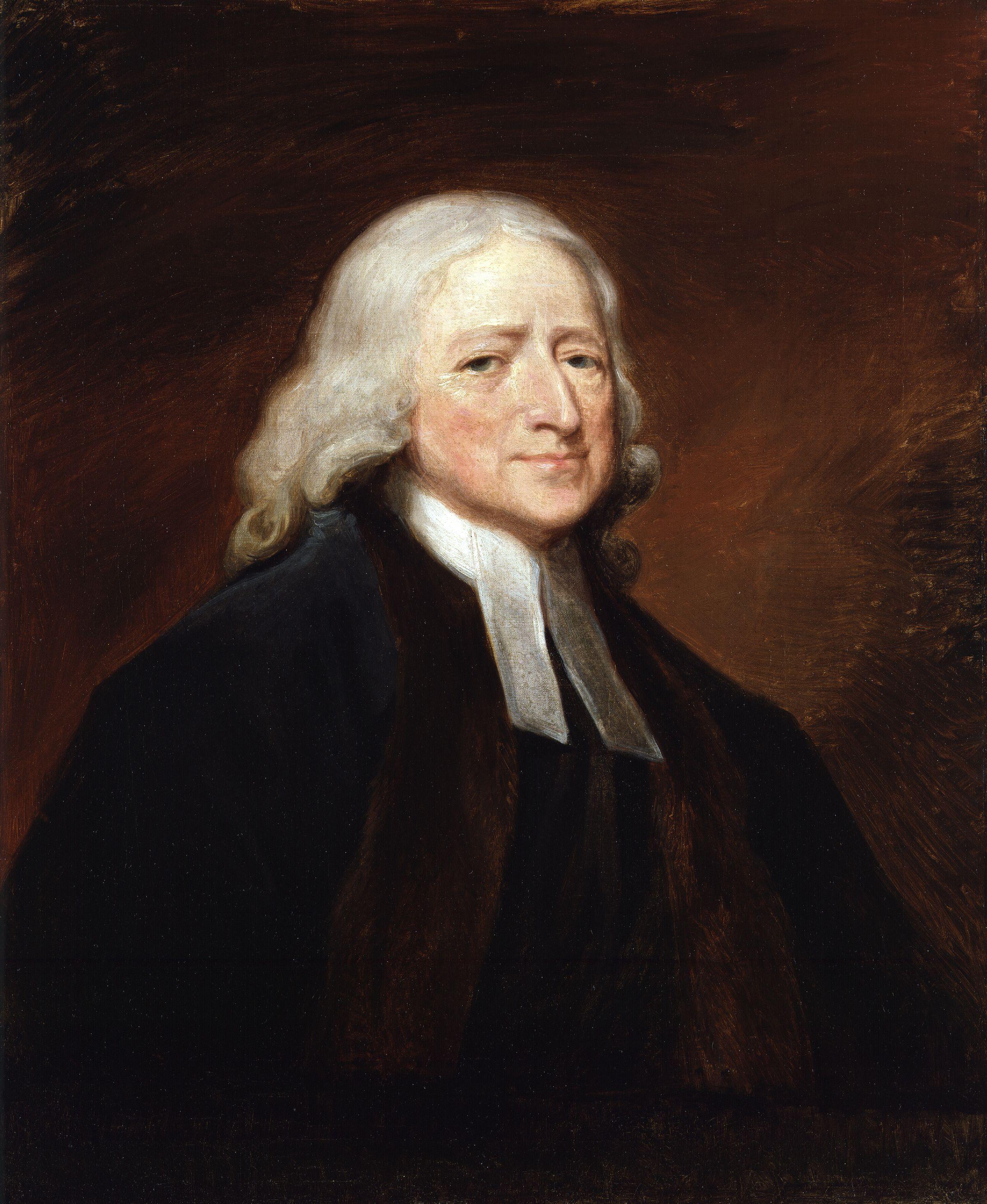
John Wesley was the son of an Anglican rector and Susanna Wesley — herself one of the most theologically literate women of the early 18th century. He was educated at Charterhouse and Christ Church, Oxford, elected fellow of Lincoln College in 1726, and ordained an Anglican priest in 1728. At Oxford he and his brother Charles led the "Holy Club," a small group of students committed to early-morning prayer, regular communion, fasting, and visiting prisoners — the discipline that earned them the mocking nickname "Methodists." The mocking name stuck. So did the discipline.
Wesley's missionary years in Georgia (1735–1737) were a personal and pastoral failure, and the voyage home was the spiritual crisis of his life. On the ship he had observed Moravian Christians remaining calm and singing hymns during a storm that terrified him. On May 24, 1738, at a Moravian society meeting on Aldersgate Street in London, Wesley heard Luther's preface to Romans read aloud and described what followed in a single sentence that became the founding moment of Methodism: "I felt my heart strangely warmed. I felt I did trust in Christ, Christ alone, for salvation; and an assurance was given me that He had taken away my sins, even mine, and saved me from the law of sin and death."
Field preaching began in 1739 when George Whitefield handed his open-air ministry in Bristol over to Wesley. Wesley overcame his initial reluctance to preach outside a church building — he called it "submitting to be more vile" — and never stopped. For the next fifty-two years he rode an estimated 250,000 miles, mostly on horseback, preaching as many as four sermons a day. He organized the converts into "societies," the societies into "classes" of twelve led by a layperson, and the classes into "bands" for confession and accountability. The class meeting was the structural genius of Methodism: every Methodist was known by name and watched over by another believer week by week.
Wesley's theology was Arminian in its account of grace (he broke decisively with Whitefield over Calvinist predestination in 1740) and Anglican in its sacramental discipline. He never left the Church of England, never authorized Methodist separation while he lived, and remained a priest until his death in 1791. But in 1784, faced with the pastoral collapse of American Methodism after the Revolution, he ordained ministers for North America — a step that the Church of England considered a breach of episcopal order and that made Methodist separation inevitable. The doctrine of Christian perfection — sanctification as a real, attainable transformation of the affections, not merely a forensic standing — remains the distinctive Wesleyan inheritance, and through revivalism, the Holiness movement, and Pentecostalism, has shaped a vast portion of global Christianity.
Key Works
- Standard Sermons (53 sermons, 1771)
- Explanatory Notes Upon the New Testament (1755)
- A Plain Account of Christian Perfection (1766)
- The Sunday Service of the Methodists in North America (1784)
- The Journal of John Wesley (8 vols., posthumous)
Further Reading
- Henry D. Rack, Reasonable Enthusiast: John Wesley and the Rise of Methodism (1989)
- Albert C. Outler (ed.), John Wesley (Library of Protestant Thought, 1964)
- Richard P. Heitzenrater, Wesley and the People Called Methodists (1995)