Jonathan Edwards
Theologian of the Great Awakening
The greatest theological mind colonial America produced. Pastor of Northampton during the Great Awakening of 1740–1742, philosophical defender of Reformed doctrine, missionary to the Mohicans at Stockbridge, and dead of a smallpox inoculation five weeks into his Princeton presidency.
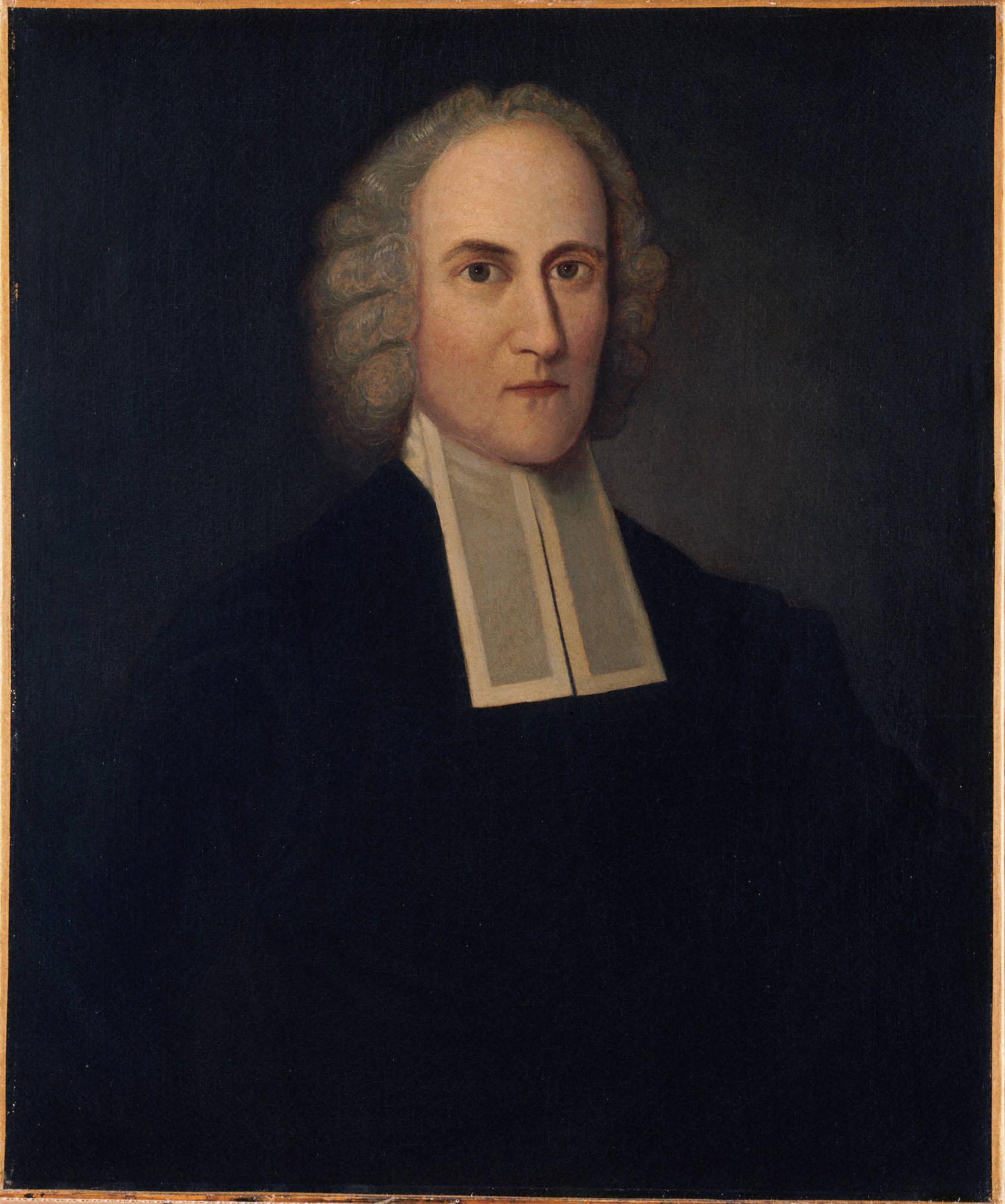
Jonathan Edwards was born in East Windsor, Connecticut in 1703, the only son in a family of eleven children, a Yale graduate at seventeen, and tutor at the college before he had turned twenty. He was an extraordinary mind from the start — his early notebooks on natural philosophy show a teenager working out an idealist metaphysics in dialogue with John Locke and Isaac Newton. He served briefly as a pastor in New York City, returned to Yale as a tutor, and in 1727 was ordained as assistant to his grandfather Solomon Stoddard at the Congregational church in Northampton, Massachusetts. When Stoddard died in 1729, Edwards inherited the most prominent pulpit in the Connecticut River Valley. He held it for twenty-two years.
The Great Awakening that swept colonial New England in 1740–1742 had its first stirrings under Edwards's preaching at Northampton in the winter of 1734–1735. The conversions came in such numbers that Edwards wrote A Faithful Narrative of the Surprising Work of God (1737) — the first systematic theological account of mass revival — which was read on both sides of the Atlantic and made Edwards the chief theologian of evangelical awakening. When George Whitefield's preaching tour of New England in 1740 triggered a much larger revival, Edwards became its leading interpreter. Sinners in the Hands of an Angry God, preached at Enfield, Connecticut in July 1741, is the famous specimen of his revival preaching — but it should not be read in isolation. His more careful work was The Distinguishing Marks of a Work of the Spirit of God (1741) and the magisterial Religious Affections (1746), which distinguished true spiritual experience from emotional excess on the basis of twelve scriptural marks.
Edwards's Northampton ministry ended in pastoral disaster. In 1750, after a long dispute over whether to admit to the Lord's Supper persons who could give no credible profession of saving faith (his grandfather Stoddard had admitted them; Edwards reversed the policy), the Northampton congregation dismissed him by a vote of approximately 230 to 23. The next seven years he spent as a missionary to the Mahican (Mohican) and Mohawk Indians at Stockbridge in the western Massachusetts hills. There, with limited library and ministering to a small congregation in two languages, he produced the philosophical masterworks of his career: Freedom of the Will (1754), Original Sin (1758), The Nature of True Virtue (written 1755, posthumous), and The End for Which God Created the World (posthumous).
Freedom of the Will is the work for which Edwards is most often remembered in the history of philosophy. It is a sustained argument that Arminian theology — the view that the human will is libertarianly free between alternatives — is internally incoherent and inconsistent with the realities of motivation, character, and divine sovereignty. Edwards reframed the discussion: the will is not free in the sense of being undetermined; it is determined by the strongest motive, and the moral character of a choice depends on the moral character of the motive, not on its causal independence. The argument has shaped every subsequent Reformed treatment of freedom and was a foundational text for what came to be called New Divinity or New England Theology — the lineage from Edwards through Samuel Hopkins, Joseph Bellamy, and Timothy Dwight to the 19th-century revivalist and theological tradition.
Edwards was called to the presidency of the College of New Jersey (Princeton) in late 1757. He arrived in February 1758, was inaugurated, took a smallpox inoculation, and died of the inoculation on March 22, 1758 — five weeks into the presidency, at the age of fifty-four. The Princeton tradition he was meant to lead became, through his successors and his theological influence, the center of American Reformed Christianity for two centuries. His own writings — collected at Yale into twenty-six volumes between 1957 and 2008 — remain the deepest theological achievement of any American writer.
Key Works
- A Faithful Narrative of the Surprising Work of God (1737)
- Sinners in the Hands of an Angry God (1741)
- The Distinguishing Marks of a Work of the Spirit of God (1741)
- A Treatise Concerning Religious Affections (1746)
- Freedom of the Will (1754)
- The Nature of True Virtue (posthumous, 1765)
- The End for Which God Created the World (posthumous, 1765)
Further Reading
- George M. Marsden, Jonathan Edwards: A Life (2003)
- The Works of Jonathan Edwards (Yale University Press, 26 volumes, 1957–2008)
- Perry Miller, Jonathan Edwards (1949)