Martin Bucer
The Bridge-Builder of Strasbourg
A former Dominican who became the leader of the Reformation in Strasbourg for 25 years. He spent his career trying to reconcile Luther and Zwingli on the Lord's Supper, mentored Calvin during his Strasbourg years, and shaped the English Reformation from his Cambridge chair.
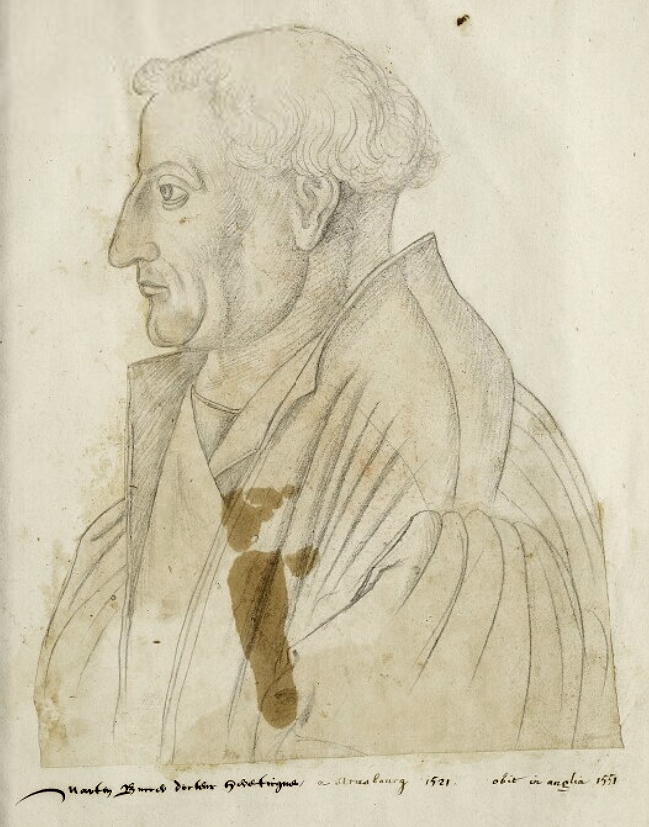
Martin Bucer entered the Dominican order at fifteen and was sent to Heidelberg in 1518, where he attended Luther's defense of his 95 Theses at the Heidelberg Disputation. He was convinced on the spot. By 1521 he had obtained release from his monastic vows; by 1522 he had married Elisabeth Silbereisen, a former nun; by 1523 he had been excommunicated, expelled from his pastorate at Landstuhl, and given refuge in the free imperial city of Strasbourg. He would lead the Strasbourg Reformation for the next twenty-five years.
Bucer's Strasbourg was the laboratory of magisterial Reformed church order before Geneva became its showcase. The city's four parishes were reformed by stages between 1523 and 1529; the Mass was abolished; a Reformed liturgy and disciplinary structure were instituted; refugees from across Europe — French Huguenots, Italian evangelicals, persecuted Anabaptists, English Marian exiles a generation later — found shelter and theological formation. When John Calvin was expelled from Geneva in 1538, it was Bucer who took him in and gave him a pastorate to the French refugee congregation in Strasbourg. The three years Calvin spent under Bucer's tutelage (1538–1541) shaped his mature theology of the church, sacraments, and worship — Calvin himself acknowledged Bucer as one of his decisive teachers.
Bucer's distinctive vocation was reconciliation. He spent his entire career trying to heal the eucharistic breach between Luther and Zwingli that had opened at Marburg in 1529. The Tetrapolitan Confession of 1530 — Bucer's confessional response to the Augsburg Confession on behalf of the cities of Strasbourg, Constance, Memmingen, and Lindau — attempted a mediating position. The Wittenberg Concord of 1536, negotiated personally between Bucer and Luther, was a real if fragile accord between south German Reformed cities and the Lutheran heartland. Bucer's gift for finding workable formulae cost him friends on both flanks: Zwinglians thought him too Lutheran, Lutherans thought him too Zwinglian, and Catholics regarded him as the most dangerous of the Reformers precisely because he could speak to all of them.
The Augsburg Interim of 1548 — Charles V's attempt to impose a Catholic settlement on the Lutheran cities after the Schmalkaldic War — ended Bucer's Strasbourg ministry. He refused to subscribe; the city council, under imperial pressure, dismissed him. Thomas Cranmer immediately invited him to England. He arrived in Cambridge in April 1549 to take the Regius Professorship of Divinity. In the two years before his death he advised Cranmer on the revision of the Book of Common Prayer (his Censura Bucer was the most important external critique that produced the more thoroughly Reformed 1552 Prayer Book), examined the Forty-Two Articles, and wrote De Regno Christi — a treatise on Christian commonwealth presented to Edward VI as a programme for English reformation. He died in Cambridge in February 1551 and was buried in Great St. Mary's Church. Under Mary I his bones were exhumed and burned. Under Elizabeth they were ceremonially restored.
Key Works
- Tetrapolitan Confession (1530, co-authored)
- Commentary on Romans (1536)
- De Regno Christi (1550) — written for Edward VI
- Concordia Wittenbergensis (Wittenberg Concord, 1536, with Luther)
- Grund und Ursach (1524) — defense of evangelical reform in Strasbourg
Further Reading
- Martin Greschat, Martin Bucer: A Reformer and His Times (2004)
- Diarmaid MacCulloch, Thomas Cranmer (1996) — on Bucer's English influence
- W. P. Stephens, The Holy Spirit in the Theology of Martin Bucer (1970)