Philip Melanchthon
Praeceptor Germaniae — Teacher of Germany
Luther's right hand and the intellectual architect of confessional Lutheranism. A Greek prodigy at twenty-one, he drafted the Augsburg Confession, wrote the first Protestant systematic theology, and shaped German Protestant education for a century.
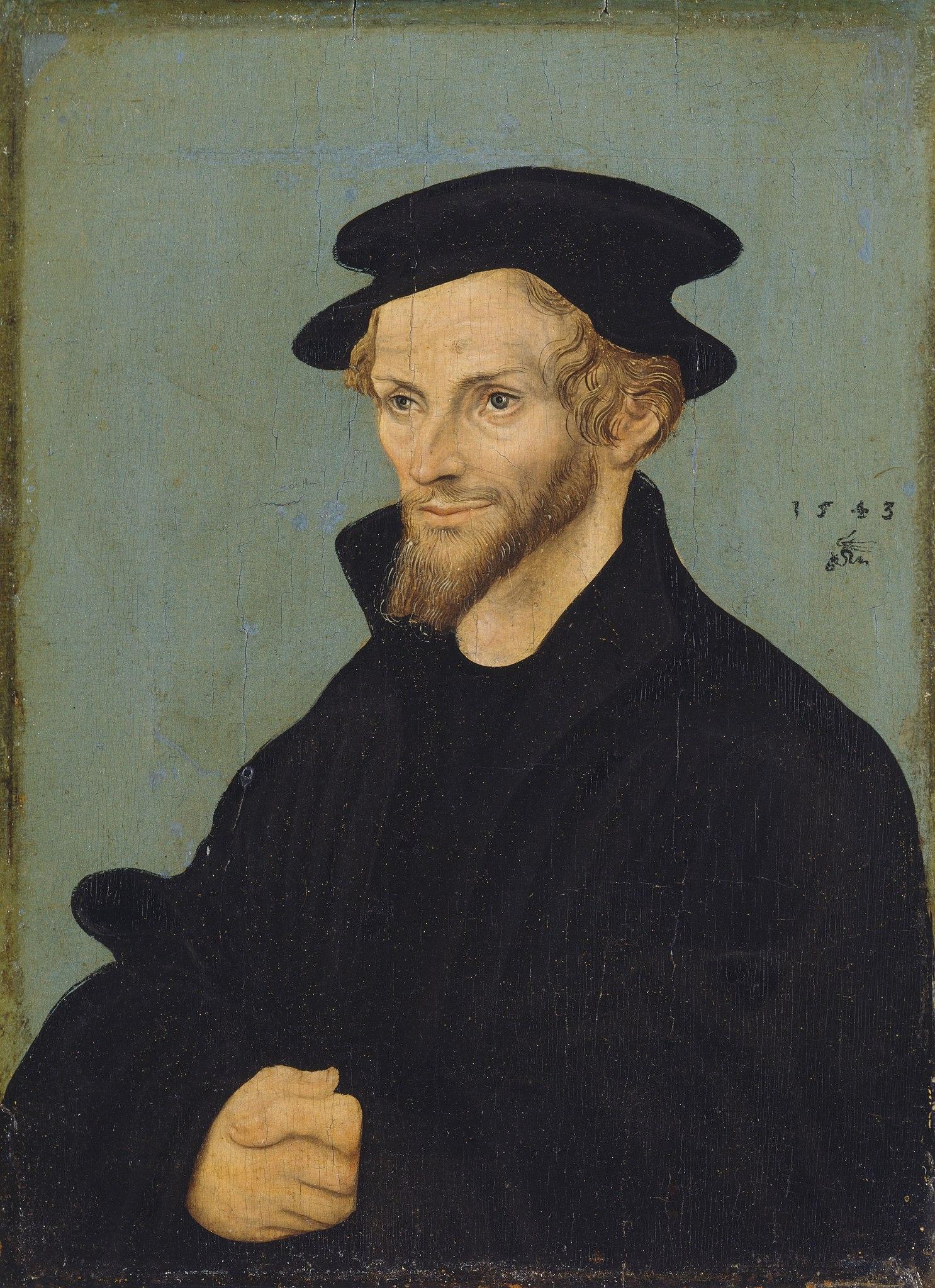
Philip Schwartzerdt — Latinized in the Renaissance fashion to Melanchthon ("black earth") by his great-uncle Johannes Reuchlin — was born in Bretten in 1497, took his master's degree at Tübingen at seventeen, and was appointed professor of Greek at the University of Wittenberg in 1518 at the age of twenty-one. Luther, twelve years his senior, attended his inaugural lecture and immediately recognized that the Reformation had been given a scholar to match its preacher. Within three years Melanchthon had become Luther's closest collaborator and, in significant respects, his more careful theological mind.
The Loci Communes Rerum Theologicarum of 1521 — written when Melanchthon was twenty-four — was the first systematic Protestant theology. Beginning from Romans and organized by topical "commonplaces" (loci), it set the structural template for Protestant dogmatics for the next century. Luther said of the book that it deserved a place in the canon next to Scripture itself. Melanchthon revised it repeatedly over the next four decades, gradually softening some of the early sharp edges (especially on free will) in ways that would generate intra-Lutheran controversy after Luther's death.
Melanchthon's diplomatic gift made him the natural drafter of the Augsburg Confession, presented to Charles V at the Diet of Augsburg in June 1530. Luther — still an imperial outlaw — could not appear in person and waited at the Coburg fortress while Melanchthon negotiated. The Confession's twenty-eight articles articulate the Lutheran position with deliberate moderation, emphasizing continuity with the ancient Church and the consensus of the catholic tradition wherever possible. The Apology of the Augsburg Confession (1531), Melanchthon's longer defense after the Catholic Confutation, is itself a major theological text and one of the Lutheran confessional documents in the Book of Concord.
Beyond the Reformation's confessional struggles, Melanchthon was the great organizer of Protestant education. He reformed the curriculum at Wittenberg and at numerous other German universities, founded gymnasium schools throughout Lutheran territories, wrote textbooks in Greek, Latin, rhetoric, dialectic, ethics, and physics, and earned the title Praeceptor Germaniae — Teacher of Germany. The educational infrastructure of Lutheran Germany for the next two centuries was substantially his creation. Without Melanchthon, there is no Lutheran university tradition, and probably no German classical education in the form that produced Goethe, Lessing, and Schleiermacher.
Melanchthon's later years were marked by intra-Lutheran controversies that he largely lost. His readiness to compromise at the Augsburg Interim of 1548 (under imperial pressure) and his views on the cooperation of the human will in conversion (synergism) and on the Lord's Supper (which moved gradually closer to the Reformed position) led the strict Gnesio-Lutherans (Matthias Flacius, Nikolaus von Amsdorf) to denounce him as a betrayer of the Lutheran cause. The Formula of Concord of 1577 — issued after his death — adjudicated the disputes largely against the Philippist position. Yet the Augsburg Confession and the Apology remain the foundational Lutheran texts, and modern Lutheran ecumenism has rediscovered Melanchthon's irenic instinct as a recoverable resource.
Key Works
- Loci Communes (1521, revised through 1559) — first Protestant systematic theology
- The Augsburg Confession (1530)
- Apology of the Augsburg Confession (1531)
- Commentary on Romans (1532)
- Treatise on the Power and Primacy of the Pope (1537)
Further Reading
- Heinz Scheible, Melanchthon: Eine Biographie (1997)
- Timothy J. Wengert, Philip Melanchthon, Speaker of the Reformation (2010)
- Robert Stupperich, Melanchthon: The Enigma of the Reformation (1965)