Thomas Cranmer
Architect of the English Prayer Book
Archbishop of Canterbury under three Tudors. Wrote the English liturgy that still shapes Anglican worship: the Book of Common Prayer. Burned for his Reformed convictions in 1556, holding into the flames the hand that had signed his recantation.
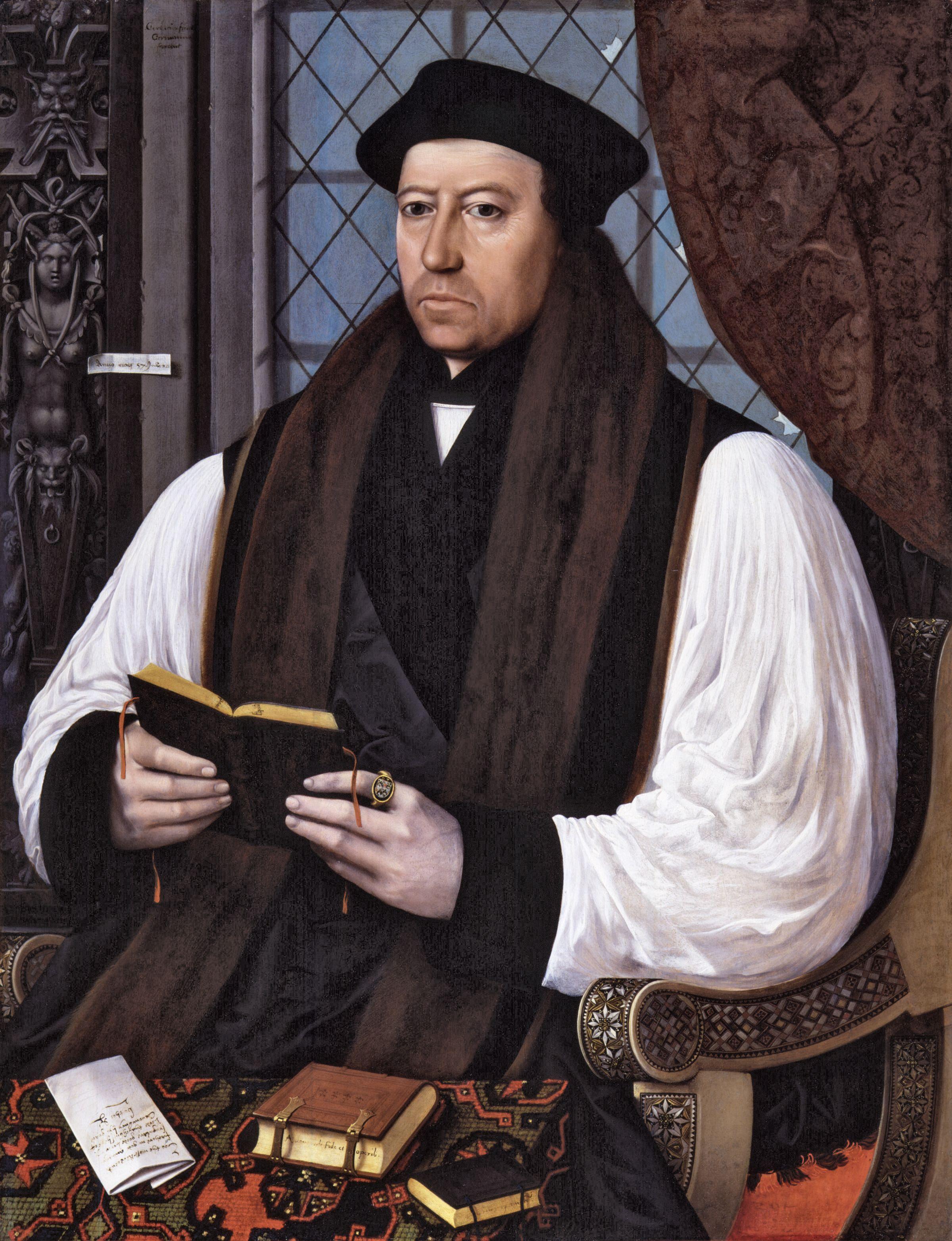
Thomas Cranmer was a Cambridge don who came to Henry VIII's notice in 1529 by suggesting that the legality of Henry's marriage to Catherine of Aragon could be settled by the universities of Europe rather than by Rome. Henry made him Archbishop of Canterbury in 1533. From that office Cranmer carried out the legal and liturgical work of the English Reformation across three reigns: Henry's (1533–1547), Edward VI's (1547–1553), and the first three years of Mary I's (1553–1556). The first two were the work of his life. The third was his death.
The Book of Common Prayer of 1549 is Cranmer's literary monument. It translated the medieval Latin services into vernacular English, simplified the liturgical calendar, and made the people's participation the structural principle of worship. The 1552 revision, more thoroughly Reformed, removed the language of bodily presence from the Communion service and inserted the famous Black Rubric. The Elizabethan Prayer Book of 1559, the Jacobean revision of 1604, and the still-used 1662 edition all rest on Cranmer's text. The English of the Prayer Book has shaped Anglican spiritual life from the 16th century through the present — and through translations, the Anglican-derived churches around the world.
Cranmer's eucharistic theology shifted over time. In the 1530s he held a doctrine of bodily presence close to Luther's. By the late 1540s, under the influence of Martin Bucer (who took refuge in England) and Peter Martyr Vermigli, he had moved to a Reformed position close to Calvin's — a real spiritual presence of Christ to the believer's faith, without any change in the bread and wine. The 1552 Communion service is the clearest liturgical expression of this Reformed eucharistic theology in any major Christian tradition.
Mary's accession in 1553 reversed the Reformation. Cranmer was tried for treason, then for heresy, and was imprisoned in Oxford. Under sustained pressure he signed six recantations of his Reformed doctrine. On March 21, 1556, he was brought to the University Church of St. Mary to make a public recantation before his burning. He stunned the church by withdrawing his recantations and declaring that the hand that had signed them would burn first. At the stake at Broad Street, Cranmer thrust his right hand into the flames and held it there until it was consumed, repeating: "This unworthy right hand." The Reformation in England survived because Mary's reign was short and her successor was Elizabeth — but the most theologically important architect of that Reformation died at the stake with his recantation withdrawn.
Key Works
- Book of Common Prayer (1549, revised 1552)
- Forty-Two Articles (1553) — basis of the Thirty-Nine Articles (1571)
- A Defence of the True and Catholic Doctrine of the Sacrament (1550)
- Homilies (vol. 1, 1547)
Further Reading
- Diarmaid MacCulloch, Thomas Cranmer (1996)
- Ashley Null, Thomas Cranmer's Doctrine of Repentance (2000)
- Peter Brooks, Thomas Cranmer's Doctrine of the Eucharist (1965)