Anne
Mother of the Theotokos
Mother of Mary; grandmother of Jesus (by tradition)
Mother of Mary, grandmother of Jesus. Her name comes not from the canonical Gospels but from the 2nd-century Protoevangelium of James — a tradition the Church has honored for nearly two thousand years.
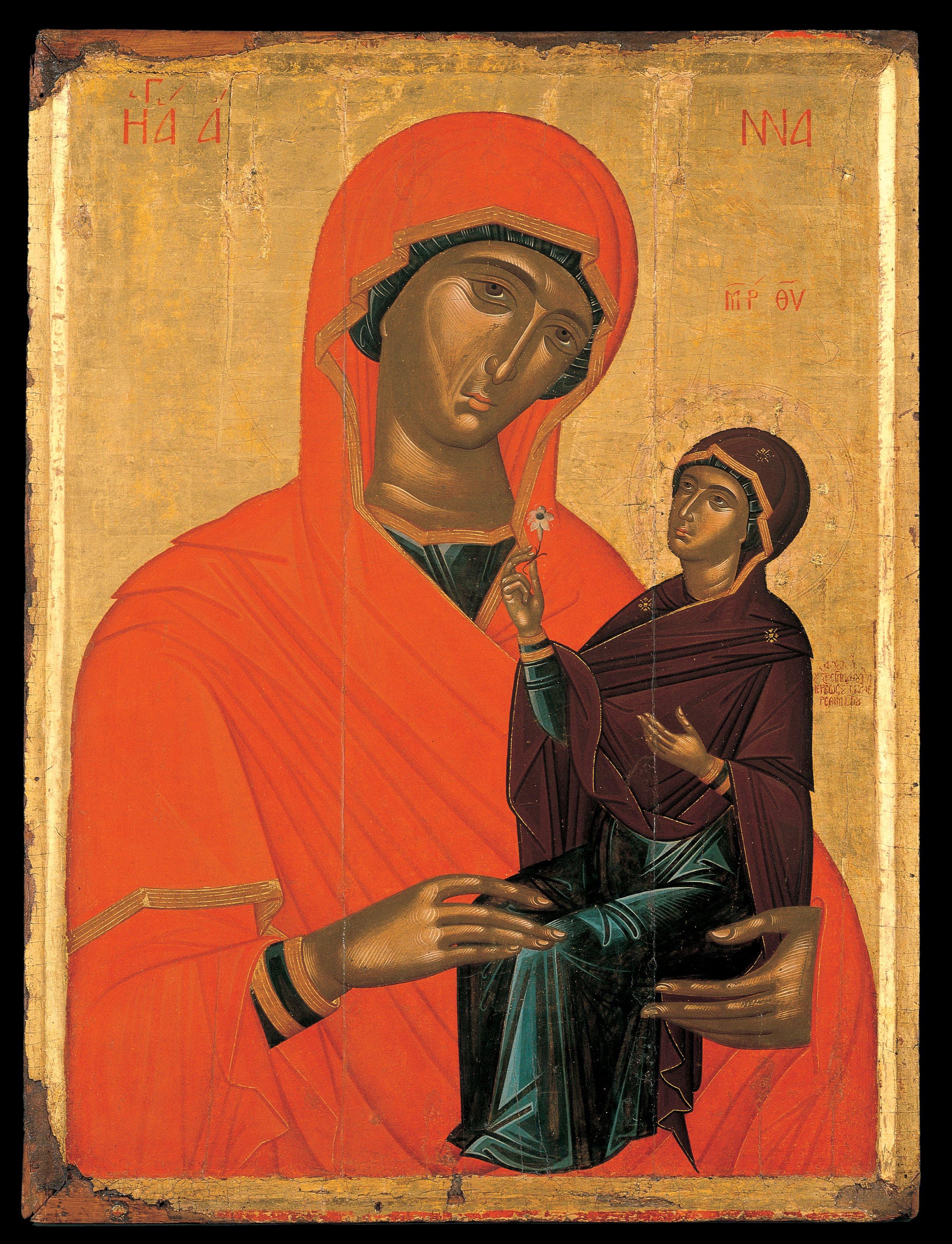
Anne (Hebrew Hannah, "grace") is the traditional name of the Virgin Mary's mother. The canonical Gospels do not name Mary's parents. The earliest source for the names Anne and Joachim is the Protoevangelium of James — a Greek apocryphal text written around the mid-2nd century, probably in Syria, that filled out the infancy narrative of Mary herself with an extended story of her parents' barrenness, miraculous conception, and dedication of the child to the Temple at age three.
The story the Protoevangelium tells parallels the Old Testament story of Hannah, the mother of Samuel (1 Samuel 1) — an aged, childless woman who is mocked at the Temple, prays for a child, receives a divine promise, and dedicates the child to God's service. The Protoevangelium has Anne praying under a laurel tree, an angel appearing to her with the announcement that she will conceive, and the birth of Mary. The structure echoes the biblical pattern of the announcement-of-birth narrative — the same pattern that later, in Luke, will frame the announcements to Elizabeth and Mary herself.
The historicity of the Protoevangelium's specific names and details is debated. What is clear is that the names Anne and Joachim entered Christian devotion early and remained central in both the Eastern and Western traditions. The feast of Anne (and Joachim) is celebrated in the Orthodox calendar on July 25 (Anne) and September 9 (the Conception of Mary by Anne). In the Latin West, the feast was officially added to the Roman calendar by Sixtus IV in 1481, though local devotion had existed for centuries before. The tradition takes Anne as the model of the older woman who, against expectation, receives the grace of bearing a child whose own significance is the salvation of the world.
Sources & Citations
- The Protoevangelium of James, chapters 1–6 (mid-2nd century AD)
- John of Damascus, Sermon on the Nativity of the Theotokos
- Pope Sixtus IV — established the feast of St. Anne in the Roman calendar (1481)