Joachim
Father of the Theotokos
Father of Mary; grandfather of Jesus (by tradition)
Father of Mary, husband of Anne. Named in the 2nd-century Protoevangelium of James as the elderly man whose offering was once refused at the Temple — then accepted when his daughter was born.
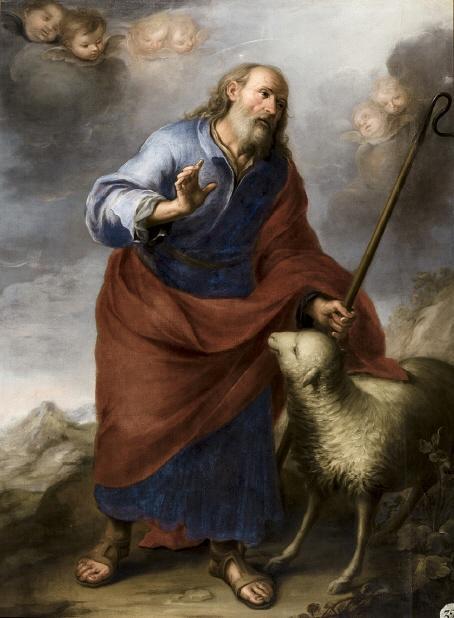
Joachim — like his wife Anne — is named in the Protoevangelium of James rather than in the canonical Gospels. The narrative of the Protoevangelium presents him as a wealthy and devout Israelite whose offering was refused at the Temple on the grounds that he and his wife had been childless (and were therefore presumed to be under God's displeasure). Shamed, Joachim retreated to the wilderness to fast and pray for forty days, during which an angel appeared to announce that his wife would conceive. He returned to find Anne pregnant. The structure of the story echoes Abraham and Sarah, Hannah and Elkanah, Zechariah and Elizabeth — the recurring biblical pattern of the elderly couple miraculously granted a child of significance.
Joachim's place in Christian tradition has been consistently iconographic. The most famous extended visual treatment is Giotto's fresco cycle in the Scrovegni Chapel in Padua (1305), where the meeting of Joachim and Anne at the Golden Gate of Jerusalem (after his return from the wilderness) is one of the most influential images in the history of Christian art. The kiss at the Golden Gate became, in Western tradition, the visual sign of the moment Mary was conceived — and was used in the high middle ages as a feast for the Immaculate Conception before the doctrine was formally defined.
Joachim and Anne are celebrated together in both the Eastern and Western liturgical calendars. In the Latin Rite their feast is July 26. In the Byzantine Rite their feast is September 9 (the day after the Nativity of the Theotokos on September 8). Both East and West have treated them with the same reverence: not as figures of canonical Scripture, but as figures of the living memory of the Church, whose names and roles the Christian tradition has guarded for nearly two thousand years.
Sources & Citations
- The Protoevangelium of James, chapters 1–5 (mid-2nd century AD)
- Giotto, Frescoes of the Scrovegni Chapel (1305) — narrative of Joachim and Anne
- Western feast (with Anne): July 26