John the Baptist
The Forerunner; Greatest Born of Women
Son of Zechariah and Elizabeth; forerunner of Christ
The forerunner of the Messiah. Lived in the Judean wilderness, preached repentance and baptized in the Jordan, identified Jesus as the Lamb of God, and was beheaded by Herod Antipas around 28 AD.
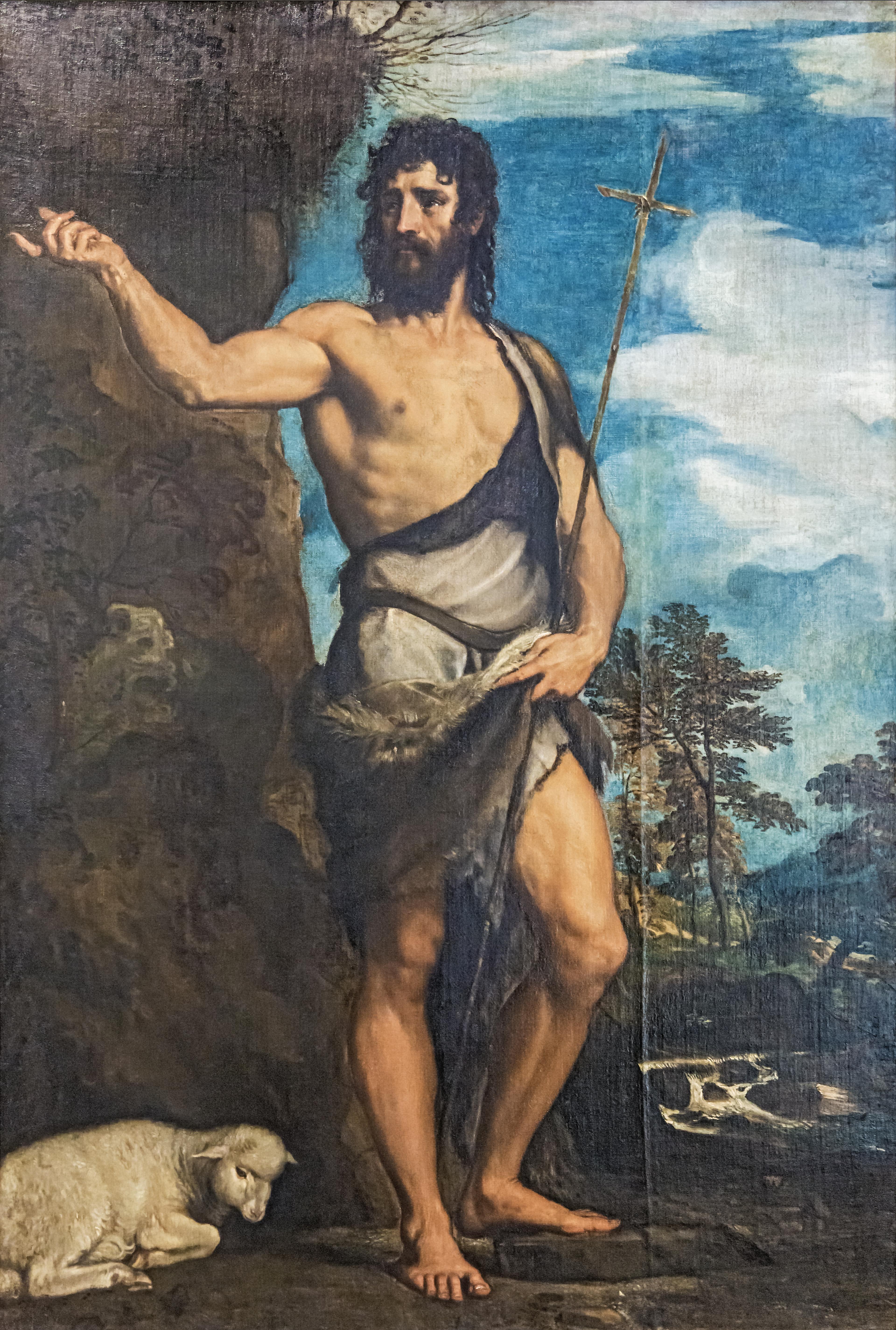
John the Baptist is one of the few New Testament figures attested in non-Christian historical sources. Josephus (Antiquities of the Jews, 18.5.2, written around 93 AD) describes John as "a good man" who exhorted the Jews to virtue and to baptism, and who was killed by Herod Antipas because Antipas feared that John's growing popularity would lead to a rebellion. Josephus's account is brief but valuable: it confirms the historical existence of John independently of the Gospels, attests his baptism ministry, and confirms his execution by Antipas.
The Gospels expand the historical sketch into a theological portrait. John, born to elderly priestly parents under the circumstances described in Luke 1, retired to the wilderness for what Luke calls his early life ("the child grew, and waxed strong in spirit, and was in the deserts till the day of his shewing unto Israel," Luke 1:80). When he appeared publicly around AD 28, he was preaching at the Jordan in the garments and diet of an Old Testament prophet (camel hair, leather belt, locusts and wild honey — Mark 1:6), explicitly identified by the evangelists as the voice in the wilderness foretold by Isaiah 40:3 and the Elijah-figure expected before the day of the Lord (Malachi 4:5–6; Matthew 11:14).
John's baptism ministry attracted crowds from across Judea and Galilee. He baptized Jesus around AD 29 in the Jordan — an event recorded in all four Gospels and treated as the moment when the heavens opened, the Spirit descended on Jesus, and the Father's voice was heard. John's witness afterward was emphatically self-effacing: "He must increase, but I must decrease" (John 3:30). When the Sanhedrin sent priests and Levites to ask who he was, his answer was that he was none of the messianic figures expected — only "the voice of one crying in the wilderness" (John 1:19–23).
Jesus's evaluation of John was extraordinary. "Verily I say unto you, Among them that are born of women there hath not risen a greater than John the Baptist: notwithstanding he that is least in the kingdom of heaven is greater than he" (Matthew 11:11). The full sentence has both halves: John is the greatest of the prophets, and the least in the kingdom — those baptized into Christ's death and resurrection — is greater than John. John bridged the old covenant and the new. He was killed by Herod Antipas around AD 28 or 30, beheaded at Antipas's court at Machaerus after his confrontation with the king's adulterous marriage. His feast on June 24 is one of the oldest in the Christian calendar — the nativity of John celebrated, uniquely among saints, six months before Christmas.
Sources & Citations
- Matthew 3; Mark 1:1–11; Luke 1, 3:1–22; John 1:19–34
- Josephus, Antiquities 18.5.2 — independent attestation of John and his death
- Matthew 11:11 — "there hath not risen a greater than John the Baptist"