David
King of Israel; Sweet Psalmist; Forefather of the Messiah
Forefather of Jesus through Joseph (Matthew 1) and Mary (Luke 3, by tradition)
The shepherd-king of Israel. Slew Goliath, united the tribes, made Jerusalem his capital, brought the Ark of the Covenant home, and received the covenant of an eternal throne — the messianic promise the Gospels open by tracing to Jesus.
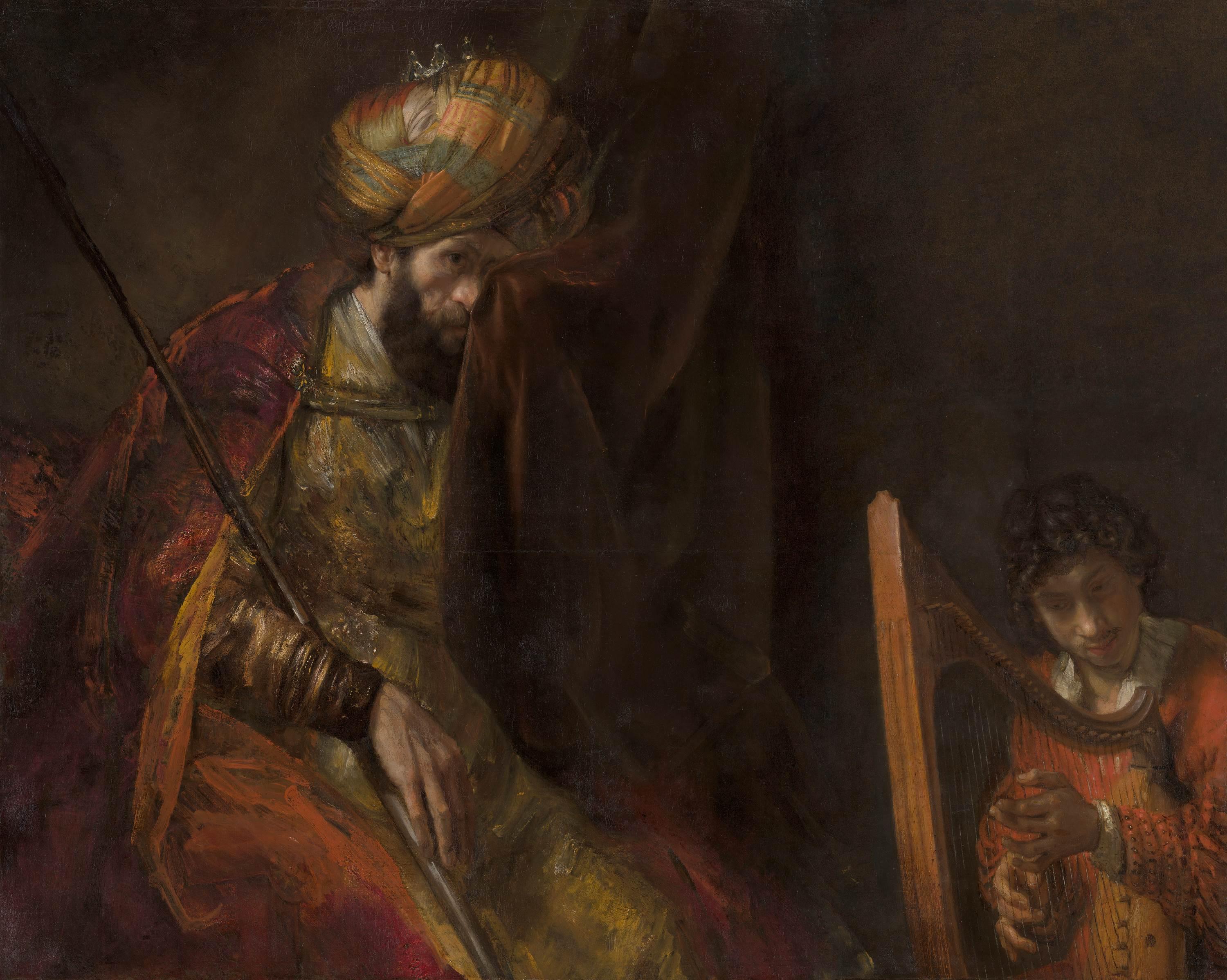
David is the second king of Israel, the founder of the dynasty that bore his name until the Babylonian exile, and (in the Gospels' framing) the ancestor through whom the messianic promise is fulfilled in Jesus. His life is recounted in 1 Samuel 16 – 2 Samuel 24, with parallel material in 1 Chronicles. His historicity beyond the biblical text was uncertain until the discovery of the Tel Dan Stele in 1993 — a 9th-century BC Aramaic inscription that explicitly mentions the "House of David" (BYT DWD) as a recognized dynasty. The find is the strongest extra-biblical evidence of a 10th-century BC Davidic kingdom.
The Davidic narrative is one of the most theologically rich and morally complex extended biographies in the Old Testament. The shepherd boy anointed by Samuel; the harpist who soothed Saul's tormented spirit; the slayer of Goliath; the captain who became Saul's son-in-law and then Saul's hunted enemy; the king of Judah at Hebron for seven years; the king of all Israel who took Jerusalem from the Jebusites and brought the Ark there; the man who danced before the Ark with all his might. All of this is one half of the narrative. The other half is the king who took Bathsheba and arranged the death of her husband Uriah; whose family was torn by rape, fratricide, and rebellion; who fled from his own son Absalom; who left a kingdom of internal violence to Solomon.
The theological center of the David narrative is the Davidic Covenant of 2 Samuel 7. The prophet Nathan, sent to David, conveys God's promise: "Thine house and thy kingdom shall be established for ever before thee: thy throne shall be established for ever" (2 Samuel 7:16). The promise becomes the lodestar of Israelite messianic hope through the prophets and the psalmists. When Matthew 1 opens his Gospel with "The book of the generation of Jesus Christ, the son of David, the son of Abraham," he is announcing that the 2 Samuel 7 promise has been kept. When Gabriel tells Mary that "the Lord God shall give unto him the throne of his father David" (Luke 1:32), he is naming the same promise.
The Psalter is the longest book of the Old Testament and traditionally attributes 74 of its 150 psalms to David. The historical question of whether David personally composed all of the Davidic psalms is impossible to settle definitively — many scholars hold that some of the Davidic psalms are by David, others are later compositions in the Davidic tradition. What is theologically clear is that the Psalms are the prayer-book of Israel and the prayer-book of the Church, and that they shape — through Davidic typology — the way the New Testament reads Jesus. The cry of Psalm 22:1 ("My God, my God, why hast thou forsaken me?") on the cross; the citation of Psalm 110:1 in the Sermon on the Mount; the language of the Davidic king in Hebrews 1 — the New Testament cannot be read without the Psalms, and the Psalms cannot be read without David.
Sources & Citations
- 1 Samuel 16 – 2 Samuel 24 (the David cycle)
- 1 Kings 1–2; 1 Chronicles 11–29
- The Psalms (74 of the 150 traditionally attributed to David)
- The Tel Dan Stele (c. 850 BC) — earliest extra-biblical reference to the "House of David"
- Matthew 1:1, 6, 17 — Jesus as "the son of David"