Solomon
King of Wisdom; Builder of the First Temple
Son of David and Bathsheba; ancestor of Jesus (Matthew 1:6)
Son of David and Bathsheba. Built the First Temple in Jerusalem. Asked for wisdom rather than wealth and was granted both. The Wisdom literature is traditionally attributed to him.
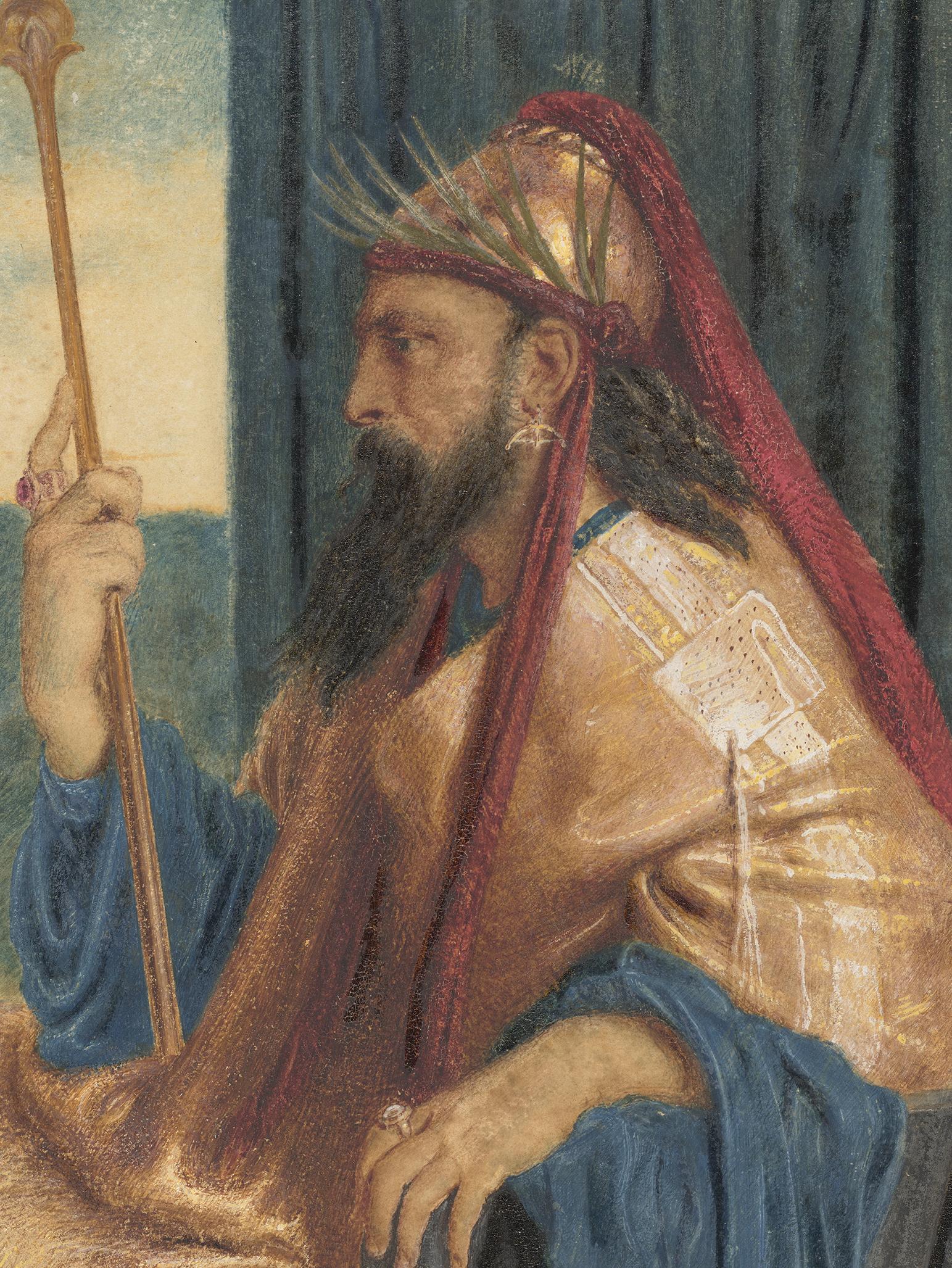
Solomon was the second-youngest son of David and the only surviving son of David's union with Bathsheba (the firstborn of that union having died in infancy as judgment for David's sin with Bathsheba). His accession to the throne, recorded in 1 Kings 1–2, was contested by his elder brother Adonijah and only secured by the intervention of David's prophet Nathan, his mother Bathsheba, and the royal guard. Solomon took the throne around 970 BC and reigned for forty years.
The theological narrative of Solomon's reign is concentrated in three episodes. First, at the beginning of his reign (1 Kings 3), Solomon prayed at Gibeon and was told by God to ask for whatever he wanted. He asked for wisdom — an "understanding heart to judge thy people, that I may discern between good and bad." God granted the wisdom and added the wealth and honor Solomon had not asked for. The famous trial scene that immediately follows — the two prostitutes claiming the same child, the king's order to divide the child with a sword, the real mother's plea to save the child — is the canonical demonstration of the Solomonic gift.
Second, the building of the Temple (1 Kings 5–8; 2 Chronicles 2–7). David had wanted to build the Temple; God had forbidden him because he was a man of war and had shed blood. Solomon, reigning in peace, was the king through whom the Temple was finally built. The seven-year construction, the importation of cedar from Hiram of Tyre, the cherubim of olive wood overlaid with gold, the Holy of Holies cubed in inner dimensions, the dedication and the descent of the glory of the Lord into the house — the Temple becomes the architectural center of Israelite religion and the symbolic center of every later Old Testament theological reflection on the presence of God.
Third, the slow apostasy of his late reign (1 Kings 11). Solomon married seven hundred wives and three hundred concubines, many of them foreign, and they turned his heart to their gods. He built high places for Chemosh and Molech outside Jerusalem. The narrator's verdict is severe: "his heart was not perfect with the Lord his God, as was the heart of David his father." The judgment is that the kingdom will be torn in two after his death — which it was, under Rehoboam. Jesus's own assessment of Solomon (Matthew 12:42) is to compare himself favorably to him: "a greater than Solomon is here." The wisdom literature of Proverbs, Ecclesiastes, and Song of Songs has been associated with Solomon since antiquity. The strict historical question of authorship is complex, but the wisdom tradition's connection to Solomon's name has shaped the Hebrew scriptures' wisdom theology for three thousand years.
Sources & Citations
- 1 Kings 1–11; 2 Chronicles 1–9
- The Wisdom literature (Proverbs, Ecclesiastes, Song of Songs — traditional attribution)
- Matthew 1:6 — "David the king begat Solomon of her that had been the wife of Urias"
- Matthew 12:42 — "a greater than Solomon is here"