Anointing of the Sick
Holy Unction · Extreme Unction · Last Rites · The Sacrament of the Sick
The rite in which the seriously ill or dying are anointed with consecrated oil and prayed over for healing of body and soul, in accordance with the instruction of James 5:14.
Is anyone among you sick? Let them call for the elders of the church. The apostolic instruction of James 5:14, the medieval narrowing into extreme unction, and Vatican II's recovery of anointing for all the seriously ill — alongside the Orthodox euchelaion and Reformation alternatives.
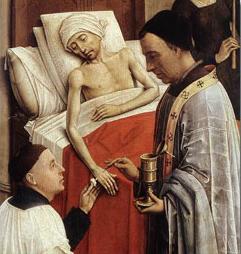
The Anointing of the Sick rests directly on James 5:14: 'Is anyone among you sick? Let them call for the elders of the church, and let them pray over them, anointing them with oil in the name of the Lord.' The early Church practiced this as part of ordinary pastoral care for the sick — Origen and Chrysostom mention it; Pope Innocent I in 416 AD describes a settled Roman discipline in which the bishop blesses the oil annually and priests anoint the sick with it. The rite was not yet narrowly tied to the moment of death.
By the early Middle Ages, the Western Church had begun to associate the anointing primarily with the dying, and the name extrema unctio (extreme unction, 'last anointing') reflects this narrowing. From the ninth to the twentieth century, the Latin West treated anointing as one of the 'last rites' — together with final confession (penance) and final communion (viaticum) — for those at the point of death. The Council of Trent (Session 14, 1551) defined extreme unction as a sacrament instituted by Christ and promulgated by the Apostle James, conferring grace, remitting venial sins, and (when expedient for the soul) strengthening or restoring bodily health.
The Second Vatican Council reversed the medieval narrowing. Sacrosanctum Concilium 73 (1963) directed that the sacrament be called 'anointing of the sick' rather than 'extreme unction' and that it be administered not only to those at the point of death but to anyone seriously ill. The revised rite (Pastoral Care of the Sick, 1972) emphasizes the sacrament's character as prayer for healing, including bodily healing, and reaches a much wider population than the medieval last-rites pattern. Catholic theology of the rite (Catechism §§1499–1532) holds that it confers a special grace of the Holy Spirit, unites the sufferer with Christ's passion, gives strength and peace, and prepares the soul for the final journey if death is near.
Eastern Orthodox practice has preserved the wider scope. Holy Unction (euchelaion, 'the prayer-oil') is administered to the seriously ill at any stage of illness, not only at death. The full Orthodox rite involves seven priests, seven epistle readings, seven gospel readings, and seven anointings — a rite of considerable theological depth that calls down the healing mercy of Christ on the body and soul of the sufferer. The rite is also publicly administered to the whole congregation during Holy Week in many Orthodox parishes.
Reformation traditions divided on the rite. Luther rejected extreme unction as a separate sacrament in The Babylonian Captivity of the Church (1520) on the grounds that James 5 promises bodily healing (which the medieval rite was no longer actually claiming), but he retained pastoral visitation of the sick with prayer. The Augsburg Confession does not list anointing among the sacraments. The Reformed tradition, following Calvin (Institutes IV.19.18), held that the anointing in James 5 was a charismatic gift of the apostolic age that had ceased, and rejected extreme unction outright. The Westminster Confession does not include anointing in its treatment of the sacraments. The Thirty-Nine Articles, Article 25, ranks 'extreme unction' among the rites 'commonly called sacraments' that the Anglican tradition does not recognize as such — though modern Anglican Prayer Books have restored a rite for the ministry to the sick that includes anointing with oil.
Modern Lutheran and Reformed practice has, in many places, recovered the pastoral practice of prayer with anointing for the seriously ill, drawing on James 5:14 directly rather than on a sacramental theology. Baptist and most Free Church traditions practice prayer for the sick, sometimes with the laying on of hands and oil, but treat it as a pastoral ordinance rather than a sacrament. What every tradition holds in common is that the Christian community is called to attend its sick members with prayer; the disagreement is over how to name and frame that attending.
How Each Tradition Receives It
| Tradition | Status | Local Name |
|---|---|---|
| Catholic | Sacrament | Anointing of the Sick / The Last Rites |
| Orthodox | Mystery — administered to the seriously ill, not only the dying | Holy Unction (Euchelaion) |
| Lutheran | Rite of pastoral care, increasingly restored | Anointing of the Sick |
| Reformed | Not a sacrament; prayer for the sick retained | Prayer for the Sick |
| Anglican | Sacramental rite restored in the modern Prayer Books | The Ministry to the Sick |
| Baptist | Not a sacrament; prayer with oil practiced in some congregations | — |
Scriptural Basis
- James 5:14–15 ('Is anyone among you sick? Let them call for the elders of the church, and let them pray over them, anointing them with oil in the name of the Lord')
- Mark 6:13 (the Twelve 'anointed with oil many who were sick and healed them')
- Luke 10:34 (the Good Samaritan poured oil and wine on the wounds of the man on the road)
- Isaiah 53:4–5 (the suffering servant who bears our infirmities)
Patristic Witnesses
- Origen, Homilies on Leviticus 2.4 (c. 240 AD) — anointing as one of the means of forgiveness
- John Chrysostom, On the Priesthood III.6 (c. 390 AD) — priests both forgive sins and intercede for the sick
- Pope Innocent I, Letter to Decentius of Gubbio (416 AD) — bishops bless the oil, priests anoint the sick
- Caesarius of Arles, Sermon 13 (c. 540 AD) — earliest Western pastoral instruction on anointing the sick
- Bede, Commentary on James (c. 720 AD) — patristic exposition of James 5:14
Further Reading
- Pope Innocent I, Letter to Decentius of Gubbio (416 AD)
- Caesarius of Arles, Sermon 13 (c. 540 AD)
- Council of Trent, Session 14, Doctrine on the Sacrament of Extreme Unction (1551)
- Sacrosanctum Concilium 73 (Second Vatican Council, 1963)
- Pastoral Care of the Sick: Rites of Anointing and Viaticum (1972, revised Latin rite)
- Catechism of the Catholic Church §§1499–1532
- Martin Luther, The Babylonian Captivity of the Church (1520)
- John Calvin, Institutes IV.19.18–21 (1559)
- The Thirty-Nine Articles, Article 25 (1571)
- The Office of Holy Unction in the Greek Euchologion
- Bernhard Poschmann, Penance and the Anointing of the Sick (Herder, 1964)