Confirmation
Chrismation · The Seal of the Holy Spirit · The Laying On of Hands
The rite that completes baptism by sealing the baptized with the gift of the Holy Spirit, administered by anointing with chrism and the laying on of hands.
The seal of the Holy Spirit. Anointing with chrism and the laying on of hands. In the East it follows infant baptism immediately; in the Latin West it became a separate rite for those already baptized; the Reformed traditions reframed it as a profession of faith.
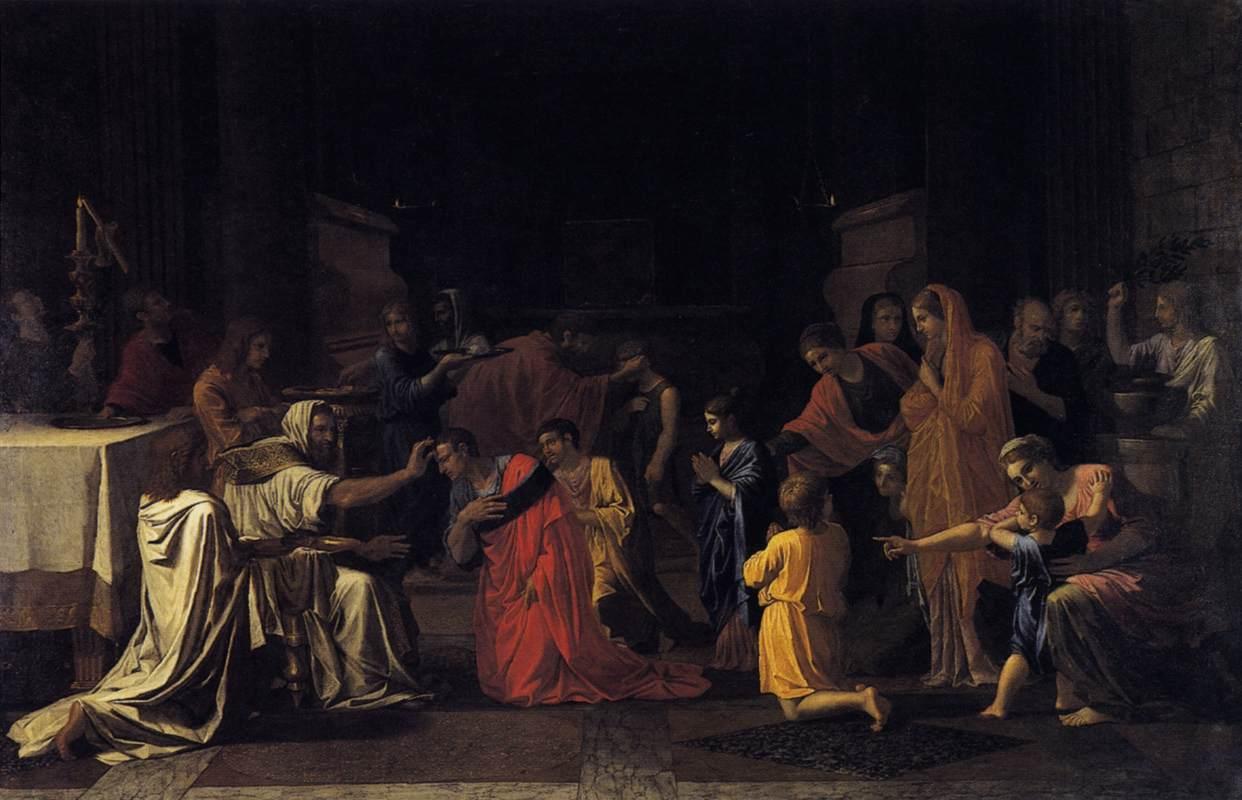
Confirmation (in the Latin West) and chrismation (in the East) developed from a single rite in the early Church: after baptismal immersion, the newly baptized were anointed with chrism (perfumed oil consecrated by the bishop), the bishop laid hands on them with prayer for the Holy Spirit, and they received the Eucharist for the first time. The New Testament foundation is the apostolic practice in Acts 8 (Peter and John in Samaria) and Acts 19 (Paul in Ephesus) of laying hands on the baptized for the gift of the Spirit. The early Latin and Greek witnesses — Tertullian, Hippolytus, Cyprian, Cyril of Jerusalem, Ambrose — describe what is essentially a single initiatory rite, even if the language and the precise ceremonies varied.
The Eastern Orthodox tradition has preserved this unified rite of initiation. Infants are baptized by triple immersion, immediately chrismated with myron (the holy oil consecrated by the patriarch) on the forehead, eyes, nostrils, mouth, ears, breast, hands, and feet — each anointing accompanied by the words 'the seal of the gift of the Holy Spirit' — and then given the Eucharist. Eastern Christians are therefore fully initiated as infants. Chrismation is not separated from baptism, theologically or chronologically.
The Latin West, by contrast, gradually separated confirmation from baptism. As Christianity spread into the countryside the bishop was no longer present at every baptism; the postbaptismal anointing came to be reserved to the bishop, while baptism itself was administered by parish priests. By the high Middle Ages, confirmation was administered by the bishop years after infant baptism. The Catholic Church teaches (Catechism §§1285–1321) that confirmation 'perfects baptismal grace,' sealing the baptized with the gift of the Holy Spirit, strengthening the bond to the Church, and equipping the recipient for witness. The Code of Canon Law specifies anointing with chrism, the laying on of hands, and the words 'Be sealed with the gift of the Holy Spirit' (Canon 880).
Anglicanism has retained confirmation in the bishop's hand. The Book of Common Prayer (1549 and after) treats it as a rite at which the baptized, having reached the age of discretion, confirm the vows their godparents made for them, and the bishop lays hands upon them with prayer for the strengthening of the Spirit. Article 25 of the Thirty-Nine Articles (1571) declines to call confirmation one of the two 'sacraments of the Gospel' (baptism and the Lord's Supper) and ranks it among the five 'commonly called sacraments' which 'have not any visible sign or ceremony ordained of God.' Yet in practice Anglican confirmation has the dignity and form of a sacramental rite.
Lutheran and Reformed traditions retained confirmation as a pastoral rite while denying it sacramental status. The Augsburg Confession (1530) limits sacraments to baptism, the Lord's Supper, and (in some Lutheran reckoning) absolution. Confirmation in Lutheran practice is the conclusion of catechetical instruction, in which the baptized confess the faith for themselves and are admitted to the Lord's Supper. The Reformed pattern — articulated by Calvin in Institutes IV.19 — is similar: a public profession of faith at the end of catechetical instruction, the laying on of hands as a sign of God's blessing rather than as a means of conveying the Spirit, and admission to the Supper. Most Presbyterian churches today describe the rite as 'profession of faith' or 'reception into communicant membership.'
Baptist and most Free Church traditions do not practice confirmation as a distinct rite, since their theology of baptism already requires a personal profession of faith. The functional equivalent — the moment at which a Christian's faith is publicly owned and the Church recognizes adult discipleship — is collapsed into believer's baptism itself. The disagreements over confirmation are downstream of the disagreements over baptism: traditions that baptize infants needed a later rite at which the baptized could own their faith; traditions that baptize believers did not.
How Each Tradition Receives It
| Tradition | Status | Local Name |
|---|---|---|
| Catholic | Sacrament of initiation | Confirmation |
| Orthodox | Mystery — administered immediately after baptism, including to infants | Chrismation |
| Lutheran | Rite of pastoral instruction, not a sacrament | Confirmation |
| Reformed | Rite of admission to the Lord's Supper | Profession of Faith / Confirmation |
| Anglican | Sacramental rite of the apostolic Church | Confirmation |
| Baptist | Not practiced as a distinct rite | — |
Scriptural Basis
- Acts 8:14–17 (Peter and John lay hands on Samaritan converts, who then receive the Holy Spirit)
- Acts 19:5–6 (Paul lays hands on the Ephesian disciples; the Spirit comes upon them)
- Hebrews 6:1–2 (foundational teachings include 'baptisms and laying on of hands')
- 2 Corinthians 1:21–22 (God has anointed us and put his seal on us)
- Ephesians 1:13 (sealed with the promised Holy Spirit)
Patristic Witnesses
- Tertullian, On Baptism 7–8 (c. 200 AD) — anointing and laying on of hands after baptismal washing
- Hippolytus, Apostolic Tradition 21–22 (c. 215 AD) — postbaptismal anointing by the bishop
- Cyprian of Carthage, Letter 73 (c. 256 AD) — only the bishop confers the Spirit by laying on of hands
- Cyril of Jerusalem, Mystagogical Catechesis III (c. 350 AD) — chrismation as the gift of the Holy Spirit
- Ambrose of Milan, On the Mysteries 7 (c. 390 AD) — the 'spiritual seal' bestowed after baptism
Further Reading
- Tertullian, De Baptismo 7–8 (c. 200 AD)
- Hippolytus, Apostolic Tradition 21–22 (c. 215 AD)
- Cyprian of Carthage, Letters 69 and 73 (c. 256 AD)
- Cyril of Jerusalem, Mystagogical Catechesis III (c. 350 AD)
- Council of Florence, Decree for the Armenians (1439) — formal Latin definition of confirmation as a sacrament
- Catechism of the Catholic Church §§1285–1321
- The Thirty-Nine Articles, Article 25 (1571)
- John Calvin, Institutes IV.19.4–13 (1559)
- Aidan Kavanagh, Confirmation: Origins and Reform (Pueblo, 1988)
- Paul Turner, Confirmation: The Baby in Solomon's Court (Liturgical Press, 2006)