Eucharist
Holy Communion · The Lord's Supper · Divine Liturgy · The Mass · The Breaking of Bread
The meal of bread and wine that Christ instituted at the Last Supper, in which the Church remembers his death, communes with the risen Christ, and proclaims his return.
The meal Christ gave his Church on the night before he died. Bread, wine, and his words: 'this is my body, this is my blood.' Every historic Christian tradition celebrates it. They disagree, sometimes profoundly, about what it is.
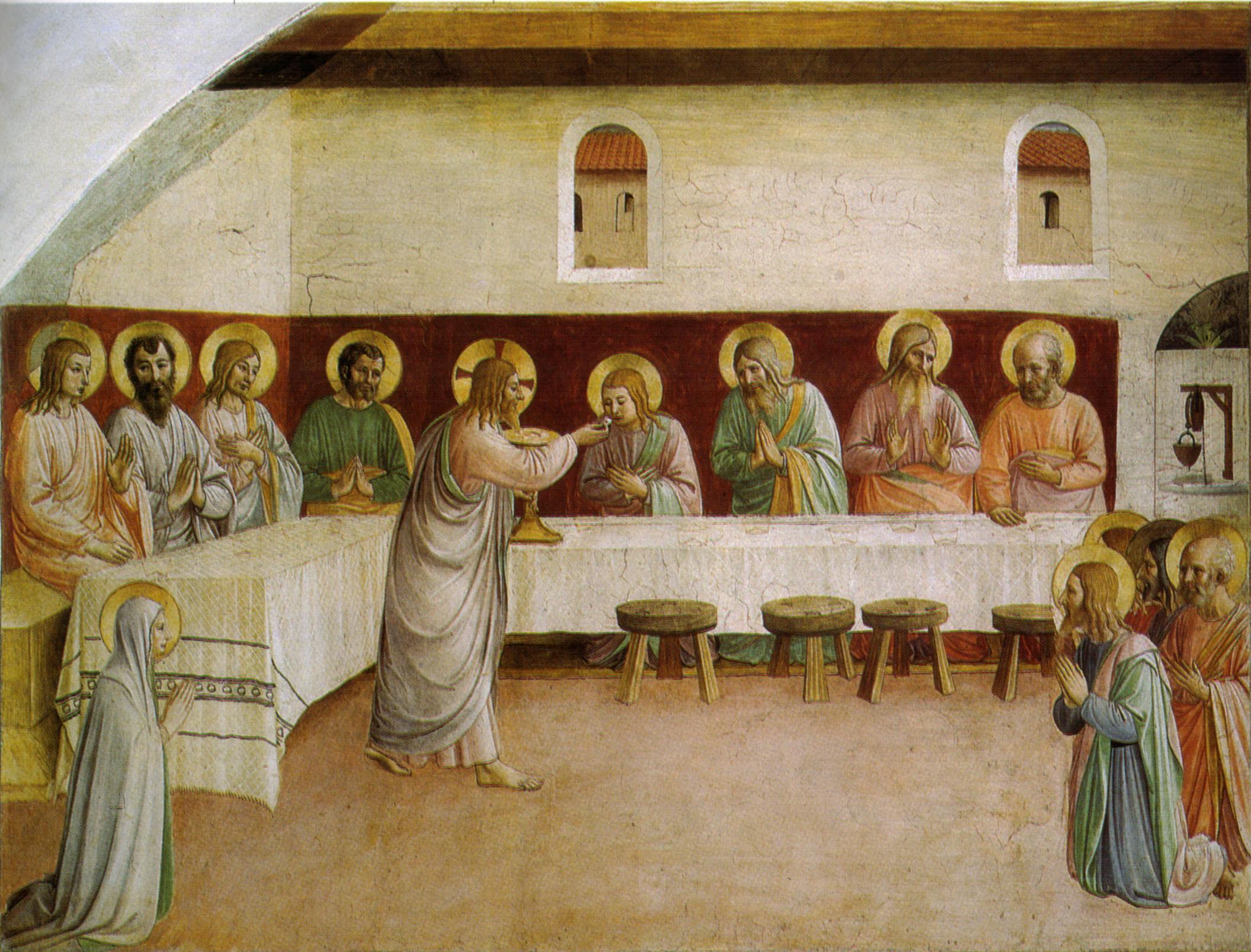
The Eucharist is the rite that every form of historic Christianity holds in common and disagrees about most sharply. Jesus instituted it on the night before his death, taking bread, giving thanks (eucharisteo, the verb from which the rite takes its name), breaking it, and giving it to his disciples with the words 'this is my body'; then taking the cup with the words 'this is my blood of the covenant, poured out for many.' The apostolic Church practiced it weekly as the 'breaking of bread' (Acts 2:42), and the Didache (c. 70–110 AD) preserves what may be the earliest extant eucharistic prayers. By the mid-second century, Justin Martyr's First Apology (c. 155 AD) describes a service recognizable in form to any historic Christian today: reading of scripture, sermon, prayers, kiss of peace, presentation of bread and wine, eucharistic prayer, communion of the faithful.
The Catholic Church teaches that the Eucharist is both sacrifice and sacrament. At the words of consecration the bread and wine become the body and blood of Christ — a change the Fourth Lateran Council (1215) and the Council of Trent (Session 13, 1551) named transubstantiation: the substance of bread and wine is converted into the substance of Christ's body and blood, while the accidents (appearance, taste, texture) remain. The Mass is also a true and propitiatory sacrifice — not a repetition of Calvary but the same sacrifice of Christ, made sacramentally present. Vatican II's Lumen Gentium 11 calls the Eucharist 'the source and summit of the Christian life.'
Eastern Orthodoxy shares the conviction of real presence but is reluctant to define the mode philosophically. The Divine Liturgy of St. John Chrysostom — the standard Orthodox liturgy — speaks of the bread and wine being 'changed' (metabole) by the descent of the Holy Spirit (the epiclesis) into the body and blood of Christ. The Confession of Dositheus (1672) does adopt the language of transubstantiation, but mainstream Orthodox theology prefers to name the change a mystery (mysterion) and to confess what it does rather than how it works. The Eucharist is the eschatological banquet of the Kingdom, in which heaven and earth are joined.
Lutheran theology, following Luther's writings against Zwingli, confesses the real bodily presence of Christ 'in, with, and under' the bread and wine (the Augsburg Confession, Article 10, 1530; the Formula of Concord, Article 7, 1577). Luther rejected transubstantiation as a philosophical overlay on the simpler biblical 'this is my body,' but insisted with the Roman tradition that what is received is the true body and blood of Christ. The label 'consubstantiation' is often used for the Lutheran view but is not a Lutheran term; the tradition prefers 'sacramental union.'
The Reformed tradition, following Calvin, holds a doctrine of real spiritual presence: by the work of the Holy Spirit the believer truly feeds on the body and blood of Christ in the Supper, though the elements themselves remain bread and wine and Christ's body is in heaven. The Heidelberg Catechism (Q. 75–80, 1563) and Westminster Confession (Chapter 29, 1647) articulate this position. Zwingli's purely memorial view — that the Supper is a remembrance and confession of faith without any objective presence — has shaped much of the Free Church and Baptist tradition, though it was not the only Reformed position. The Anglican tradition has historically held a range of views within the bounds set by Article 28 of the Thirty-Nine Articles (1571): the body of Christ is given, taken, and eaten only after a heavenly and spiritual manner, and the means of receiving is faith.
Baptist and most Free Church traditions treat the Lord's Supper as an ordinance — a divinely commanded act of obedience and remembrance rather than a sacrament that conveys grace. The bread and cup are signs that point to the once-for-all sacrifice of Christ on the cross; the meal is a memorial of Christ's death and a proclamation of his return until he comes (1 Corinthians 11:26). What the historic traditions all share, beneath the differences, is the conviction that the Eucharist is not optional. It is the meal Christ gave his Church, and in receiving it the Church is constituted as his body.
How Each Tradition Receives It
| Tradition | Status | Local Name |
|---|---|---|
| Catholic | Sacrament — source and summit | The Most Holy Eucharist / The Mass |
| Orthodox | Mystery / sacrament — the center of worship | The Divine Liturgy / Holy Communion |
| Lutheran | Sacrament | The Lord's Supper / Holy Communion |
| Reformed | Sacrament | The Lord's Supper |
| Anglican | Sacrament of the Gospel | Holy Communion / The Eucharist |
| Baptist | Ordinance | The Lord's Supper |
Scriptural Basis
- Matthew 26:26–28 / Mark 14:22–24 / Luke 22:19–20 (the institution at the Last Supper)
- 1 Corinthians 11:23–26 (Paul's eucharistic tradition)
- John 6:51–58 (the Bread of Life discourse)
- Acts 2:42 (the apostolic 'breaking of bread')
Patristic Witnesses
- Didache 9–10 (c. 70–110 AD) — the earliest eucharistic prayers outside the New Testament
- Ignatius of Antioch, Letter to the Smyrnaeans 7 (c. 110 AD) — 'the Eucharist is the flesh of our Saviour'
- Justin Martyr, First Apology 65–67 (c. 155 AD) — the first detailed description of Christian eucharistic worship
- Irenaeus, Against Heresies IV.18 (c. 180 AD) — eucharist as offering of creation, body and blood of Christ
- Cyril of Jerusalem, Mystagogical Catechesis IV–V (c. 350 AD) — Eastern mystagogy of the Holy Mysteries
Further Reading
- Didache (The Teaching of the Twelve Apostles), chs. 9–10
- Justin Martyr, First Apology 65–67 (c. 155 AD)
- Council of Trent, Session 13, Decree on the Most Holy Sacrament of the Eucharist (1551)
- Martin Luther, The Babylonian Captivity of the Church (1520)
- John Calvin, Institutes IV.17 (1559)
- The Augsburg Confession, Article 10 (1530)
- The Thirty-Nine Articles, Article 28 (1571)
- Westminster Confession of Faith, Chapter 29 (1647)
- Alexander Schmemann, The Eucharist: Sacrament of the Kingdom (St. Vladimir's Seminary Press, 1988)
- Edward Schillebeeckx, The Eucharist (Sheed & Ward, 1968)