Holy Orders
Ordination · The Sacrament of Orders · Cheirotonia · The Setting Apart of Ministers
The rite by which the Church ordains bishops, priests, and deacons through prayer and the laying on of hands, continuing the apostolic ministry instituted by Christ.
Bishop, priest, deacon — the threefold ministry visible by the time of Ignatius of Antioch. Catholic and Orthodox apostolic succession, Anglican retention, Lutheran modification, Reformed presbyterial ordination, and Baptist congregational call.
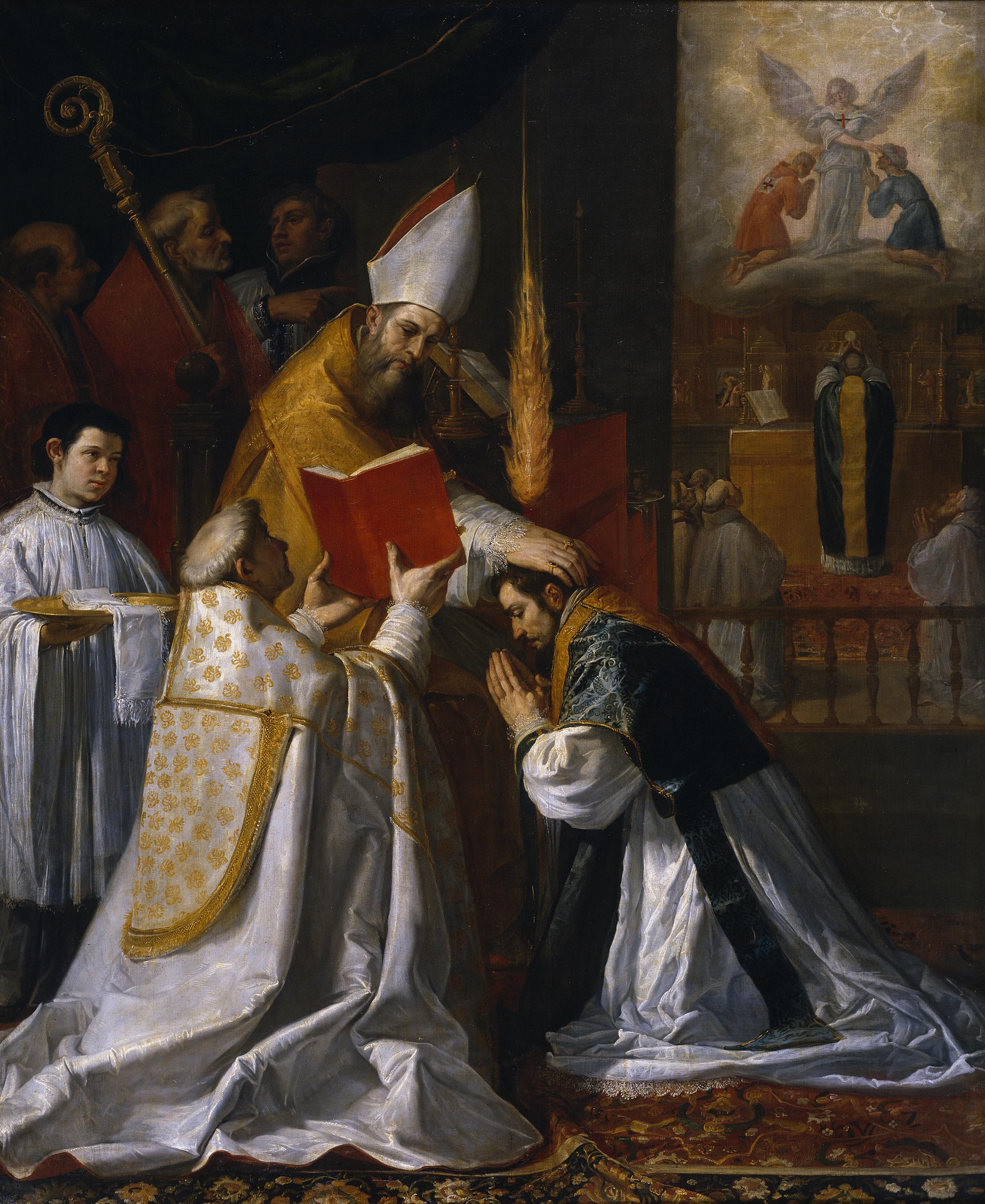
The threefold ministry of bishop, priest (presbyter), and deacon emerged in the New Testament era and was fully visible by the early second century. The pastoral epistles use the terms episkopos (overseer) and presbyteros (elder) somewhat interchangeably, and diakonos (servant/deacon) appears as a distinct office (1 Timothy 3; Titus 1; Acts 6). By the time of Ignatius of Antioch (c. 110 AD), the three orders are clearly distinguished: 'do nothing without the bishop … the presbyters as the council of God … and the deacons as the deacons of Jesus Christ' (Letter to the Magnesians 6, 7). Hippolytus's Apostolic Tradition (c. 215 AD) preserves the earliest extant ordination prayers, which closely resemble those still used in the Roman, Byzantine, and modern Western liturgies.
Catholic theology of Holy Orders (Catechism §§1536–1600) holds that ordination is a sacrament instituted by Christ, conferred validly only by a bishop in apostolic succession, and bestows an indelible character on the ordinand. The Council of Trent (Session 23, 1563) defined this against Reformation challenges. The three degrees — episcopate, presbyterate, diaconate — are integrally related: the bishop possesses the fullness of orders, the priest shares in the bishop's priesthood, the deacon is ordained for service. The conviction that valid ordination requires unbroken apostolic succession from the apostles is a defining mark of the Catholic understanding.
Eastern Orthodoxy holds substantially the same theology of the three orders, the necessity of episcopal ordination in apostolic succession, and the sacramental character of orders. The Orthodox ordination service (cheirotonia) follows the ancient pattern: the candidate is led to the altar, the bishop lays hands on him, and the prayer of consecration invokes the Holy Spirit. Orthodox bishops are drawn from the monastic celibate clergy, while priests and deacons may be married (the rule is that ordination cannot follow marriage, only the other way around). The Patriarchates of Constantinople, Antioch, Alexandria, and Jerusalem trace their episcopal succession to the apostles in the same way the Roman Church does.
Anglicanism, through the Preface to the Ordinal in the Book of Common Prayer (1550, retained 1662), states that 'from the apostles' time there have been these orders of ministers in Christ's Church: bishops, priests, and deacons.' Anglican churches have retained the threefold order and the practice of ordination by bishops in succession. The validity of Anglican orders has been disputed: Pope Leo XIII's Apostolicae Curae (1896) declared them 'absolutely null and utterly void,' a judgment Anglicans have contested both on historical and theological grounds. Most Eastern Orthodox churches have not given a definitive judgment but generally treat Anglican orders with caution.
The Reformed and Presbyterian traditions reframed the theology of orders rather than abolishing ordination. Calvin's Institutes IV.3 identifies the New Testament offices as pastors, teachers (doctors), elders, and deacons. Ordination is administered by the laying on of hands of the presbytery — the assembled body of ministers — rather than by a bishop in succession. The Westminster Form of Presbyterial Church-Government (1645) and the various Presbyterian books of order describe ordination as a solemn setting apart for the ministry of word and sacrament, not as a sacrament in the Catholic sense. The conviction is that the apostolic succession that matters is succession in apostolic teaching, not succession in episcopal consecration.
Lutheran theology occupies a middle ground. The Augsburg Confession (Article 14) requires that no one publicly preach or administer sacraments 'without a regular call' (rite vocatus), and the Treatise on the Power and Primacy of the Pope (1537) explicitly affirms that ordination by other pastors is valid when bishops in succession refuse to ordain Reformed candidates. Some Lutheran churches (notably the Church of Sweden and the Finnish Lutheran Church) have retained episcopal succession; most have not. The Apology of the Augsburg Confession (Article 13) is willing to call ordination a sacrament 'if we understand the ministry of the Word as a means of grace.'
Baptist and Free Church traditions practice ordination as a congregational act: the local church (sometimes with the assistance of neighboring churches) examines, approves, and lays hands on its minister. The act is solemn but is not understood as conferring a special character or as part of an unbroken episcopal succession. The question of apostolic succession is treated by these traditions as a question of fidelity to apostolic doctrine, not of unbroken physical laying-on of hands. Across the historic divide, however, every tradition affirms that ordained ministry exists by Christ's institution and that the Church cannot do without it.
How Each Tradition Receives It
| Tradition | Status | Local Name |
|---|---|---|
| Catholic | Sacrament — three degrees (bishop, priest, deacon) | Holy Orders |
| Orthodox | Mystery — three degrees, all conferred by the bishop | Cheirotonia (Ordination) |
| Lutheran | Pastoral office; ordination retained but generally not as a sacrament | Ordination to the Office of the Holy Ministry |
| Reformed | Ordination by the laying on of hands of the presbytery | Ordination to the Ministry of Word and Sacrament |
| Anglican | Sacramental rite; three-fold order of bishops, priests, deacons retained | Holy Orders |
| Baptist | Ordination practiced congregationally; no sacramental status | Ordination |
Scriptural Basis
- Acts 6:1–6 (the laying on of hands by the apostles to ordain the seven deacons)
- Acts 13:2–3 (the Spirit sets apart Barnabas and Saul; the church lays hands on them)
- Acts 14:23 (Paul and Barnabas appoint elders in every church)
- 1 Timothy 4:14 (Timothy's gift given through prophecy and the laying on of hands of the presbytery)
- 2 Timothy 1:6 (the gift of God by the laying on of Paul's hands)
- Titus 1:5 (Titus is left in Crete to appoint elders in every town)
Patristic Witnesses
- 1 Clement 42, 44 (c. 96 AD) — apostolic succession of bishops and presbyters
- Ignatius of Antioch, Letters to the Magnesians, Trallians, Smyrnaeans (c. 110 AD) — threefold order of bishop, presbyter, deacon
- Didache 15 (c. 70–110 AD) — appointment of bishops and deacons
- Hippolytus, Apostolic Tradition 2–8 (c. 215 AD) — earliest extant ordination prayers
- Cyprian of Carthage, Letter 67 (c. 254 AD) — election and ordination of bishops by the people and neighboring bishops
Further Reading
- 1 Clement 42, 44 (c. 96 AD)
- Ignatius of Antioch, Letters (c. 110 AD)
- Hippolytus, Apostolic Tradition 2–8 (c. 215 AD)
- Council of Trent, Session 23, Doctrine on the Sacrament of Order (1563)
- Catechism of the Catholic Church §§1536–1600
- Pope Leo XIII, Apostolicae Curae (1896)
- The Book of Common Prayer, Preface to the Ordinal (1550 / 1662)
- Augsburg Confession, Article 14 (1530)
- Treatise on the Power and Primacy of the Pope (1537)
- John Calvin, Institutes IV.3 (1559)
- Westminster Form of Presbyterial Church-Government (1645)
- John D. Zizioulas, Being as Communion (St. Vladimir's Seminary Press, 1985) — Orthodox ecclesiology and ordination