Matrimony
Holy Matrimony · Christian Marriage · The Mystery of Marriage
The lifelong covenant of one man and one woman, blessed by the Church, which the Catholic and Orthodox traditions count among the seven sacraments and Protestant traditions honor as a divinely instituted estate.
What God has joined together, let no one separate. A creation ordinance that the Catholic and Orthodox traditions count among the seven sacraments and Protestant traditions honor as a covenant — the union of man and woman as a sign of Christ and his Church.
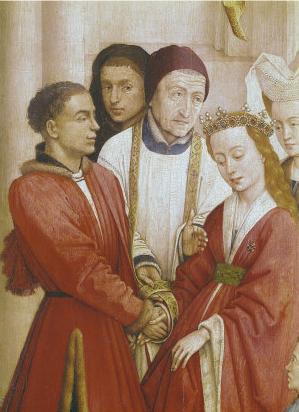
Christian marriage rests on Genesis 1–2 and on Jesus's appeal to creation in Matthew 19: 'from the beginning of creation God made them male and female … what God has joined together, let no one separate.' The apostolic Church practiced marriage as a settled institution, blessed in some way by the local community though not yet wrapped in the elaborate liturgy that would later develop. Ignatius of Antioch already in the early second century counsels that marriages should be entered with the bishop's consent (Letter to Polycarp 5). Tertullian's Ad Uxorem (c. 200 AD) speaks of marriage 'arranged by the Church, confirmed by the offering, sealed by the blessing, written down by angels, ratified by the Father.'
The Catholic theology of marriage as a sacrament developed gradually. Augustine identified three 'goods' of marriage in De Bono Coniugali (c. 401 AD): proles (offspring), fides (fidelity), and sacramentum (the indissoluble bond signifying Christ's union with the Church). The medieval canonists worked out the elements of validity (consent of the parties, freedom from impediments, sacramental form), and the Council of Florence (Decree for the Armenians, 1439) and the Council of Trent (Session 24, 1563) formally defined matrimony as one of the seven sacraments. Trent's decree Tametsi required that for validity a Catholic marriage must be contracted in the presence of the parish priest and two witnesses — a discipline that closed the door on clandestine marriages that had been a serious pastoral problem. The Catholic Catechism (§§1601–1666) teaches that the ministers of the sacrament are the spouses themselves, who confer it on each other through their consent; the priest witnesses and blesses but does not 'perform' the sacrament in the way he confers, say, the Eucharist.
Eastern Orthodoxy treats marriage as one of the seven mysteries. The Orthodox marriage rite is one of the most beautiful in the Christian tradition: the bride and groom are 'crowned' as king and queen of a new household, the couple processes around the gospel-stand three times in the 'Dance of Isaiah,' the gospel of the wedding at Cana (John 2) is read, and the entire ceremony is presided over by a priest who actively blesses the union. Orthodox theology is more open than Roman Catholic theology to recognizing the death of a marriage through divorce — the Orthodox tradition permits up to three marriages by oikonomia (pastoral accommodation), though the second and third rites are penitential in character.
The Reformers denied that marriage is a sacrament instituted by Christ. Luther's Babylonian Captivity (1520) argued that marriage is a 'worldly estate' ordained by God in creation but not a sacrament of the new covenant; the New Testament references to marriage as a 'mystery' (Ephesians 5:32) translate the Greek mysterion, which the Vulgate had rendered sacramentum, but the term in Paul is not used in the technical sacramental sense. Luther continued to honor marriage as a sacred institution and himself married Katharina von Bora in 1525; his pastoral writings on marriage are warm and substantial. The Augsburg Confession (Article 23, on clerical marriage) defends the right of pastors to marry and reframes marriage as an institution of natural and divine law, not a Gospel sacrament.
The Reformed tradition takes a similar view. Calvin in Institutes IV.19.34–37 ranks marriage among the rites 'commonly called sacraments' but denies that it has the marks of a true sacrament — divine institution as a sign of the Gospel and a promise of grace attached to it. The Westminster Confession of Faith (Chapter 24) treats marriage as a creation ordinance instituted for mutual help, procreation, and the avoidance of uncleanness, allowing divorce on the grounds of adultery and willful desertion. Anglican practice has retained the elevated language of the Book of Common Prayer marriage service — 'an honourable estate, instituted of God in the time of man's innocency, signifying unto us the mystical union that is betwixt Christ and his Church' — while Article 25 of the Thirty-Nine Articles places matrimony among the rites 'commonly called sacraments' that the tradition does not number among the two sacraments of the Gospel.
Baptist and Free Church traditions follow the Reformed pattern: marriage is a covenant before God, an ordinance of creation rather than a sacrament of redemption, but is honored and protected as a divine institution. Across the historic divide, the common confession is that marriage is the union of one man and one woman for the whole of life, for mutual help, the procreation and rearing of children, and the signification of Christ's faithful love for his Church. The disagreements about indissolubility, divorce, and the precise theological category 'sacrament' are real, but the doctrine of marriage as a divinely instituted covenant is shared by the whole tradition.
How Each Tradition Receives It
| Tradition | Status | Local Name |
|---|---|---|
| Catholic | Sacrament — indissoluble between the baptized | Holy Matrimony |
| Orthodox | Mystery — crowned in the rite of marriage | The Mystery of Holy Matrimony |
| Lutheran | Honorable estate, not a sacrament | Holy Matrimony |
| Reformed | Covenant ordained by God in creation; not a sacrament | Christian Marriage |
| Anglican | Holy estate, sometimes called sacramental | Holy Matrimony |
| Baptist | Covenant before God; ordinance of creation | Christian Marriage |
Scriptural Basis
- Genesis 1:27–28; 2:18–24 (creation of male and female; 'a man shall leave his father and mother and cleave to his wife')
- Malachi 2:14–16 ('the Lord has been a witness between you and the wife of your youth')
- Matthew 19:3–9 (Jesus on divorce: 'what God has joined together, let no one separate')
- Mark 10:6–9 (the same teaching)
- 1 Corinthians 7 (Paul's extensive treatment of marriage)
- Ephesians 5:21–33 (marriage as a 'great mystery' referring to Christ and the Church)
Patristic Witnesses
- Ignatius of Antioch, Letter to Polycarp 5 (c. 110 AD) — marriages should be made with the bishop's consent
- Tertullian, Ad Uxorem and De Monogamia (c. 200 AD) — earliest extended Latin treatment of Christian marriage
- Clement of Alexandria, Stromata III (c. 200 AD) — defense of marriage against ascetic disparagement
- John Chrysostom, On Marriage and Family Life (c. 390 AD) — extensive pastoral homilies on marriage
- Augustine, On the Good of Marriage (De Bono Coniugali, c. 401 AD) — the three goods of marriage: offspring, fidelity, sacrament
Further Reading
- Tertullian, Ad Uxorem II.9 (c. 200 AD)
- Augustine, De Bono Coniugali (c. 401 AD)
- John Chrysostom, Homilies on Ephesians 20 (c. 392 AD)
- Council of Trent, Session 24, Decree Tametsi and Doctrine on the Sacrament of Matrimony (1563)
- Catechism of the Catholic Church §§1601–1666
- The Service of Crowning (Akolouthia tou Stephanomatos) — the Byzantine marriage rite
- Martin Luther, The Babylonian Captivity of the Church (1520)
- John Calvin, Institutes IV.19.34–37 (1559)
- Westminster Confession of Faith, Chapter 24 (1647)
- The Book of Common Prayer, The Form of Solemnization of Matrimony (1549 / 1662)
- John Witte Jr., From Sacrament to Contract: Marriage, Religion, and Law in the Western Tradition (Westminster John Knox, 2nd ed. 2012)
- John Meyendorff, Marriage: An Orthodox Perspective (St. Vladimir's Seminary Press, 3rd ed. 1984)