Reconciliation
The Sacrament of Penance · Confession · The Sacrament of Conversion · Holy Confession
The rite in which a baptized Christian who has sinned confesses to God in the presence of a minister of the Church and receives absolution.
Whatever you loose on earth shall be loosed in heaven. Confession of sin and absolution — from the Didache through the Lateran requirement to private auricular confession, Luther's retention, and the Reformed reframing as mutual confession.
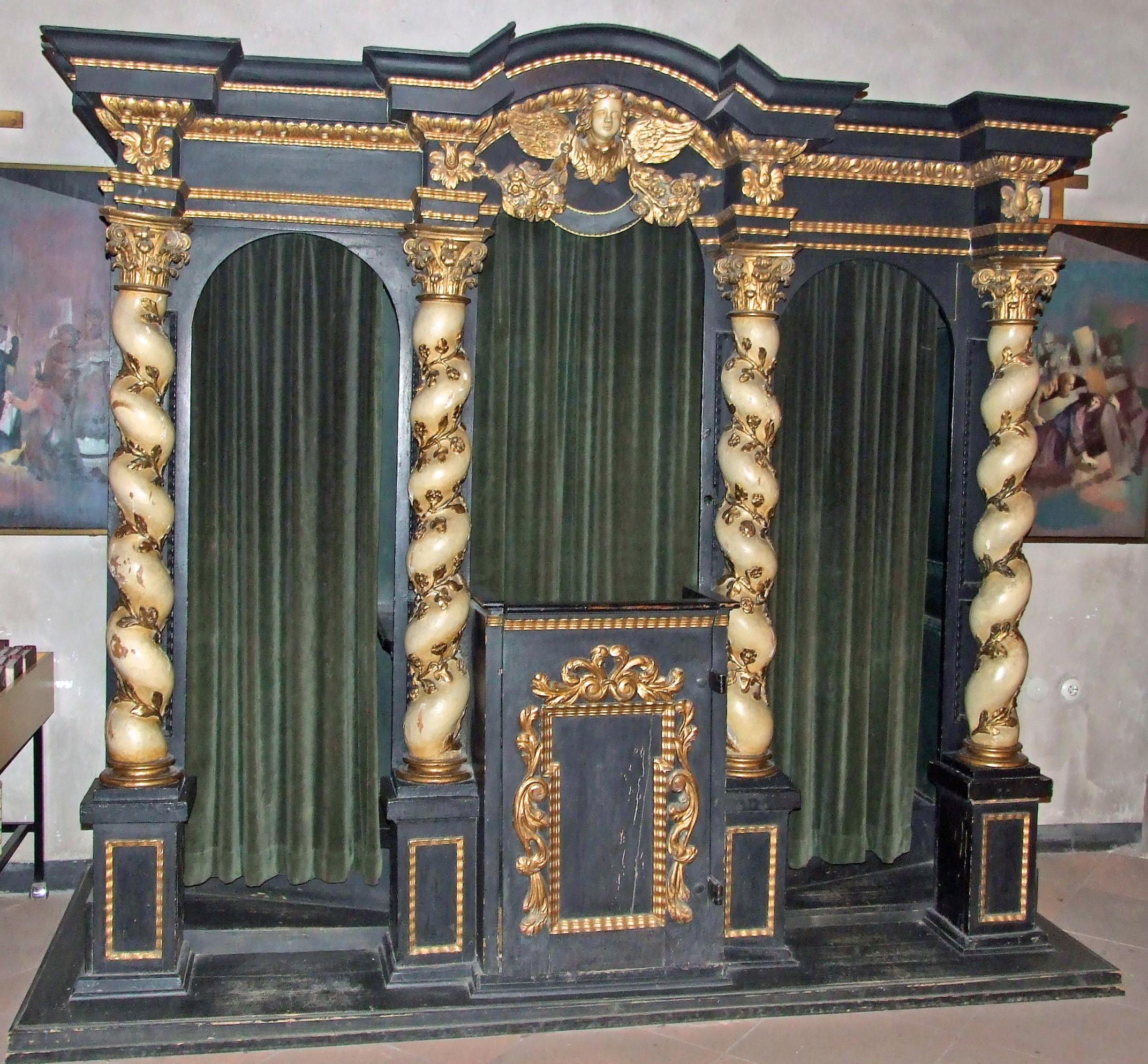
The Sacrament of Reconciliation rests on the authority Christ gave his apostles in John 20:23: 'If you forgive the sins of any, they are forgiven; if you withhold forgiveness from any, it is withheld.' From the first generation the Church understood that Christians who sinned gravely after baptism needed a way back into communion. The earliest practice (visible in the Didache, Hermas, and Tertullian) was public: serious sins were confessed before the bishop, the offender was admitted to an order of penitents and excluded from the Eucharist for a stipulated period, and absolution was given at the conclusion of penance. By the seventh and eighth centuries the Celtic monastic tradition had developed private auricular confession to a priest with immediate absolution — the form that became standard in the Latin West.
The Catholic Church teaches that confession of grave sin to a priest is required for absolution, and that this sacrament was instituted by Christ (Catechism §§1422–1498). The Council of Trent (Session 14, 1551) defined the essential elements: contrition for sin (sorrow and resolution to amend), confession of all mortal sins known to the penitent, satisfaction (the prayers or works imposed as penance), and absolution by the priest in the name of the Trinity. The priest acts in persona Christi — in the person of Christ — and is bound by the inviolable seal of the confessional. Vatican II's revision of the rite (the Ordo Paenitentiae of 1973) emphasized reconciliation with God and with the Church together.
Eastern Orthodox practice is similar in substance but different in tone. Confession is heard not in a confessional booth but typically standing before an icon of Christ, with the priest as witness rather than judge — the formula of absolution in Russian and Greek practice often emphasizes that 'Christ is invisibly present, receiving your confession; I am only a witness.' Spiritual direction by an elder (in Russian, the starets) is treated as integral to the rite; the penitent unburdens not only sins but the entire condition of the soul. Confession is generally required before receiving Holy Communion, particularly in the Slavic tradition.
The Reformation reframed but did not entirely abolish confession. Luther's Small Catechism (1529) retains a chapter on confession and absolution and treats private absolution as a means by which the gospel is applied to the troubled conscience. The Augsburg Confession (Articles 11 and 25) affirms private confession 'not for the sake of enumeration of sins, but for the sake of absolution.' Lutheran practice has historically retained the rite, and the Lutheran Service Book includes a Rite of Individual Confession and Absolution. The treatise from the Apology of the Augsburg Confession on penance is one of the most pastorally important documents of early Lutheranism.
The Reformed tradition, following Calvin (Institutes III.4 and IV.19), denied that penance is a sacrament instituted by Christ, but retained robust public confession of sin in worship and a discipline of mutual confession. The Reformed pastor was understood as a 'physician of souls' available for private counsel. James 5:16 — 'confess your sins to one another' — was read as mandating mutual rather than priestly confession. The Westminster Confession (Chapter 15) treats repentance unto life as a doctrine to be preached, not a sacramental act with priestly absolution. Public confession at the start of the Lord's Day service, often followed by the assurance of pardon read from scripture, remains the standard Reformed liturgical pattern.
The Anglican tradition holds together both impulses. The Book of Common Prayer provides for general confession in public worship and for private confession with absolution under the heading 'The Reconciliation of a Penitent.' The classical Anglican rule on private confession — 'all may, some should, none must' — captures a position deliberately wider than Roman requirement and narrower than Reformed prohibition. The Baptist and most Free Church traditions practice confession to God directly on the basis of 1 John 1:9, with confession to other believers seen as healthy and biblical (James 5:16) but never tied to absolution by a minister.
How Each Tradition Receives It
| Tradition | Status | Local Name |
|---|---|---|
| Catholic | Sacrament | The Sacrament of Penance / Reconciliation |
| Orthodox | Mystery | Holy Confession |
| Lutheran | Retained as a sacramental rite — private absolution available | Confession and Absolution |
| Reformed | Not a sacrament; church discipline and mutual confession retained | Confession of Sin |
| Anglican | Sacramental rite ('all may, some should, none must') | Reconciliation of a Penitent |
| Baptist | Not practiced sacramentally; private confession to God; church discipline | — |
Scriptural Basis
- Matthew 16:19 (the keys of the Kingdom given to Peter — 'whatever you bind…whatever you loose')
- Matthew 18:18 (the same authority given to the apostles)
- John 20:21–23 (the risen Christ breathes the Spirit on the apostles: 'If you forgive the sins of any, they are forgiven')
- James 5:16 ('confess your sins to one another, and pray for one another, that you may be healed')
- 1 John 1:9 ('if we confess our sins, he is faithful and just to forgive')
Patristic Witnesses
- Didache 4 and 14 (c. 70–110 AD) — confession of faults in the assembly before the Eucharist
- Hermas, The Shepherd, Mandate 4 (c. 140 AD) — discussion of post-baptismal repentance
- Tertullian, De Paenitentia and De Pudicitia (c. 203 AD) — earliest Latin treatises on post-baptismal repentance
- Cyprian, On the Lapsed (c. 251 AD) — restoration of those who lapsed under Decian persecution
- John Chrysostom, Homilies on Repentance (c. 390 AD) — pastoral counsel on confession
Further Reading
- Tertullian, De Paenitentia (c. 203 AD)
- Cyprian of Carthage, De Lapsis (c. 251 AD)
- Fourth Lateran Council, Canon 21 (Omnis utriusque sexus, 1215) — annual confession required
- Council of Trent, Session 14, Doctrine on the Sacrament of Penance (1551)
- Catechism of the Catholic Church §§1422–1498
- Martin Luther, The Small Catechism — Confession (1529)
- Augsburg Confession, Articles 11 and 25 (1530)
- Apology of the Augsburg Confession, Article 12 (1531)
- John Calvin, Institutes III.4 and IV.19.14–17 (1559)
- Westminster Confession of Faith, Chapter 15 (1647)
- Ordo Paenitentiae, the revised Roman rite (1973)
- Bernhard Poschmann, Penance and the Anointing of the Sick (Herder, 1964)