Raphael — Hebrew Refā'ēl, 'God heals' — is the central angelic figure of the Book of Tobit, a deuterocanonical text accepted as Scripture by Catholic and Orthodox Christians and treated as edifying but non-canonical by most Protestants. In the narrative, Raphael disguises himself as a kinsman named Azarias and accompanies the young Tobias on a long journey from Nineveh to Ecbatana, teaching him how to drive out the demon Asmodeus from the chamber of his bride Sarah, how to heal his father Tobit's blindness with the gall of a fish, and how to marry Sarah without becoming her eighth groom to die before consummation.
At the resolution of the story (Tobit 12:15), Raphael reveals himself to Tobit and Tobias: 'I am Raphael, one of the seven holy angels, who present the prayers of the saints, and who go in and out before the glory of the Holy One.' This single verse establishes two important traditions that ripple through both Jewish and Christian angelology. First, it fixes the count of seven archangels who stand before the throne — the basis for the Eastern Orthodox veneration of the seven named archangels (Michael, Gabriel, Raphael, Uriel, Salaphiel, Jegudiel, Barachiel in the standard Russian tradition; with some Coptic and Syriac variations). Second, it establishes the doctrine that the angels actively present the prayers of the saints to God — a teaching the Apocalypse of John echoes (Revelation 8:3–4) and which became foundational for the patristic and medieval theology of intercession.
Because Tobit was part of the Septuagint — the Greek Bible read by Jesus and the apostles — Raphael was a familiar figure to the early Church. His veneration as a healer-archangel persisted across the medieval West and continues in Catholic and Orthodox liturgical calendars. The Roman Catholic feast of Saints Michael, Gabriel, and Raphael falls on September 29; the Eastern Orthodox Synaxis of the Bodiless Powers on November 8 includes him among the seven.
1 Enoch gives Raphael a different and more dramatic role. In chapter 10:4–8, when God ordains the binding of the rebellious Watchers, it is Raphael who is commissioned: 'Bind Azazel hand and foot, and cast him into the darkness: and make an opening in the desert, which is in Dudael, and cast him therein. And lay upon him rough and jagged rocks, and cover him with darkness, and let him abide there for ever, and cover his face that he may not see light.' Raphael is therefore both healer of human bodies and binder of the principal rebel of the heavenly host — a striking parallel between the medical and the cosmological that the patristic tradition (especially in the Christus Victor framework) found theologically resonant.
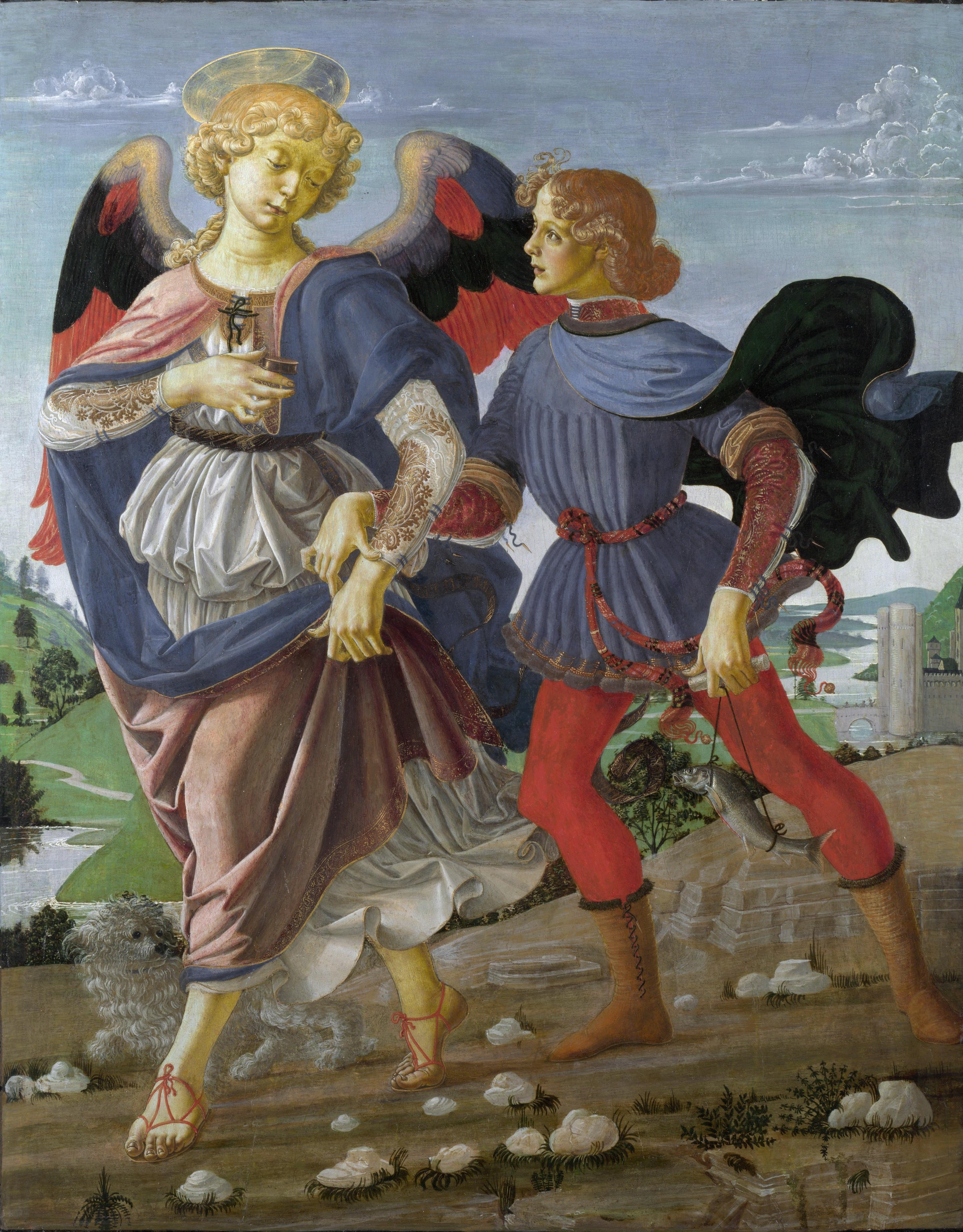
In Christian iconography, Raphael is typically depicted as a young, traveling figure with a staff, a pilgrim's wallet, and a fish — the iconographic shorthand for the Tobit narrative. Verrocchio's 'Tobias and the Angel' (c. 1470–1475, National Gallery, London) is the most famous Italian Renaissance treatment, with the young Leonardo da Vinci almost certainly responsible for some of the details. Botticini, Filippino Lippi, Titian, Pietro Perugino, and Rembrandt all returned to the Tobit subject. The figure of the angel guiding the young man through a dangerous journey became a paradigmatic image of providential care in Western Christian visual culture.