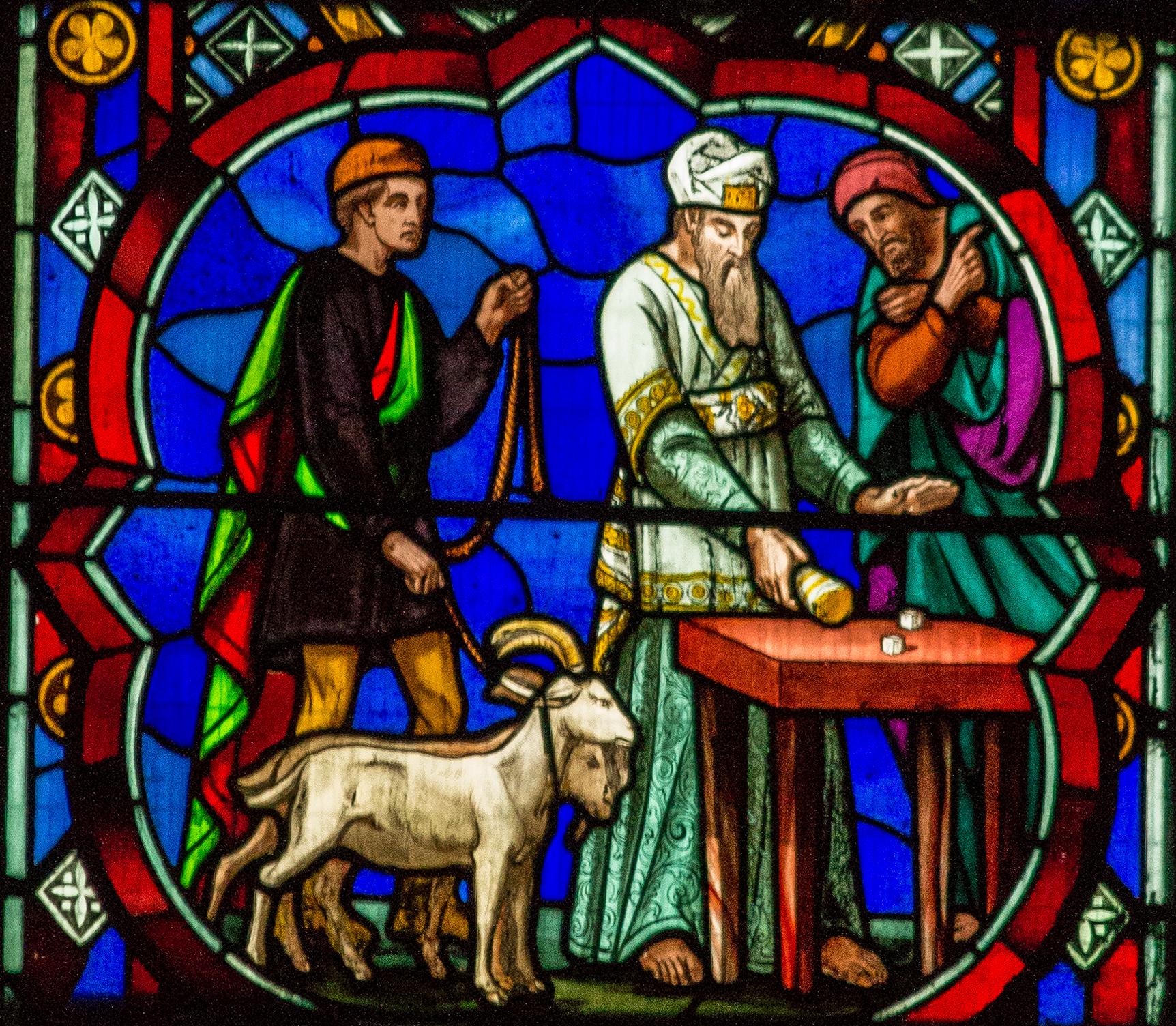
Azazel is the most theologically dense of the named Watchers. His name appears in two completely different contexts that the tradition has had to hold together: the Day of Atonement ritual of Leviticus 16, and the Watcher narrative of 1 Enoch. The connection between these two has been debated for two thousand years.
In Leviticus 16, the high priest casts lots over two goats on Yom Kippur. One lot is 'for the LORD' (la-YHWH) and is sacrificed as a sin offering. The other lot is 'for Azazel' (la-Azazel); the priest confesses the sins of Israel over the second goat's head and the animal is led into the wilderness to a 'solitary place' (Hebrew 'eretz gezerah) to die. The traditional English translation 'scapegoat' (from Tyndale's coinage 'escape goat') treats Azazel as an abstract noun meaning 'goat that goes away.' The Septuagint translators read it as a place name. But the rabbinic and Second Temple tradition consistently read 'Azazel' as the name of a being — a desert demon to whom the burden of Israel's sins is sent.
1 Enoch 8 takes this reading further. Azazel is named as the Watcher who taught humanity 'to make swords, and knives, and shields, and breastplates, and made known to them the metals (of the earth) and the art of working them, and bracelets, and ornaments, and the use of antimony, and the beautifying of the eyelids, and all kinds of costly stones, and all coloring tinctures.' The specificity is theologically purposeful. Azazel's corruption is the dual corruption of violence and seduction — the arts of war and the arts of cosmetic display — which the text presents as the twin engines of human civilization's drift away from God.
1 Enoch 9 records the appeal of the four loyal archangels on behalf of suffering humanity. The response of the Most High in 1 Enoch 10:4–8 is precise: 'The Lord said unto Raphael: Bind Azazel hand and foot, and cast him into the darkness: and make an opening in the desert, which is in Dudael, and cast him therein. And lay upon him rough and jagged rocks, and cover him with darkness, and let him abide there for ever, and cover his face that he may not see light. And on the day of the great judgment he shall be cast into the fire. And heal the earth which the angels have corrupted, and proclaim the healing of the earth, that they may heal the plague.'
The connection between this passage and Leviticus 16 is not accidental. Both place Azazel in the wilderness. Both involve the symbolic bearing-away of guilt. Both end with Azazel bound to a state of permanent isolation. The Second Temple reading of the Day of Atonement, preserved in 1 Enoch 10:8 — 'the whole earth has been corrupted through the works that were taught by Azazel; to him ascribe all sin' — was that the scapegoat ritual was a public symbolic confession that the sins of Israel were ultimately attributable not only to human choice but to the corruption introduced by Azazel and the Watchers.
The patristic reception varied. Origen, in Contra Celsum, comments on the obscurity of the name and prefers the abstract reading. Later medieval commentators tended to identify Azazel with Satan or with one of the chief demons under Satan's command. In the seventeenth century, John Milton's Paradise Lost names Azazel as Satan's standard-bearer, the angel who unfurls the great banner of the rebel host on the first morning in Hell — a literary tradition that has shaped modern Western imagination of the fallen angel as much as any patristic text.