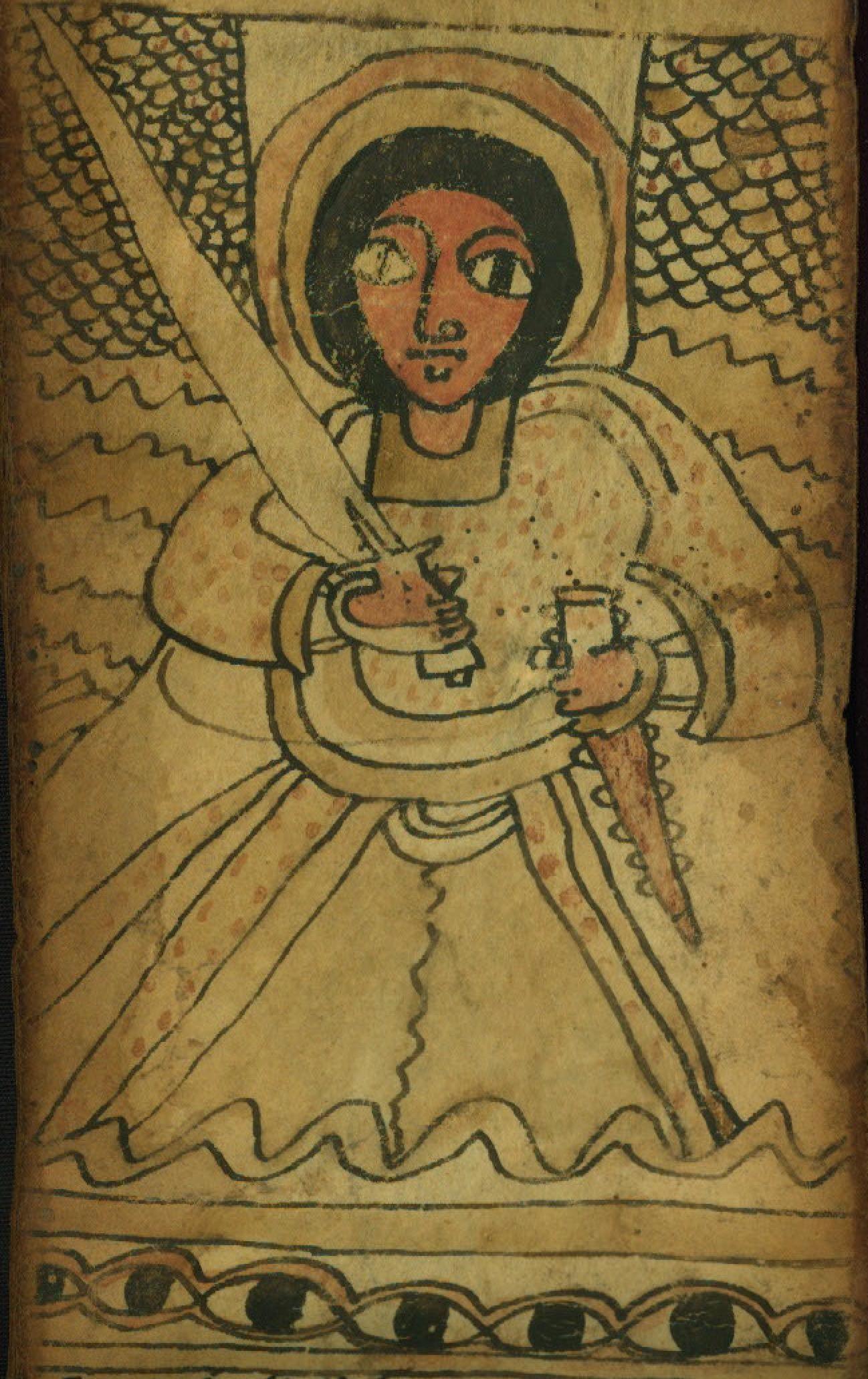
Phanuel — 'Face of God' or 'God has turned' — is one of the four archangels who stand before the throne in 1 Enoch 40, the great vision of the heavenly court. The other three named with him are Michael, Gabriel, and Raphael. In the parallel list at 1 Enoch 9:1, the fourth name is given as Uriel instead. Whether Phanuel and Uriel are the same angel under different names or two distinct beings with similar portfolios is debated in both ancient and modern scholarship, but the equation is old: many ancient Ethiopian and Coptic traditions treat them as one figure.
1 Enoch 40:9 gives Phanuel a specific dual portfolio. 'The fourth voice I heard fending off the Satans and forbidding them to come before the Lord of Spirits to accuse them who dwell on the earth.' His office is forensic: he stands at the bar of the heavenly tribunal, blocking the accusations of the accusing spirits. The Hebrew Bible never names this office, but it depicts it: the Satan ('the accuser') in Job 1–2 and Zechariah 3 is precisely the prosecuting figure who Phanuel's office is set against. 1 Enoch develops what canonical Scripture suggests but does not elaborate.
Phanuel's second portfolio in 1 Enoch is repentance and the inheritance of eternal life. He is the angel who governs the process by which the soul turns back toward God and is restored to the path of life. In some Christian receptions of the tradition — particularly in early Ethiopian and Coptic liturgical material — this connects him with John 14:6: Christ as the way, the truth, and the life, and Phanuel as the angel who ushers the soul toward that way.
The name Phanuel is also the name of the place where Jacob wrestled with the angel in Genesis 32:30 — 'And Jacob called the name of the place Peniel: for I have seen God face to face, and my life is preserved.' Some Jewish mystical traditions read this as evidence that the wrestling angel was Phanuel himself, the angel-of-the-divine-face. Christian commentators have generally read the Genesis episode as a theophany of the pre-incarnate Christ rather than as an angelic encounter, but the linguistic parallel is suggestive.
Because Phanuel is not named in any canonical text, he is rarely depicted in Christian art. His functions — accuser-blocker and angel of repentance — are usually absorbed iconographically into depictions of Michael (as defender) or Uriel (as angel of repentance). The fact that 1 Enoch's list of four archangels has both 'Uriel' and 'Phanuel' as candidates for the fourth slot is part of why the Eastern tradition settled on seven archangels rather than four: the longer list resolves the ambiguity by allowing both.